
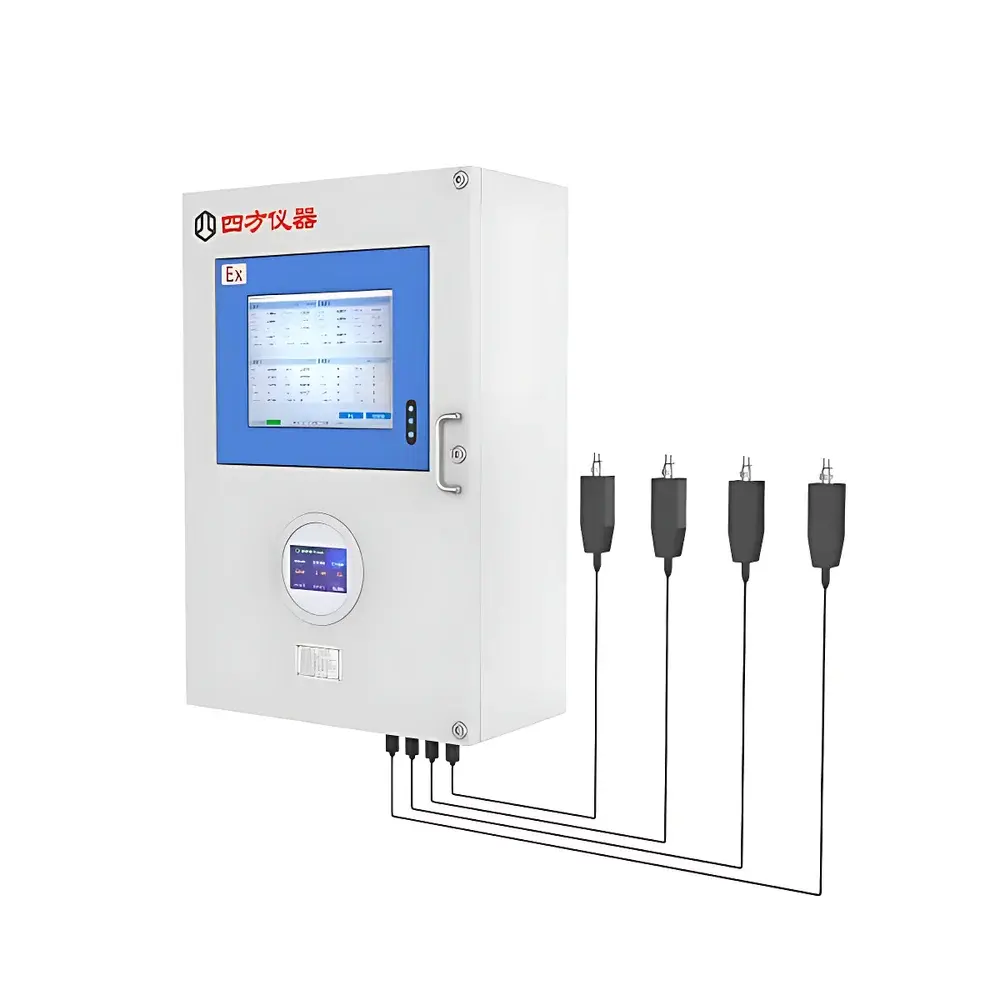
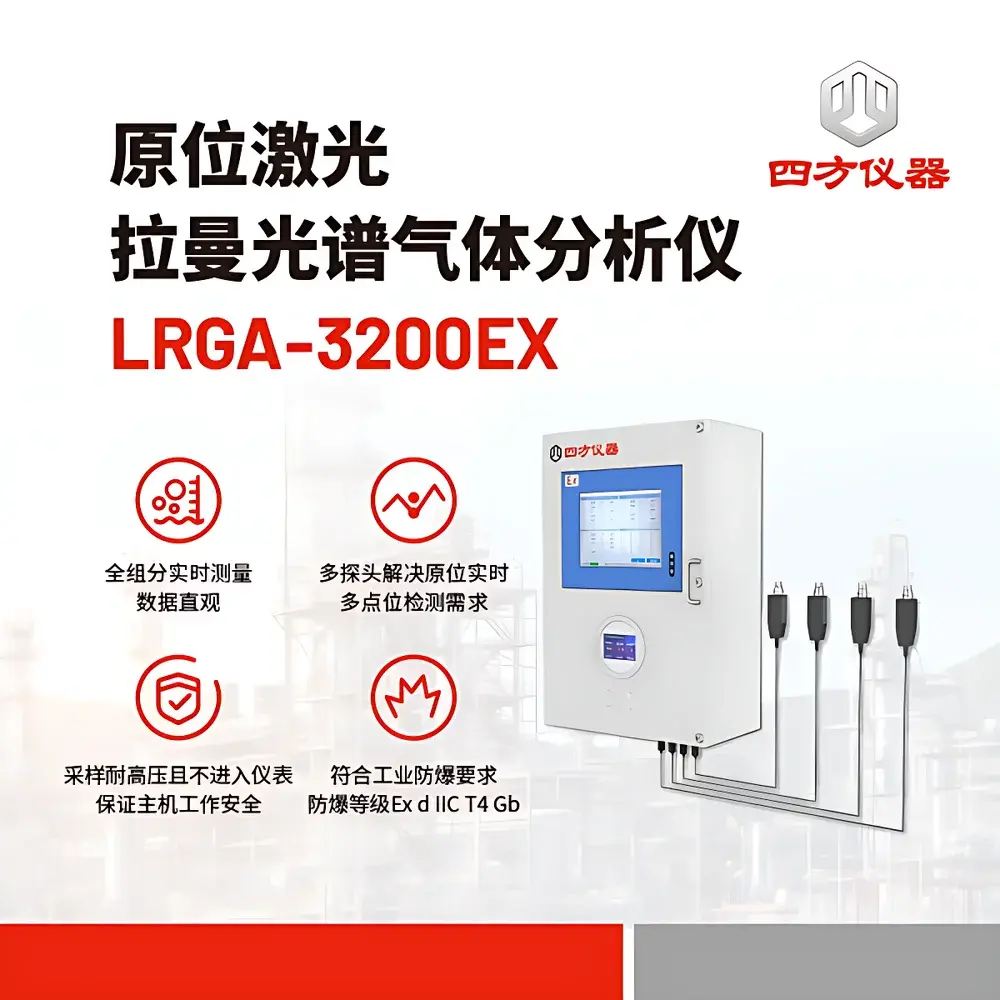
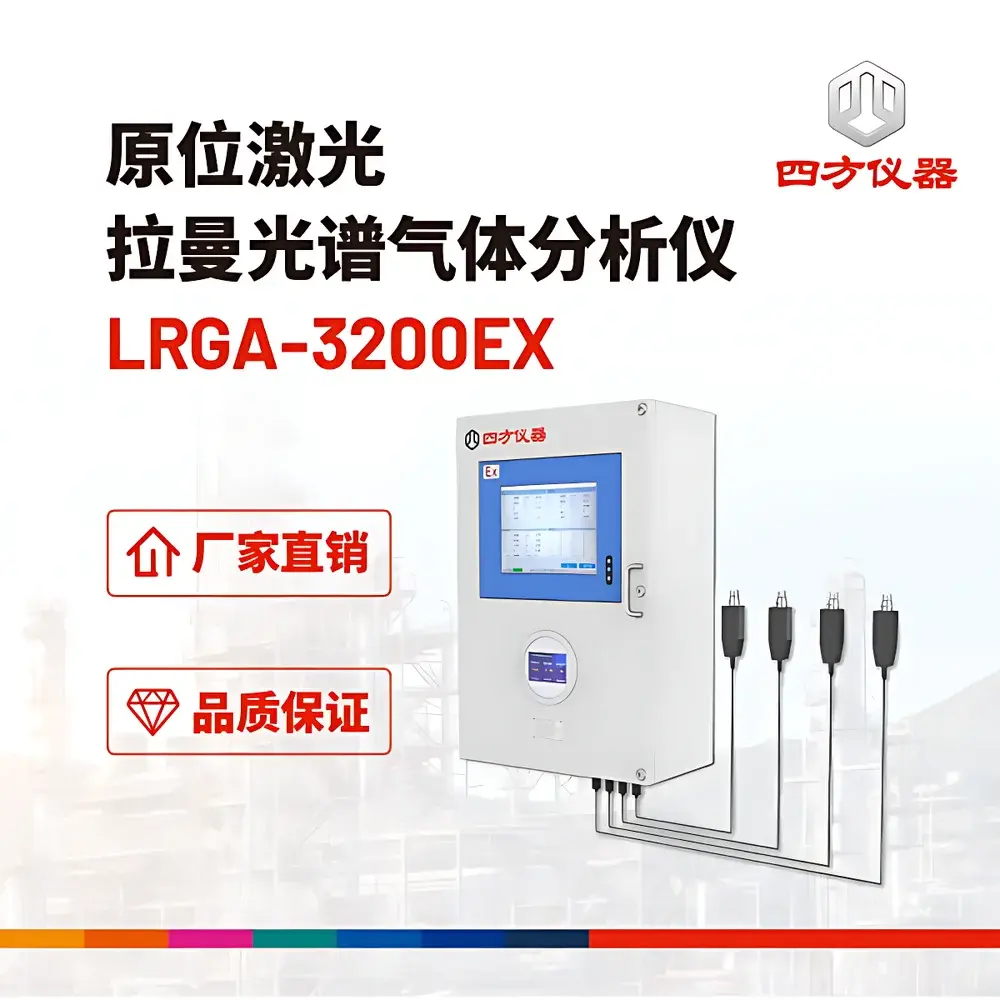
CUBIC INSTRUMENTS LRGA-3200EX In-situ Laser Raman Gas Analyzer for Coal Chemical Industry
| Brand | CUBIC INSTRUMENTS |
|---|---|
| Origin | Hubei, China |
| Model | LRGA-3200EX |
| Type | Online Raman Spectrometer |
| Spectral Range | 0–100% (v/v) |
| Spectral Repeatability | 1% F.S. |
| Accuracy | ±1% F.S. |
| Response Time | <1 s |
| Operating Pressure | up to 4 MPa |
| Probe Quantity | 4 |
| Fiber Optic Cable Length | 5 m (standard, customizable) |
| Enclosure Rating | IP65 |
| Explosion Protection | Ex d II C T4 Gb |
| Ambient Operating Temperature (Analyzer) | 10–35 °C |
| Probe Operating Temperature | –20–200 °C |
| Humidity | 0–95% RH (non-condensing) |
| Power Supply | 100–240 VAC, 50–60 Hz |
| Max. Power Consumption | <200 W |
| Communication Interfaces | RS-232, RS-485, TCP/IP Ethernet, USB, 4–20 mA analog output |
| Dimensions (L×W×H) | 540 × 300 × 900 mm |
| Weight | 75 kg |
Overview
The CUBIC INSTRUMENTS LRGA-3200EX is an in-situ, explosion-proof laser Raman gas analyzer engineered for continuous, real-time molecular identification and quantification of multi-component process gases in coal chemical plants. Unlike absorption-based or chromatographic methods, the LRGA-3200EX relies on inelastic scattering of monochromatic laser light—Raman spectroscopy—to generate vibrational fingerprints unique to each molecular species. This principle enables direct, non-contact measurement of homonuclear diatomic gases (e.g., H₂, N₂, O₂), which are invisible to IR and UV-Vis techniques, as well as hydrocarbons (CH₄, C₂H₂, C₂H₄, C₃H₆), acid gases (H₂S, CO₂), and syngas components (CO). The system performs simultaneous analysis of up to 20 gas species at full spectral resolution without sample extraction, pre-concentration, or consumables—eliminating calibration drift associated with flow path degradation or column aging.
Key Features
- In-situ probe-based architecture: Four ruggedized, high-temperature Raman probes (–20–200 °C operating range) mount directly onto process piping or reactors, enabling true real-time monitoring without sampling delays or transport artifacts.
- Positive-pressure explosion-proof design (Ex d II C T4 Gb): Certified for Zone 1 hazardous areas containing flammable vapors and gases including H₂, CH₄, and C₂H₂—fully compliant with IEC 60079-1 and GB 3836.1/2 standards.
- No consumables or moving parts: Eliminates reliance on GC columns, carrier gases, valves, or vacuum pumps—reducing total cost of ownership and unscheduled downtime.
- Sub-second spectral acquisition: Full Raman spectrum collected and processed within <1 second, supporting closed-loop process control and rapid fault detection.
- Integrated industrial touchscreen HMI: Explosion-rated capacitive display with intuitive graphical interface; supports local operation, trend visualization, alarm configuration, and data export via USB.
- Robust optical design: Optimized fiber-coupled excitation/detection path with thermally stabilized laser source and high-throughput spectrometer ensures long-term signal stability under thermal cycling and vibration typical in coal gasification and Fischer–Tropsch units.
Sample Compatibility & Compliance
The LRGA-3200EX is validated for quantitative analysis of representative coal-derived gas streams—including syngas, coke oven gas, methanol synthesis gas, and Fischer–Tropsch tail gas. It meets ASTM E2598–22 (Standard Practice for Quantitative Analysis Using Raman Spectroscopy) and aligns with ISO 8573-1 for compressed gas purity verification. Its hardware and firmware architecture support audit-ready operation per GLP and GMP requirements, including configurable user access levels, electronic signature capability, and optional 21 CFR Part 11-compliant software modules for regulated environments. All mechanical and electrical interfaces conform to IEC 61000-6-2 (immunity) and IEC 61000-6-4 (emissions) standards.
Software & Data Management
The embedded RamanQuant™ analysis engine applies multivariate curve resolution (MCR) and partial least squares (PLS) regression models trained on certified reference gas mixtures across pressure and temperature gradients. Calibration models are stored in tamper-evident format with versioning and change logs. Data logging supports dual storage: internal SSD (≥1 year at 1 Hz) and external network archive via Modbus TCP or OPC UA. Real-time 4–20 mA outputs map to user-defined component concentrations; digital outputs include alarm status, spectral quality metrics (SNR, baseline flatness), and diagnostic flags. Remote diagnostics and firmware updates are supported over secure TLS-enabled Ethernet.
Applications
- Coal gasification: Real-time monitoring of H₂/CO ratio, CH₄ slip, and sulfur compounds (H₂S, COS) in raw syngas prior to acid gas removal.
- Coke oven battery off-gas: Simultaneous tracking of H₂, CH₄, benzene precursors (C₂H₂), and NH₃ for emission compliance and heat recovery optimization.
- Methanol synthesis loop: In-line quantification of CO, CO₂, H₂, and inert buildup (N₂, Ar) to maintain optimal stoichiometric number and catalyst lifetime.
- Fischer–Tropsch reactors: Detection of light olefins (C₂H₄, C₃H₆) and paraffins to infer chain growth probability and adjust H₂/CO feed ratio.
- Hydrogen purification units: Verification of H₂ purity (>99.99%) and detection of trace O₂, H₂O, and CO downstream of PSA beds.
FAQ
Does the LRGA-3200EX require gas sampling or conditioning systems?
No. It operates entirely in-situ using fiber-optic coupled probes mounted directly on process lines—no extractive sampling, filters, dryers, or pressure regulators are needed.
Can it distinguish between isotopic variants (e.g., ¹²CH₄ vs. ¹³CH₄)?
Not at standard resolution; its spectral resolution (~8 cm⁻¹) is optimized for industrial process gases, not isotopic fine structure. Isotopic analysis requires high-resolution FT-Raman or laser-induced breakdown spectroscopy (LIBS).
How often does the system require recalibration?
Under stable operating conditions, factory calibrations remain valid for ≥12 months; annual verification against NIST-traceable gas standards is recommended per ISO/IEC 17025 guidelines.
Is remote software support available for model retraining?
Yes—CUBIC INSTRUMENTS provides secure remote access for spectral library expansion, PLS model refinement, and troubleshooting via encrypted VPN channels.
What safety certifications apply to the probe assembly?
Each probe carries independent Ex d II C T4 Gb certification (IEC 60079-1) and IP65 ingress protection; full system documentation includes ATEX and IECEx test reports upon request.
Related Products






