
CUBIC INSTRUMENTS LRGA-3200EX In-Situ Laser Raman Gas Analyzer for Ethylene Cracking Processes
| Brand | CUBIC INSTRUMENTS |
|---|---|
| Origin | Hubei, China |
| Model | LRGA-3200EX |
| Type | Online Raman Spectrometer |
| Spectral Range | 0–100% (v/v) |
| Spectral Repeatability | 1% F.S. |
| Measurement Accuracy | ±1% F.S. |
| Response Time | <1 s |
| Operating Pressure (Probe) | Up to 4 MPa |
| Probe Temperature Range | –20 °C to +200 °C |
| Analyzer Ambient Temp. | 10–35 °C |
| Humidity | 0–95% RH, non-condensing |
| Power Input | 100–240 VAC, 50–60 Hz |
| Max. Power Consumption | <200 W |
| Communication Interfaces | RS-232 / RS-485 / TCP/IP / USB / 4–20 mA analog output |
| Enclosure Rating | IP65 |
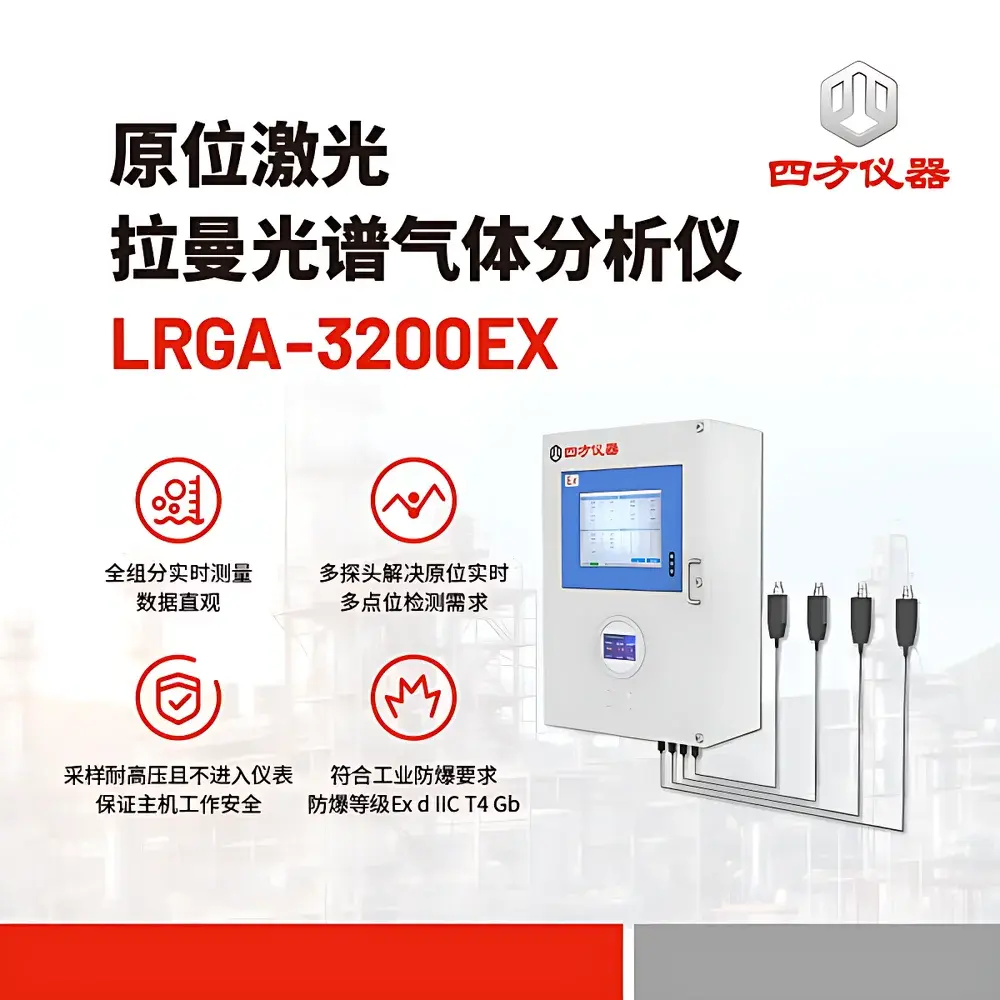
| Explosion Protection | Ex d II C T4 Gb |
| Dimensions (L×W×H) | 540 × 300 × 900 mm |
| Weight | 75 kg |
| Standard Fiber Optic Cable Length | 5 m |
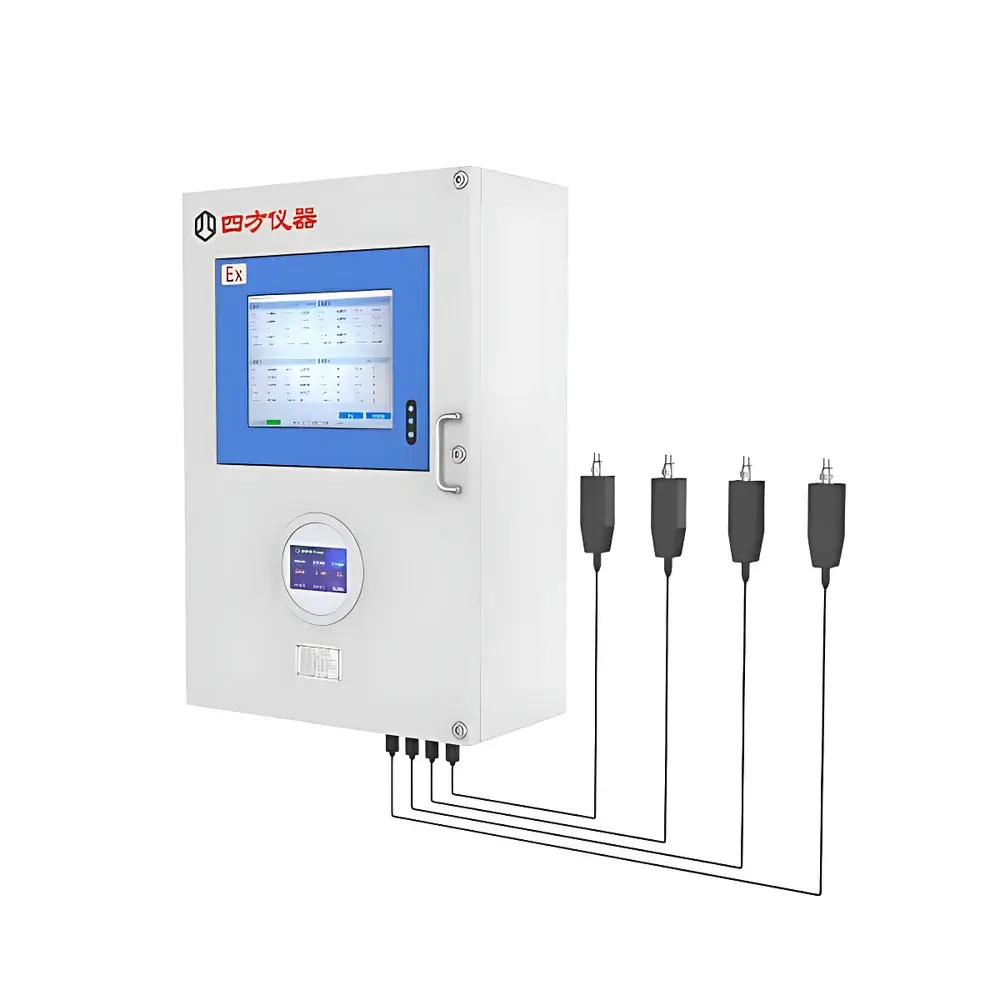
| Number of Probes | 4 |
Overview
The CUBIC INSTRUMENTS LRGA-3200EX is an industrial-grade, in-situ laser Raman gas analyzer engineered for real-time, non-invasive compositional monitoring of high-temperature, high-pressure process streams in ethylene cracking units. It operates on the fundamental principle of spontaneous Raman scattering: monochromatic laser light interacts with molecular vibrational modes in the gas phase, generating wavelength-shifted photons whose spectral positions and intensities are uniquely characteristic of chemical identity and concentration. Unlike absorption-based techniques (e.g., IR or UV-Vis), Raman spectroscopy enables direct detection of homonuclear diatomic gases—such as H₂, N₂, and O₂—which lack permanent dipole moments and are therefore invisible to infrared methods. The LRGA-3200EX integrates a Class IV near-infrared laser source, high-throughput spectrometer optics, thermally stabilized CCD detector, and fiber-coupled probe assemblies designed for direct insertion into process piping or reactors. Its in-situ architecture eliminates sample extraction, conditioning, and transport delays—ensuring true process-representative measurement with sub-second response latency.
Key Features
- In-situ measurement capability: No gas sampling system, no carrier gas, no consumables (e.g., chromatographic columns, valves, or pumps)—reducing maintenance burden and analytical uncertainty introduced by phase change or adsorption losses.
- Homonuclear diatomic gas detection: Simultaneous quantification of H₂, N₂, and O₂ alongside hydrocarbons (C₂H₄, C₂H₂, C₃H₆), CO, CO₂, H₂S, CH₄, and other key裂解 (cracking) stream components—up to 20 species concurrently.
- Explosion-proof, pressure-rated probe design: Certified to Ex d II C T4 Gb; rated for continuous operation at up to 4 MPa and –20 °C to +200 °C at the probe tip; constructed with 316 stainless steel wetted parts and sapphire optical windows.
- Multi-probe configuration support: Up to four independent fiber-optic probes can be connected to a single analyzer chassis, enabling spatially distributed monitoring across reactor zones, quench towers, or fractionation columns.
- Robust optical architecture: Laser power stabilization, temperature-compensated grating alignment, and dark-current corrected spectral acquisition ensure long-term baseline stability and measurement reproducibility of ≤1% F.S. over 30-day intervals.
- Integrated human-machine interface: Industrial-grade防爆 (explosion-proof) capacitive touchscreen display with intuitive navigation; supports external keyboard/mouse via USB; provides real-time spectral visualization, trend plots, alarm status, and calibration logs.
Sample Compatibility & Compliance
The LRGA-3200EX is validated for use in hydrocarbon processing environments where aggressive, corrosive, and flammable gas mixtures are present—including pyrolysis effluents containing coke precursors, sulfur compounds, and unsaturated hydrocarbons. Its optical path avoids contact with condensable vapors or particulates, mitigating fouling risk. All firmware and data handling routines comply with foundational requirements for industrial instrumentation under IEC 61508 (functional safety) and IEC 61000-6-2/6-4 (EMC immunity/emission). While not inherently 21 CFR Part 11-compliant out-of-the-box, audit trail logging, user access control, and electronic signature enablement are available through optional software modules—supporting GLP/GMP-aligned deployment in regulated manufacturing settings. Calibration traceability aligns with ISO/IEC 17025 principles when performed using NIST-traceable certified gas standards.
Software & Data Management
The embedded analyzer firmware runs on a real-time Linux OS with deterministic scheduling for spectral acquisition and chemometric processing. Quantitative analysis employs multivariate calibration models (PLS-R, PCR) trained on reference gas mixtures spanning full operational concentration ranges (0–100% v/v). Software includes automated baseline correction, cosmic ray rejection, peak deconvolution, and dynamic interference compensation for overlapping Raman bands (e.g., C₂H₄/C₂H₂ or CH₄/H₂S). Data export supports CSV, XML, and OPC UA protocols; historical spectra and concentration time-series are stored locally on encrypted SSD with configurable retention policies. Remote diagnostics, firmware updates, and model retraining are supported via secure TLS-encrypted TCP/IP connection. Optional cloud gateway integration enables centralized fleet monitoring and predictive maintenance analytics.
Applications
- Real-time optimization of furnace outlet temperature and residence time in ethylene cracking furnaces via rapid H₂/C₂H₄ ratio feedback.
- Monitoring of quench oil dilution and coking onset through detection of aromatic precursors and polyaromatic hydrocarbons (PAHs) in cracked gas.
- Verification of desulfurization efficiency by tracking H₂S, COS, and mercaptans downstream of amine treaters.
- Leak detection and composition verification in recycle gas loops (e.g., hydrogen recovery units) without process interruption.
- Startup/shutdown sequence validation—confirming purge completeness (O₂/N₂ levels) and feed introduction timing prior to ignition.
- Support for advanced process control (APC) and digital twin modeling through high-fidelity, low-latency compositional inputs.
FAQ
Can the LRGA-3200EX measure hydrogen in high-temperature syngas streams above 150 °C?
Yes—the probe’s sapphire window and thermally isolated optical head maintain spectral fidelity at probe tip temperatures up to 200 °C; laser wavelength stability is actively compensated across the operating range.
Is calibration required after installation, and how often must it be repeated?
Initial field calibration using certified multi-component gas standards is mandatory; subsequent recalibration frequency depends on process stability and regulatory requirements—typically every 3–6 months under steady-state operation, with drift monitoring enabled via built-in reference peaks.
Does the system support integration with DCS or MES platforms?
Yes—via native Modbus TCP, OPC UA, or 4–20 mA analog outputs; all communication drivers include configurable polling intervals, data tagging, and alarm event forwarding per ISA-88/ISA-95 conventions.
What maintenance is required for the fiber-optic probe assembly?
No routine optical cleaning or alignment is needed; the probe’s sealed, purged optical cavity and sapphire window resist fouling; annual visual inspection and end-face cleanliness verification are recommended.
How does the analyzer handle spectral interference from water vapor or methane in wet cracking gas?
Chemometric models incorporate water and methane as explicit interferents during PLS training; spectral preprocessing includes adaptive water-vapor band subtraction and rotational Raman background modeling to preserve quantification accuracy.




