
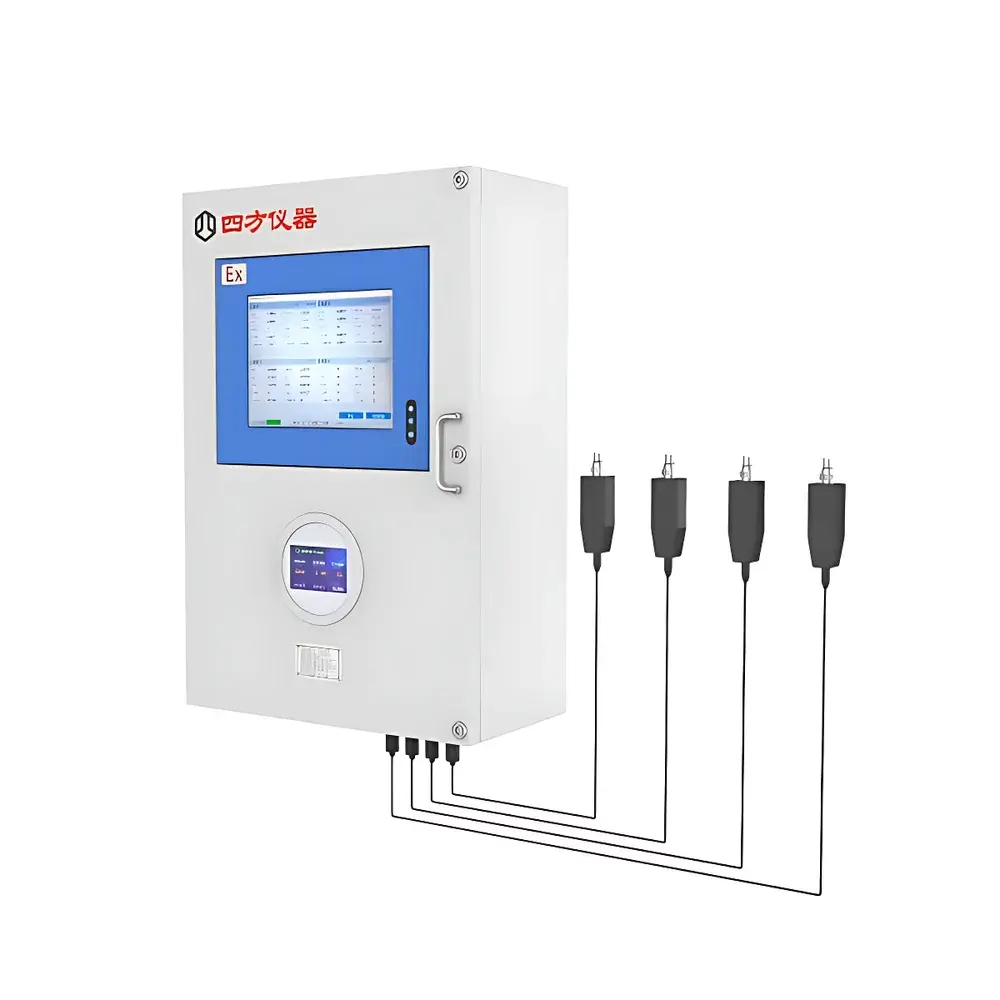
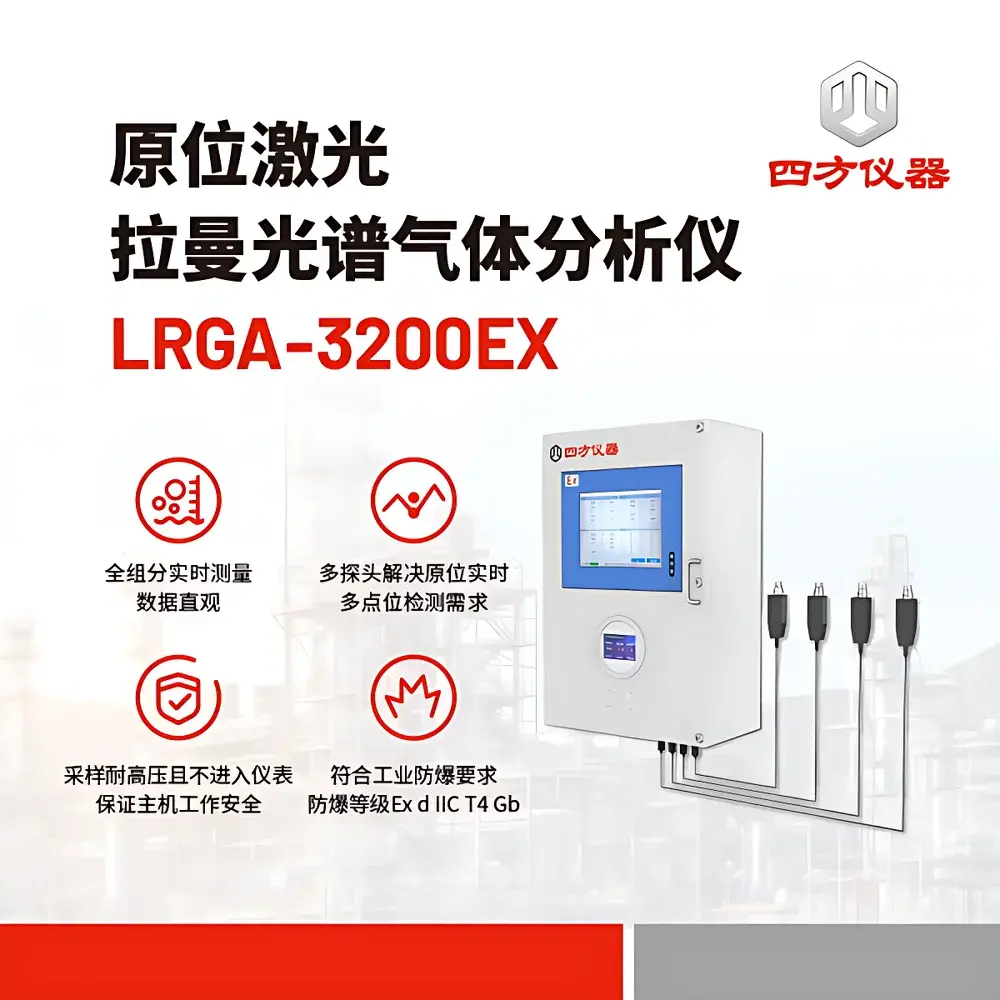
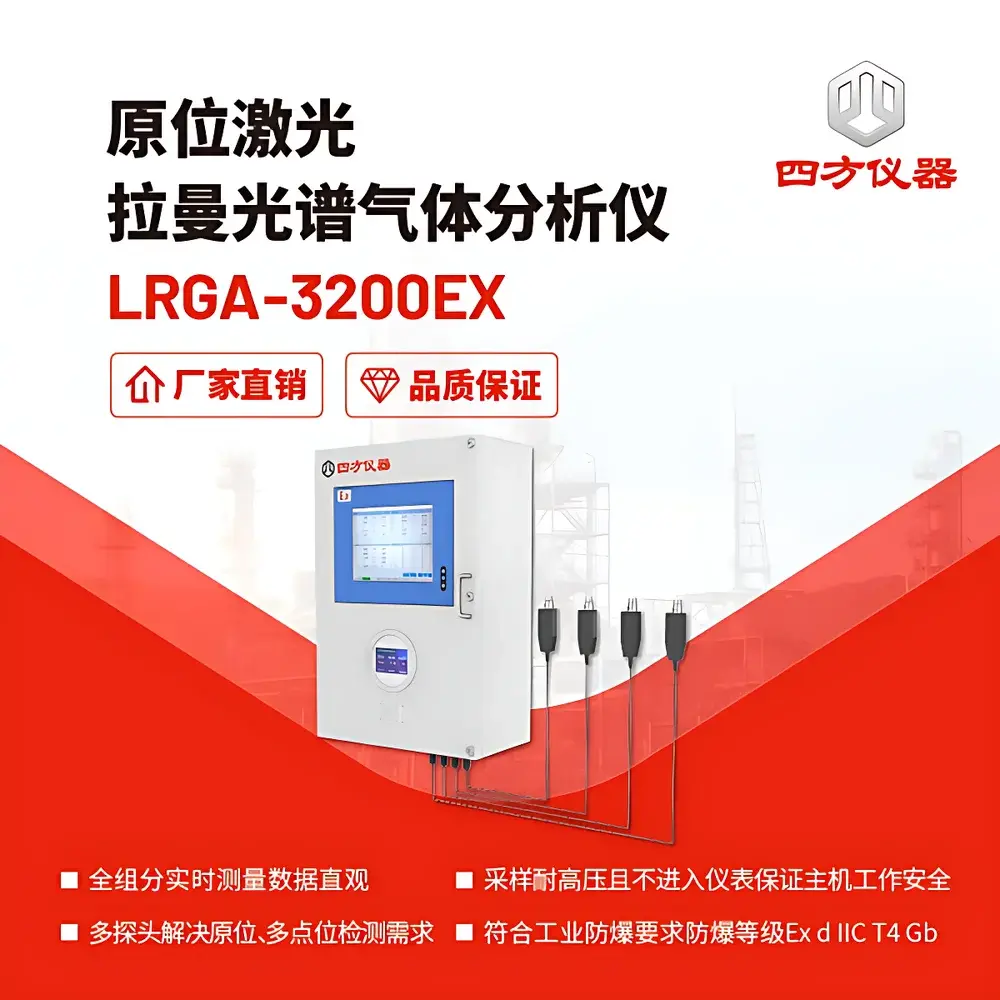
CUBIC INSTRUMENTS LRGA-3200EX In-situ Raman Gas Analyzer
| Brand | CUBIC INSTRUMENTS |
|---|---|
| Origin | Hubei, China |
| Model | LRGA-3200EX |
| Spectral Range | 400–700 nm |
| Spectral Resolution | 0.01% |
| Spatial Resolution | 1 µm (lateral), 2 µm (axial) |
| Minimum Wavenumber | 10 cm⁻¹ |
| Spectral Repeatability | 1% F.S. |
| Measurement Accuracy | ±1% F.S. |
| Operating Pressure | up to 4 MPa |
| Explosion Protection | Ex d II C T4 Gb |
| IP Rating | IP65 |
| Power Supply | 100–240 VAC, 50–60 Hz |
| Max Power Consumption | <200 W |
| Communication Interfaces | RS-232, RS-485, TCP/IP, USB, 4–20 mA analog output |
| Probe Quantity | 4 |
| Standard Fiber Length | 5 m (customizable) |
| Dimensions (L×W×H) | 540 × 300 × 900 mm |
| Weight | 75 kg |
| Ambient Operating Temperature (Analyzer) | 10–35 °C |
| Probe/Process Temperature | −20 to +200 °C |
| Relative Humidity | 0–95% RH (non-condensing) |
Overview
The CUBIC INSTRUMENTS LRGA-3200EX is an industrial-grade in-situ Raman gas analyzer engineered for real-time, non-invasive molecular identification and quantification of multi-component gas streams under process conditions. It operates on the principle of spontaneous Raman scattering: a monochromatic laser excites rotational and vibrational modes of gas molecules, generating characteristic spectral fingerprints that are spectrally resolved and intensity-calibrated for quantitative analysis. Unlike absorption-based techniques (e.g., FTIR or tunable diode laser spectroscopy), Raman spectroscopy enables direct detection of homonuclear diatomic gases—such as H₂, N₂, and O₂—which lack permanent dipole moments and are therefore invisible to IR methods. The LRGA-3200EX integrates a high-stability excitation source, fiber-coupled Raman probe(s), and a thermally stabilized spectrometer with back-illuminated CCD detection, delivering second-scale response times without sample extraction, dilution, or conditioning.
Key Features
- In-situ measurement capability: optical probes mount directly onto process lines or reactors, eliminating sampling delays, pressure drops, and condensation risks associated with extractive systems.
- Homonuclear diatomic gas detection: native sensitivity to H₂, N₂, and O₂ enables comprehensive gas composition monitoring in hydrogenation, ammonia synthesis, air separation, and fuel cell applications.
- Multi-gas simultaneous analysis: calibrated for up to 20 components—including CO, CO₂, CH₄, C₂H₂, C₂H₄, C₃H₆, and H₂S—with full-spectrum deconvolution algorithms ensuring cross-interference correction.
- Explosion-proof architecture: probe housings conform to Ex d II C T4 Gb certification; analyzer enclosure meets IP65 ingress protection for harsh industrial environments.
- Zero-consumables operation: no chromatographic columns, carrier gases, valves, or pumps—reducing lifecycle cost and maintenance downtime.
- Robust thermal management: spectrometer core temperature stabilized to ±0.1 °C, minimizing wavelength drift and preserving long-term calibration integrity.
Sample Compatibility & Compliance
The LRGA-3200EX is validated for continuous operation in pressurized (up to 4 MPa), high-temperature (−20 to +200 °C at probe tip), and corrosive gas environments. Probe materials include 316L stainless steel and sapphire windows compatible with H₂S, Cl₂, NH₃, and hydrocarbon-rich streams. System design adheres to IEC 60079-0 (explosive atmospheres), IEC 61326-1 (EMC for industrial instrumentation), and ISO 17025 traceability requirements for calibration documentation. While not inherently 21 CFR Part 11 compliant, audit-ready data logging (with user authentication, electronic signatures, and immutable timestamps) can be enabled via optional software modules for regulated pharmaceutical or fine chemical manufacturing.
Software & Data Management
The embedded Linux-based control system features a 10.1-inch capacitive touch display with intuitive HMI for real-time spectrum visualization, peak tracking, and alarm configuration. All spectral data—including raw interferograms, baseline-corrected spectra, and concentration time-series—are stored locally on industrial-grade SSD with configurable retention policies. Remote access is supported via secure SSH, VNC, or RESTful API over TCP/IP. Export formats include CSV, HDF5, and JCAMP-DX for integration with LIMS, DCS, or MES platforms. Calibration models are managed using partial least squares (PLS) regression with cross-validation metrics (R² > 0.995, RMSECV < 0.5% F.S.) and support field revalidation using certified gas standards.
Applications
- Hydrogen production & purification: real-time monitoring of H₂ purity, CO/CO₂ slip, and methane content in PEM electrolyzer off-gas and PSA tail streams.
- Petrochemical cracking units: online tracking of ethylene, propylene, acetylene, and butadiene ratios during fluid catalytic cracking (FCC) and steam cracking.
- Syngas quality control: simultaneous quantification of H₂/CO/CO₂/N₂ in Fischer–Tropsch feed and methanol synthesis loops.
- Bio-gas upgrading: continuous verification of CH₄ enrichment and H₂S removal efficiency in amine scrubbers and membrane separation units.
- Chemical reactor surveillance: in-reactor monitoring of reaction progress, intermediate formation, and catalyst deactivation indicators (e.g., coke precursors).
FAQ
Can the LRGA-3200EX detect hydrogen (H₂) without interference from other gases?
Yes. Its Raman-active signature at ~4155 cm⁻¹ is spectrally isolated from common process gases, and multivariate calibration compensates for overlapping bands from CH₄, CO₂, and H₂O vapor.
What is the minimum detectable concentration for trace gases like H₂S?
Detection limits depend on path length, pressure, and integration time; typical LODs range from 10–50 ppmv for H₂S at 1 atm and 1-second integration, validated per ISO 10423 Annex H protocols.
Is fiber optic cable replacement required after exposure to high-temperature process streams?
No. The probe-integrated sapphire window and metal-sealed fiber ferrule withstand sustained exposure up to 200 °C; standard 5-m quartz fibers retain transmission stability beyond 10,000 hours under thermal cycling.
How often does the system require recalibration?
Factory calibration remains stable for ≥12 months under normal operation; annual verification with NIST-traceable gas mixtures is recommended for GLP/GMP compliance.
Can multiple probes be synchronized for spatially resolved measurements?
Yes. Up to four independent probes can be time-multiplexed via TTL-triggered acquisition, enabling differential analysis across reactor zones or pipeline cross-sections.
Related Products





