
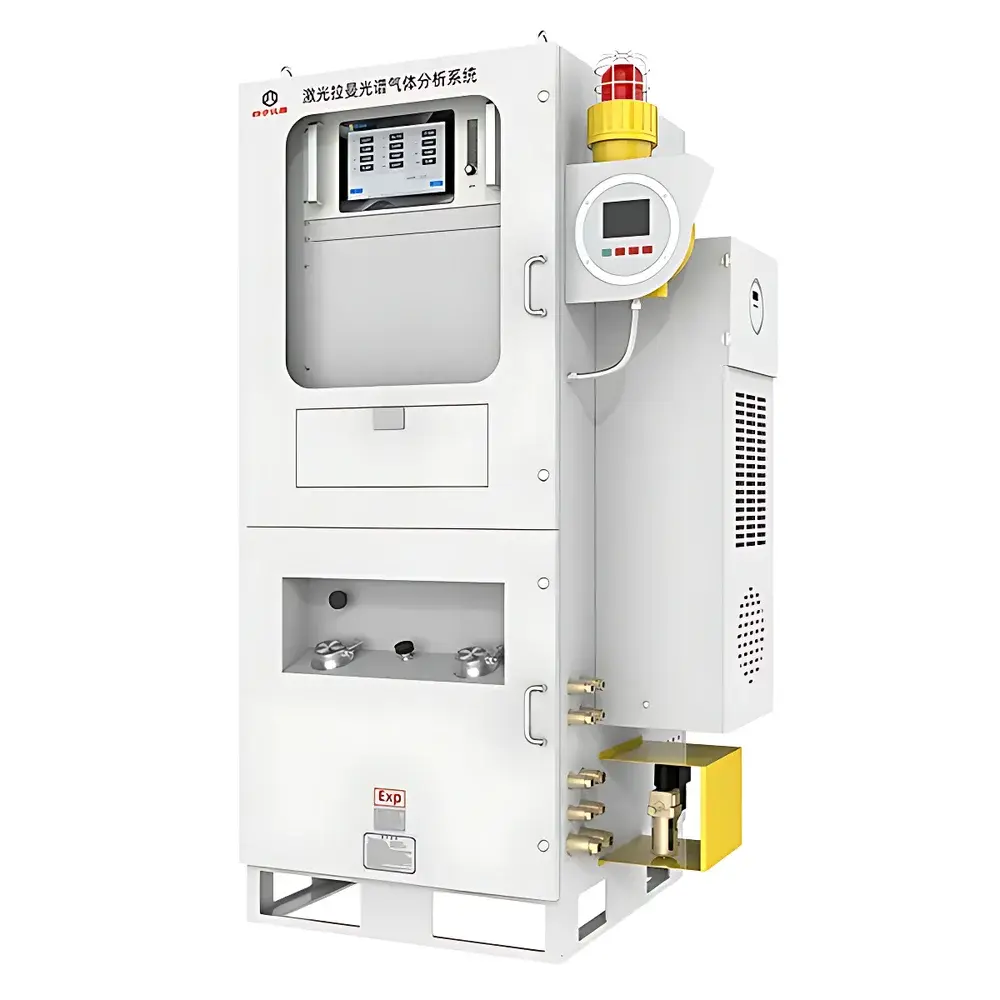
CUBIC INSTRUMENTS LRGA-6000 Laser Raman Gas Analyzer
| Brand | CUBIC INSTRUMENTS |
|---|---|
| Origin | Hubei, China |
| Manufacturer Type | Authorized Distributor |
| Product Category | Domestic |
| Model | LRGA-6000 |
| Price Range | USD 140,000–280,000 |
| Instrument Type | Grating-Based Raman Spectrometer |
| Spectral Range | 400–700 nm |
| Spectral Resolution | 0.01% |
| Minimum Wavenumber | 10 cm⁻¹ |
| Spectral Repeatability | Not Specified |
| Spatial Resolution | Not Applicable |
Overview
The CUBIC INSTRUMENTS LRGA-6000 is a high-performance, industrial-grade laser Raman gas analyzer engineered for real-time, multi-component quantitative analysis of process and ambient gases. It operates on the physical principle of inelastic laser light scattering—Raman spectroscopy—where monochromatic excitation induces molecular vibrational transitions, generating unique spectral fingerprints for each gas species. Unlike absorption-based techniques (e.g., NDIR), Raman scattering enables direct detection of homonuclear diatomic molecules—including N₂, O₂, and H₂—without reliance on dipole moment changes. The LRGA-6000 integrates a stabilized 532 nm or 785 nm excitation source, high-throughput transmission grating spectrometer, thermoelectrically cooled CCD detector, and sealed optical path optimized for harsh industrial environments. Designed for continuous online deployment, it delivers simultaneous quantification of up to 12 gas components with sub-30-second response latency from sample introduction.
Key Features
- Multi-gas fingerprint identification via high-fidelity Raman spectral acquisition across 10–4000 cm⁻¹ effective wavenumber range (calibrated to 400–700 nm detection band)
- Real-time concentration calculation using proprietary gas-phase Raman cross-section library and matrix correction algorithms
- Automatic air purge calibration cycle to suppress baseline drift; no external reference gas required
- Full-range linear response from 0–10% to 0–100% v/v for individual components, with ≤±1% F.S. linearity error per ASTM E2912-22
- Zero-consumable architecture: no carrier gas, chromatographic columns, filaments, or replaceable optical filters
- Ruggedized 1000 × 800 × 1780 mm cabinet (IP54 rated) with integrated sample conditioning module (heated inlet, particulate filter, pressure regulation)
- Embedded Linux OS with 10.1″ capacitive touchscreen HMI; optional USB/RS-485/Ethernet interfaces for SCADA integration
Sample Compatibility & Compliance
The LRGA-6000 is validated for direct analysis of unmodified, pressurized, or ambient-pressure gas streams containing CO, CO₂, CH₄, C₂H₆, C₃H₈, H₂, N₂, O₂, H₂S, C₂H₄, C₂H₂, NH₃, and H₂O vapor. It complies with IEC 61000-6-2 (EMC immunity) and IEC 61000-6-4 (EMC emission) standards. For regulated industries, data integrity features include audit-trail-enabled software (aligned with FDA 21 CFR Part 11 principles), electronic signature support, and configurable user access levels (Administrator/Operator/Viewer). All calibration and measurement records are timestamped, non-erasable, and exportable in CSV or PDF format per GLP/GMP documentation requirements.
Software & Data Management
CUBIC’s RamanView™ firmware provides real-time spectral visualization, dynamic peak fitting (Voigt deconvolution), and auto-baseline correction. The system supports time-series trending of up to 16 concurrent gas concentrations, with configurable alarm thresholds (high/low, rate-of-change). Raw spectra and processed results are stored locally on dual-redundant 64 GB eMMC storage, with optional cloud synchronization via MQTT or OPC UA. Remote diagnostics, firmware updates, and spectral library expansion are performed securely over TLS-encrypted connections. Export formats include ASCII, HDF5, and ASTM E1382-compliant spectral metadata tagging.
Applications
- Coal Chemical Industry: Real-time monitoring of syngas composition (H₂/CO/CO₂/N₂/CH₄) in gasifiers and Fischer–Tropsch reactors
- Natural Gas & LNG Facilities: Continuous calorific value (Wobbe index) calculation from CH₄/C₂₊ hydrocarbon ratios and inert gas dilution
- Steel & Iron Production: Blast furnace top-gas analysis (CO/CO₂/N₂/H₂) for energy recovery optimization
- Petrochemical Refining: FCC off-gas composition tracking (C₁–C₄ hydrocarbons, H₂S) without chromatographic separation
- Environmental Monitoring: Landfill biogas (CH₄/CO₂/H₂S) and wastewater treatment plant digester gas QA/QC
- Power Generation: Transformer fault gas analysis (H₂/CH₄/C₂H₂/C₂H₄) per IEEE C57.104 guidelines
FAQ
Does the LRGA-6000 require periodic recalibration with certified gas standards?
No—its self-calibrating air-purge algorithm maintains long-term stability; however, annual verification against traceable NIST-certified gas mixtures is recommended for ISO/IEC 17025 compliance.
Can it operate in explosive atmospheres (ATEX Zone 1)?
The base unit is non-certified; explosion-proof variants (ATEX II 2G Ex db IIB T4 Gb / IECEx DBI 20.0020X) are available as custom-engineered configurations.
What is the minimum detectable concentration for H₂ in a nitrogen matrix?
At standard temperature and pressure (25°C, 1 atm), the practical LOD is 0.1% v/v (1000 ppm) with 1σ confidence, limited by rotational Raman signal-to-noise ratio—not instrument electronics.
Is spectral library customization supported for proprietary gas mixtures?
Yes—users may import custom Raman cross-section datasets and define new quantification models via RamanView™ SDK (C++/Python API included).
How does it handle water vapor interference in hot, wet sample streams?
Integrated heated sample line (up to 180°C) and Peltier-cooled condensate trap prevent condensation; spectral deconvolution explicitly accounts for H₂O rotational-vibrational bands.




