
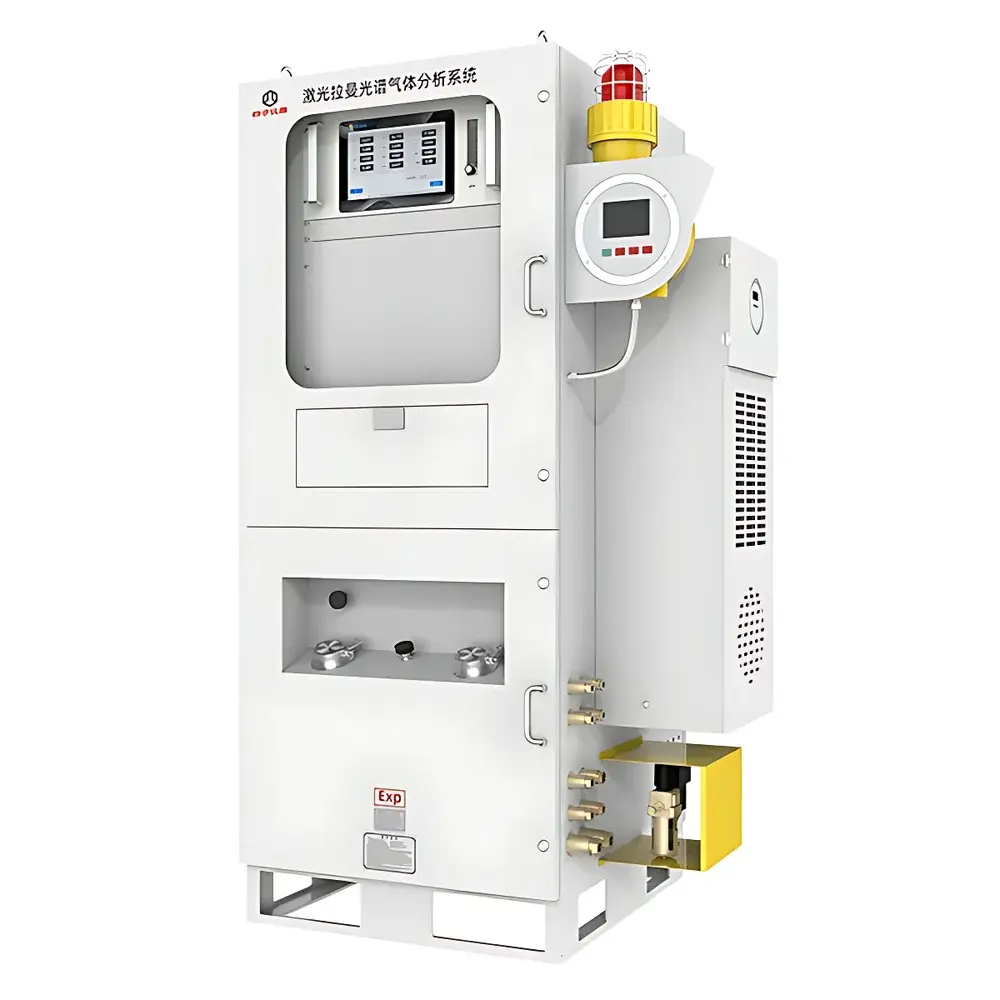
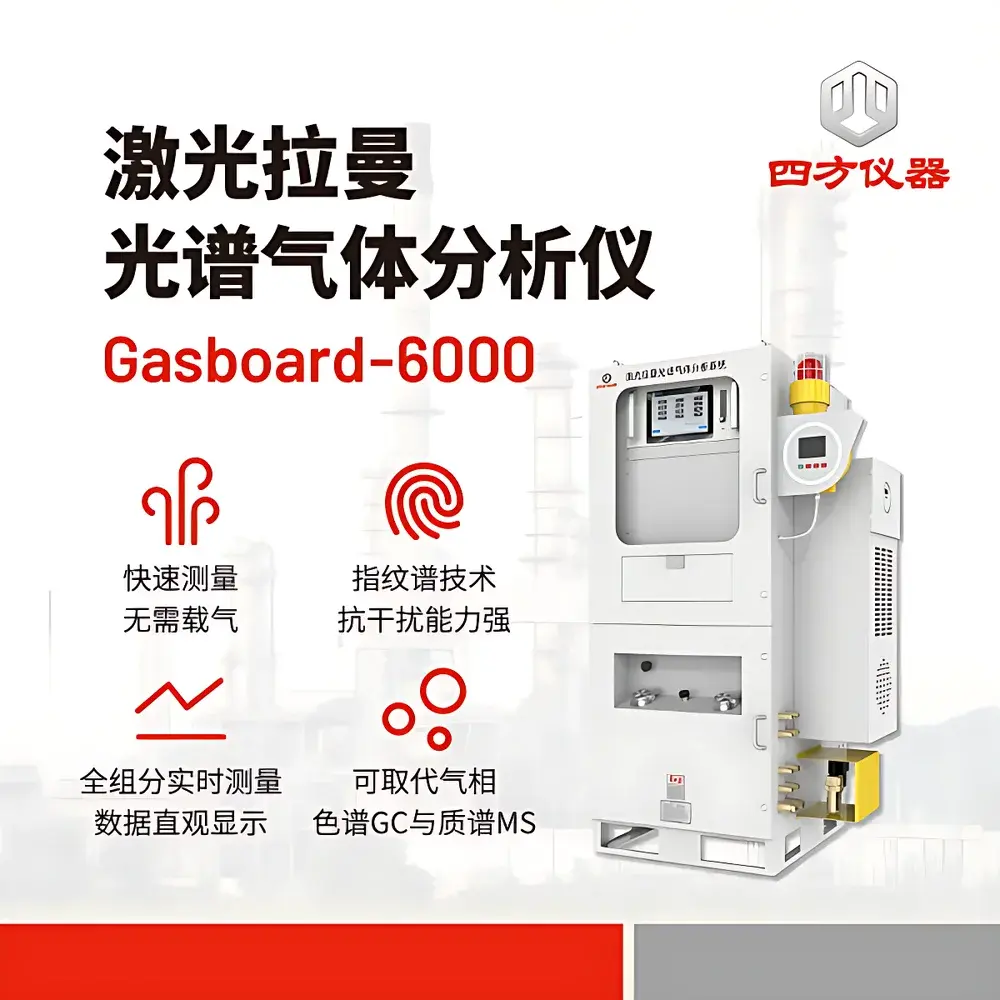
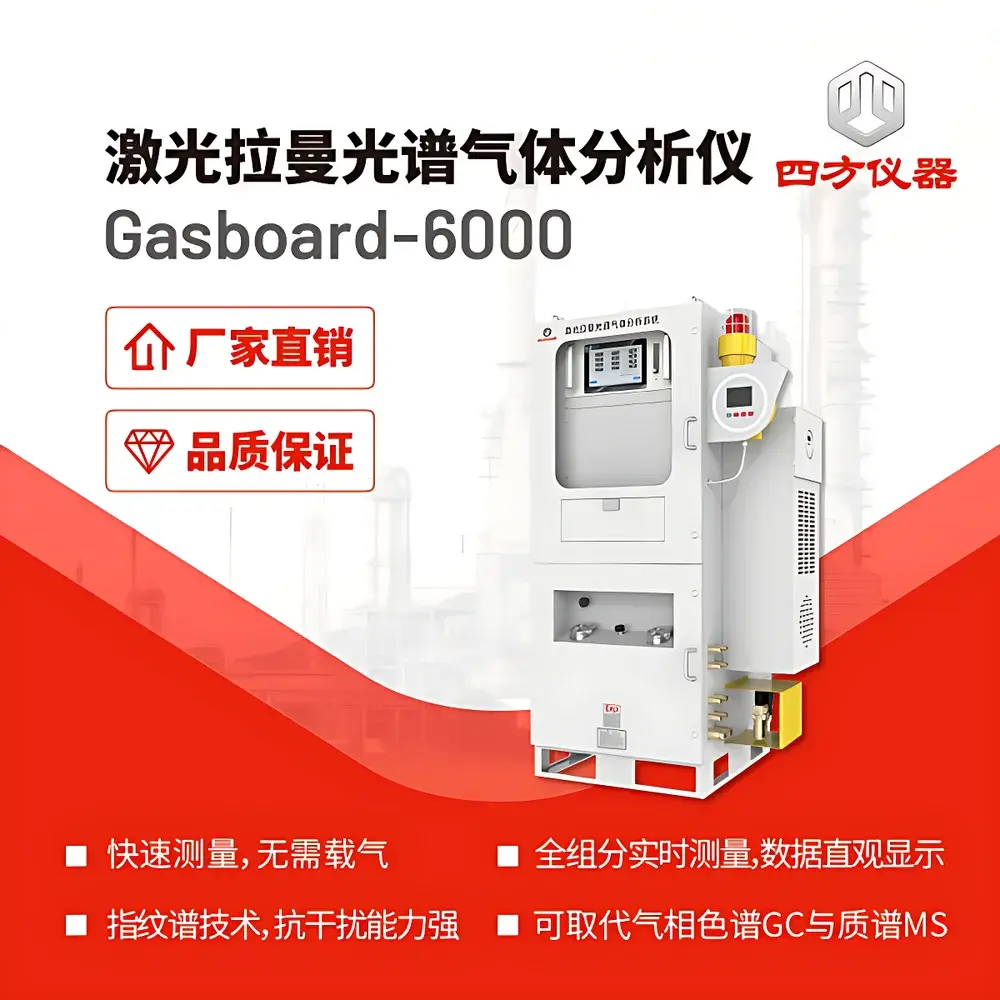
CUBIC INSTRUMENTS LRGA-6000 Raman Gas Analyzer
| Brand | CUBIC INSTRUMENTS |
|---|---|
| Origin | Hubei, China |
| Model | LRGA-6000 |
| Spectrometer Type | Grating-based Raman Spectrometer |
| Spectral Range | 400–700 nm |
| Spectral Resolution | 0.01% |
| Spatial Resolution | Lateral 1 µm, Axial 2 µm |
| Minimum Wavenumber Shift | 10 cm⁻¹ |
| Spectral Repeatability | ≤1% (dependent on configured measurement range) |
| Measurement Range | 0–10% to 0–100% (user-selectable per gas) |
| Linearity Error | ≤±1% FS |
| Response Time | ≤30 s |
| Dimensions | 1000 × 800 × 1780 mm |
Overview
The CUBIC INSTRUMENTS LRGA-6000 Raman Gas Analyzer is a high-performance, grating-based laser Raman spectrometer engineered for continuous, real-time, multi-component gas analysis in industrial process and environmental monitoring applications. It operates on the fundamental principle of inelastic laser light scattering—Raman spectroscopy—where monochromatic excitation induces vibrational energy transitions in molecular bonds, producing characteristic spectral fingerprints unique to each chemical species. Unlike absorption-based techniques, Raman detection is inherently sensitive to homonuclear diatomic gases (e.g., N₂, O₂, H₂), which lack permanent dipole moments and are therefore invisible to infrared (NDIR) methods. The LRGA-6000 leverages high-efficiency optical coupling, background-suppressed signal collection, and advanced spectral deconvolution algorithms to deliver quantitative concentration data without calibration drift or consumables.
Key Features
- Laser-excited Raman fingerprinting enables simultaneous identification and quantification of ≥12 gases—including N₂, O₂, H₂, CH₄, C₂H₆, C₃H₈, CO, CO₂, H₂S, C₂H₂, C₂H₄, and H₂O—in a single measurement cycle
- Response time ≤30 seconds from sample introduction to validated concentration output, supporting closed-loop process control
- User-configurable measurement ranges spanning 0–10% to 0–100% volume/volume per target analyte, with linearity error ≤±1% full scale
- Gas concentration normalization algorithm combined with automated air-purge zero calibration mitigates long-term baseline drift
- Zero-carrier-gas architecture eliminates dependency on helium, nitrogen, or hydrogen supply lines—reducing operational overhead and safety risks
- Robust mechanical design rated for continuous operation in Class I, Division 2 hazardous locations (certification documentation available upon request)
- Integrated touchscreen HMI with intuitive workflow navigation; optional external keyboard and mouse support for advanced configuration
Sample Compatibility & Compliance
The LRGA-6000 is optimized for direct analysis of pressurized, humid, or particulate-laden process streams across coal chemical, petrochemical, metallurgical, power generation, cement, and environmental emission monitoring sectors. Sample conditioning is minimized: inlet temperature tolerance spans −10 °C to +60 °C; dew point handling up to 95% RH; and particulate filtration integrated upstream of the measurement cell. The analyzer complies with ISO/IEC 17025:2017 general requirements for competence of testing and calibration laboratories. Its software architecture supports audit-trail logging and user-access controls aligned with FDA 21 CFR Part 11 and EU Annex 11 expectations for regulated environments. While not intrinsically certified, the system may be deployed in explosion-proof enclosures meeting ATEX Directive 2014/34/EU or IECEx standards when integrated by qualified system integrators.
Software & Data Management
The embedded firmware runs on a Linux-based real-time OS with deterministic acquisition timing and dual-channel spectral processing (raw signal + calibrated concentration). Data export supports CSV, XML, and Modbus TCP protocols for integration into DCS, SCADA, or MES platforms. Historical spectra and concentration logs are stored locally on encrypted SSD storage (≥3 years at 1-min sampling interval) and synchronized via TLS-secured HTTPS to cloud-based dashboards. All software updates undergo cryptographic signature verification. Calibration history, operator actions, and instrument status events are recorded with timestamp, user ID, and IP address—enabling full traceability under GLP/GMP and ISO 9001 quality management systems.
Applications
- Coal Chemical Industry: Real-time monitoring of syngas composition (H₂/CO/CO₂/N₂/CH₄) in gasifiers and Fischer–Tropsch reactors
- Petrochemical & Natural Gas: Quantitative analysis of hydrocarbon slates (C₁–C₄), H₂S, and moisture in pipeline gas and LNG liquefaction units
- Steelmaking: Blast furnace top-gas recycling control via precise CO/CO₂/H₂/N₂ ratios
- Power Generation: Transformer oil dissolved gas analysis (DGA) surrogate monitoring and flue gas desulfurization (FGD) bypass stream verification
- Environmental Compliance: Continuous emissions monitoring (CEMS) for landfill biogas (CH₄/CO₂/H₂S), wastewater treatment off-gas, and fugitive emission surveys
- Cement Kiln Optimization: In-situ CO and O₂ tracking for combustion efficiency tuning and NOₓ precursor control
FAQ
Does the LRGA-6000 require daily calibration?
No. It employs an automatic air-purge zero-reference cycle triggered at user-defined intervals (e.g., every 4–24 hours), eliminating manual span calibration under stable operating conditions.
Can it measure hydrogen (H₂) and nitrogen (N₂) simultaneously with hydrocarbons?
Yes. Its Raman-active detection mechanism provides intrinsic sensitivity to homonuclear diatomic molecules—unlike NDIR or electrochemical sensors—which cannot resolve these species.
Is the system compatible with existing plant networks?
Yes. Standard communication interfaces include Modbus TCP, OPC UA (optional), and analog 4–20 mA outputs (configurable per channel); Ethernet/IP and Profibus DP modules are available as factory-installed options.
What maintenance is required beyond routine optical cleaning?
Annual verification of laser wavelength stability and spectrometer alignment is recommended; no consumables, columns, or carrier gases are used during normal operation.
How is measurement uncertainty determined for custom gas mixtures?
Uncertainty budgets are generated per IUPAC Technical Report guidelines using certified reference gas blends traceable to NIST SRMs, with combined standard uncertainty typically <1.5% k=2 for major components in validated matrices.
Related Products




