
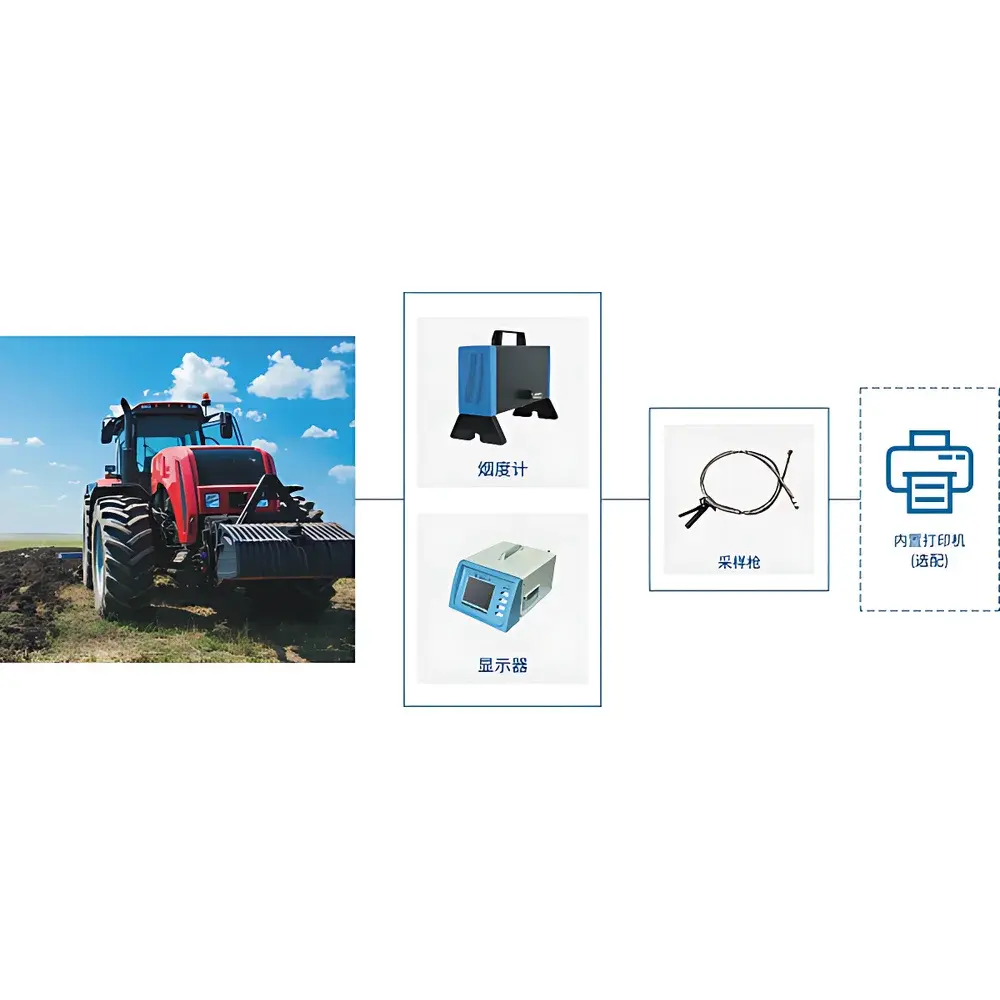
CUBIC INSTRUMENTS Portable Opacity Meter System for Off-Road Machinery and Diesel Vehicle Exhaust Smoke Testing (Standalone Version)
| Brand | CUBIC INSTRUMENTS |
|---|---|
| Origin | Hubei, China |
| Manufacturer Type | Authorized Distributor |
| Country of Origin | China |
| Model | Standalone Version |
| Instrument Type | Portable |
| Measurement Principle | Optical Transmission (Nephelometric Absorption) |
| Maximum Permissible Error | ±2.0% |
| Display | Integrated LCD Monitor |
| Sampling Probe | Fixed-length, heat-resistant stainless steel probe |
| Optional | Built-in thermal printer |
| Compliance | GB 3847–2018, GB 36886–2018 |
| Electrical Interface | RS-232 / RS-485 digital output & print port |
| Power Supply | AC 220 V ±10%, 50 Hz ±1 Hz |
| Measurement Range | Opacity N: 0–99.99% |
| Absorption Coefficient K | 0–16 m⁻¹ |
| Resolution | N: 0.1% |
| K | 0.01 m⁻¹ |
Overview
The CUBIC INSTRUMENTS Portable Opacity Meter System (Standalone Version) is a field-deployable optical transmission instrument engineered for regulatory-grade smoke opacity and light absorption coefficient (K-value) measurement in diesel-powered off-road machinery and on-road vehicles. It operates on the principle of infrared or visible-light beam attenuation through exhaust plumes—quantifying the degree of light extinction caused by particulate matter (soot, carbonaceous aerosols) suspended in the exhaust stream. Unlike filter-based or scattering-based methods, this system employs a calibrated dual-beam transmissometer architecture with integrated reference path compensation, ensuring stable baseline performance under variable ambient temperature and humidity conditions. Designed explicitly to meet the metrological and procedural requirements of GB 3847–2018 (for road-going diesel vehicles using free-acceleration and loaded-mode testing) and GB 36886–2018 (for construction, agricultural, and industrial off-road diesel equipment), the system delivers traceable, repeatable opacity data suitable for roadside enforcement, factory-level conformity audits, and periodic inspection programs.
Key Features
- Simultaneous real-time display of opacity (N, %) and absorption coefficient (K, m⁻¹), both calculated per ISO 8549-1 and harmonized with Chinese national standards.
- Thermostatically controlled measurement chamber maintains constant internal temperature (±0.5 °C), minimizing condensation-induced signal drift and eliminating moisture-related interference during high-humidity exhaust sampling.
- Automatic zero calibration sequence executed prior to each test cycle—using clean-air purging and optical path self-check—to ensure long-term photometric stability without manual intervention.
- Dedicated analog input ports for optional engine oil temperature and rotational speed sensors, enabling synchronized correlation of smoke emissions with operating parameters for diagnostic-level analysis.
- Modular hardware architecture supports field-upgradable firmware and configurable communication protocols (RS-232/RS-485), facilitating integration into centralized fleet monitoring platforms or mobile inspection databases.
Sample Compatibility & Compliance
The system is validated for use with diesel engines operating across diverse duty cycles—including idling, free acceleration, and steady-state load conditions—as specified in GB 3847–2018 Annexes B and C, and GB 36886–2018 Clause 6. It accommodates exhaust gas temperatures up to 600 °C via its ceramic-coated sampling probe and withstands transient backpressure fluctuations typical of turbocharged and aftertreated engines. All optical components comply with GB/T 15479–2019 (Industrial Process Analyzers – General Technical Requirements) and are subject to factory calibration traceable to NIM (National Institute of Metrology, China). The device meets electromagnetic compatibility (EMC) Class B requirements per GB/T 18268.1–2010 and carries CCC certification for domestic market deployment.
Software & Data Management
While the standalone version operates without external PC dependency, its embedded firmware supports timestamped data logging (up to 10,000 test records), automatic pass/fail flagging against user-defined limit thresholds, and CSV export via serial interface. When connected to a host computer or tablet, optional CUBIC DataLink software enables GLP-compliant audit trails—including operator ID, calibration history, environmental metadata (ambient T/RH), and digital signatures—aligning with ISO/IEC 17025 documentation practices. Exported datasets include full raw photodetector voltage traces, integrated K-value integrals over prescribed time windows (e.g., 1-s max hold per GB 3847), and statistical summaries (mean, standard deviation, peak value) per test event.
Applications
- Roadside emission enforcement by municipal environmental protection bureaus and traffic management authorities.
- Pre-delivery verification and post-repair validation for construction equipment dealerships and agricultural machinery service centers.
- Periodic in-service inspection (ISI) programs mandated under China’s “Blue Sky Defense Campaign” for municipal fleets and logistics operators.
- Engine development laboratories conducting comparative smoke mapping under transient cycles (e.g., ISO 8178 C1).
- Third-party certification bodies performing type-approval testing per CNCA-C11-01:2020 requirements.
FAQ
Does this system require annual recalibration by an accredited lab?
Yes—per GB 3847–2018 Clause 7.3.2, opacity meters must undergo traceable recalibration at least once per year using certified neutral density filters and reference light sources; CUBIC provides NIM-traceable calibration certificates upon request.
Can it be used on engines equipped with DPFs or SCR systems?
Yes—the optical transmission method remains valid for low-smoke exhaust streams; however, users must verify probe insertion depth and flow velocity per GB 36886–2018 Section 7.2.2 to avoid dilution artifacts.
Is the built-in printer compatible with standard thermal paper rolls?
Yes—it accepts 57 mm wide, direct-thermal rolls with auto-cutter functionality; printed reports include QR-coded test IDs for digital record linkage.
What environmental conditions affect measurement accuracy?
Ambient temperatures below 0 °C may impact probe heater response time; operation is rated for −10 °C to +50 °C, with relative humidity ≤90% non-condensing.
How is data integrity ensured during wireless or offline operation?
All measurements are stored in non-volatile flash memory with cyclic redundancy check (CRC-32) validation; power-loss recovery preserves unsaved records from interrupted sessions.







