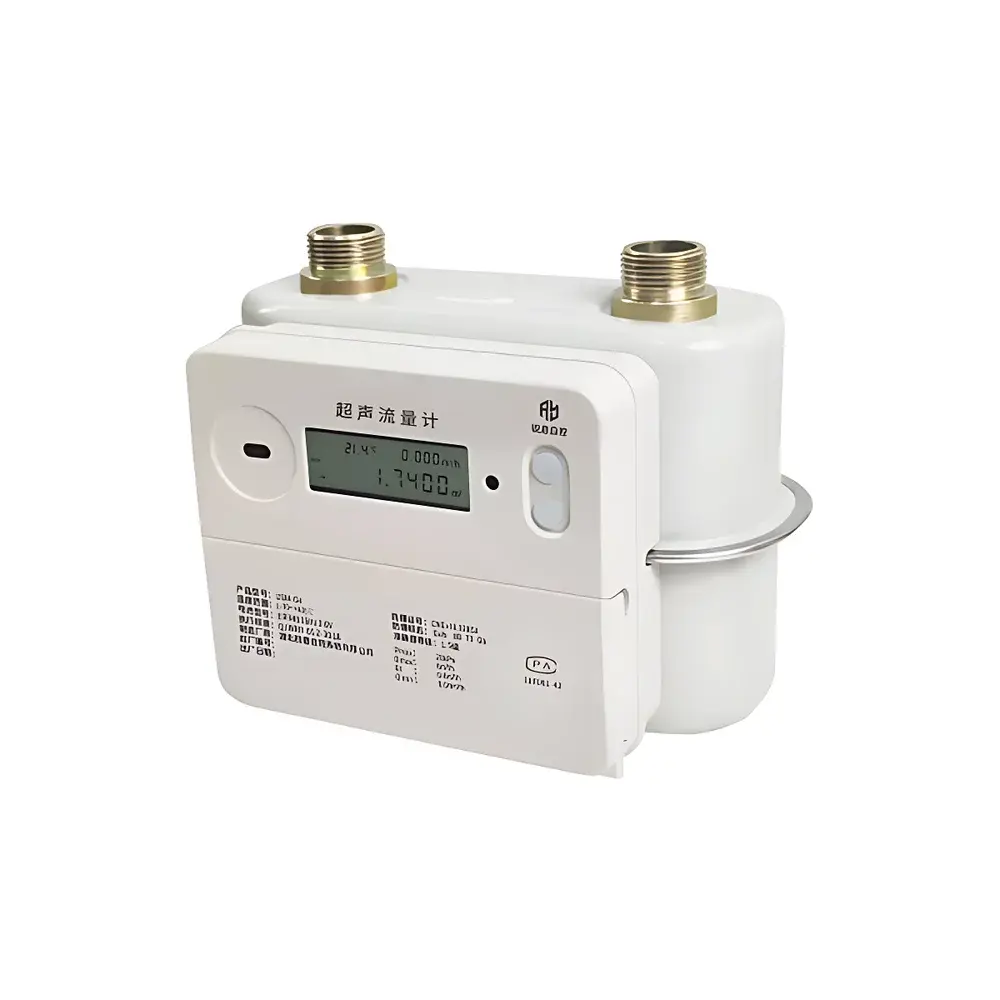
CUBIC INSTRUMENTS USM-G2.5/G4 Stainless-Steel Cased Ultrasonic Gas Meter
| Brand | CUBIC INSTRUMENTS |
|---|---|
| Origin | Hubei, China |
| Manufacturer Type | Authorized Distributor |
| Regional Category | Domestic (China) |
| Model | USM-G2.5 / USM-G4 |
| Product Type | Ultrasonic Gas Flowmeter |
| Measurement Principle | Transit-Time Ultrasonic Method with L-Shaped Flow Path |
| Accuracy Class | Class 1.5 (EN 1359 / OIML R137 compliant) |
| Flow Range | USM-G2.5: 0.025–4 m³/h |
| USM-G4 | 0.04–6 m³/h |
| Interface | Threaded (M30) |
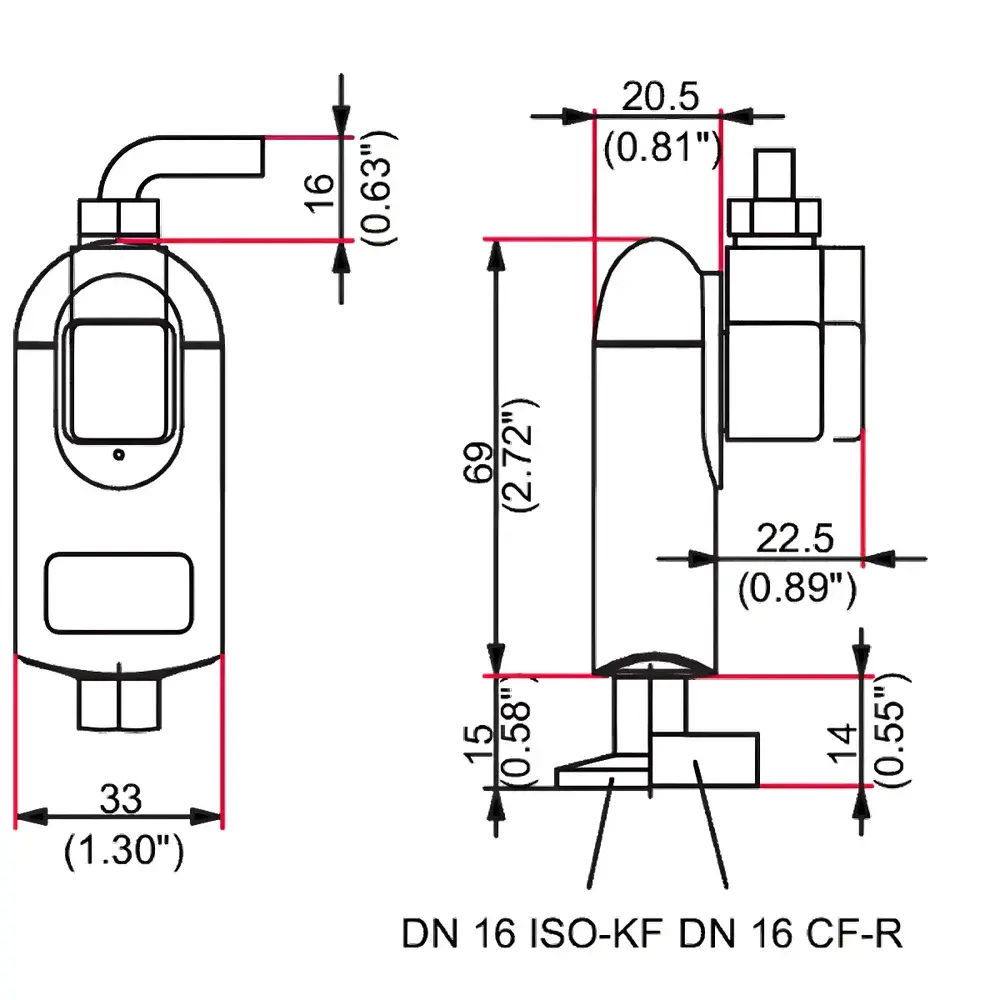
| Dimensions (L×W×H) | 232 × 172 × 135 mm |
| Weight | 1.6 kg |
| Power Supply | ER34615 Lithium Battery, 3.6 V |
| Operating Temperature | −10 °C to +40 °C |
| Storage Temperature | −20 °C to +60 °C |
| Operating Pressure | 0–20 kPa (gauge) |
| Temperature Compensation | Integrated Pt1000 sensor |
| Ingress Protection | IP65 |
| Explosion Protection | Ex ib IIB T3 Gb |
| Measurement Uncertainty | ±3% at Qmin ≤ Q < Qt |
| Core Components | Domestically developed ultrasonic transducers, ASIC-based signal processing unit, and firmware with embedded thermal drift compensation algorithm |
Overview
The CUBIC INSTRUMENTS USM-G2.5/G4 Stainless-Steel Cased Ultrasonic Gas Meter is a certified residential gas flow measurement device engineered for long-term stability, high repeatability, and minimal maintenance in low-pressure natural gas distribution networks. It operates on the transit-time ultrasonic principle: two opposing ultrasonic transducers emit and receive acoustic pulses across a precisely defined L-shaped flow channel. By measuring the time difference between upstream and downstream propagation, the meter calculates volumetric flow velocity with inherent immunity to mechanical wear, pressure drop, or particulate-induced signal attenuation. The patented L-shaped flow path minimizes stagnant zones and reduces sediment accumulation near transducer surfaces—critical for maintaining measurement integrity in unfiltered domestic gas streams. Designed to meet OIML R137 and EN 1359 requirements for class 1.5 gas meters, it supports continuous operation over a minimum 15-year service life under typical urban gas supply conditions (methane-rich, ≤20 kPa gauge pressure, ambient temperature variation).
Key Features
- Stainless-steel housing providing enhanced corrosion resistance in humid, saline, or chemically aggressive installation environments
- Integrated Pt1000 temperature sensor enabling real-time thermal compensation per ISO 6976 and EN 1776 standards
- Self-contained ultrasonic transducer assembly with hermetically sealed ceramic elements and optimized acoustic coupling for stable signal-to-noise ratio (>45 dB)
- L-shaped flow geometry reducing particle deposition on transducer faces and improving low-flow resolution (Qmin = 0.025 m³/h for USM-G2.5)
- Battery-powered architecture using industrial-grade ER34615 (3.6 V) lithium thionyl chloride cell, rated for ≥10 years of operation at 10,000 readings/year
- Firmware with adaptive gain control, automatic zero-point calibration, and diagnostic logging for flow profile anomalies
- No moving parts—eliminates mechanical hysteresis, gear wear, and associated calibration drift
Sample Compatibility & Compliance
The USM-G2.5/G4 is validated for use with pipeline-quality natural gas (CH₄ ≥ 85%, Wobbe index 45–55 MJ/m³), town gas, and propane-air mixtures within specified pressure and temperature limits. It complies with international metrological and safety frameworks including OIML R137 Edition 2012 (gas meters), EN 1359:2017 (domestic gas meters), and IEC 60079-11:2011 for intrinsic safety (Ex ib IIB T3 Gb). Its IP65-rated enclosure ensures protection against dust ingress and water jets from any direction—suitable for indoor meter cabinets, semi-outdoor utility rooms, and basement installations. All firmware and hardware revisions are traceable per ISO/IEC 17025 documentation requirements, supporting GLP-compliant verification protocols.
Software & Data Management
The meter supports pulse output (impulse rate configurable via DIP switch) and optional M-Bus or Wireless M-Bus (EN 13757-4) communication for integration into AMI (Advanced Metering Infrastructure) systems. Configuration and diagnostics are performed via IR optical interface using CUBIC’s proprietary PC-based Metrology Suite, which logs timestamped events—including battery voltage decay, temperature excursions, flow reversals, and transducer impedance shifts—for audit-ready traceability. Firmware updates follow secure signed-package protocol compliant with IEC 62443-3-3 SL2, ensuring integrity during remote deployment. Data export formats include CSV and XML, compatible with common utility billing platforms and SCADA historians.
Applications
- Residential natural gas billing in multi-dwelling units and single-family homes
- Sub-metering in commercial buildings (restaurants, laundromats, small workshops) where compact footprint and silent operation are essential
- Gas consumption monitoring in off-grid or microgrid-connected dwellings with intermittent supply pressure
- Field verification and comparative testing against reference turbine or diaphragm meters per ISO 4064-2
- Integration into smart city infrastructure projects requiring long-life, low-maintenance endpoint devices
FAQ
What is the expected battery lifetime under standard usage conditions?
Under nominal load (10,000 hourly reads/year), the ER34615 battery delivers ≥10 years of uninterrupted operation, verified per IEC 60086-4 accelerated aging tests.
Does the meter support remote firmware updates?
Yes—via secure Wireless M-Bus or M-Bus interface using digitally signed firmware packages compliant with IEC 62443-3-3 SL2.
Is temperature compensation applied automatically during measurement?
Yes—the integrated Pt1000 sensor feeds real-time temperature data to the ASIC, applying EN 1776-compliant thermal correction to volumetric flow values.
Can this meter be used for biogas or hydrogen-blended natural gas?
It is certified for conventional natural gas (EN 437). For non-standard gas compositions, prior validation per ISO 6976 and EN 1776 is required to confirm acoustic velocity consistency and thermal expansion coefficients.
How is metrological traceability maintained over the service life?
Each unit ships with a factory calibration certificate referencing NIM (National Institute of Metrology, China) traceable standards. Internal diagnostics log transducer performance parameters for periodic verification without physical disassembly.