
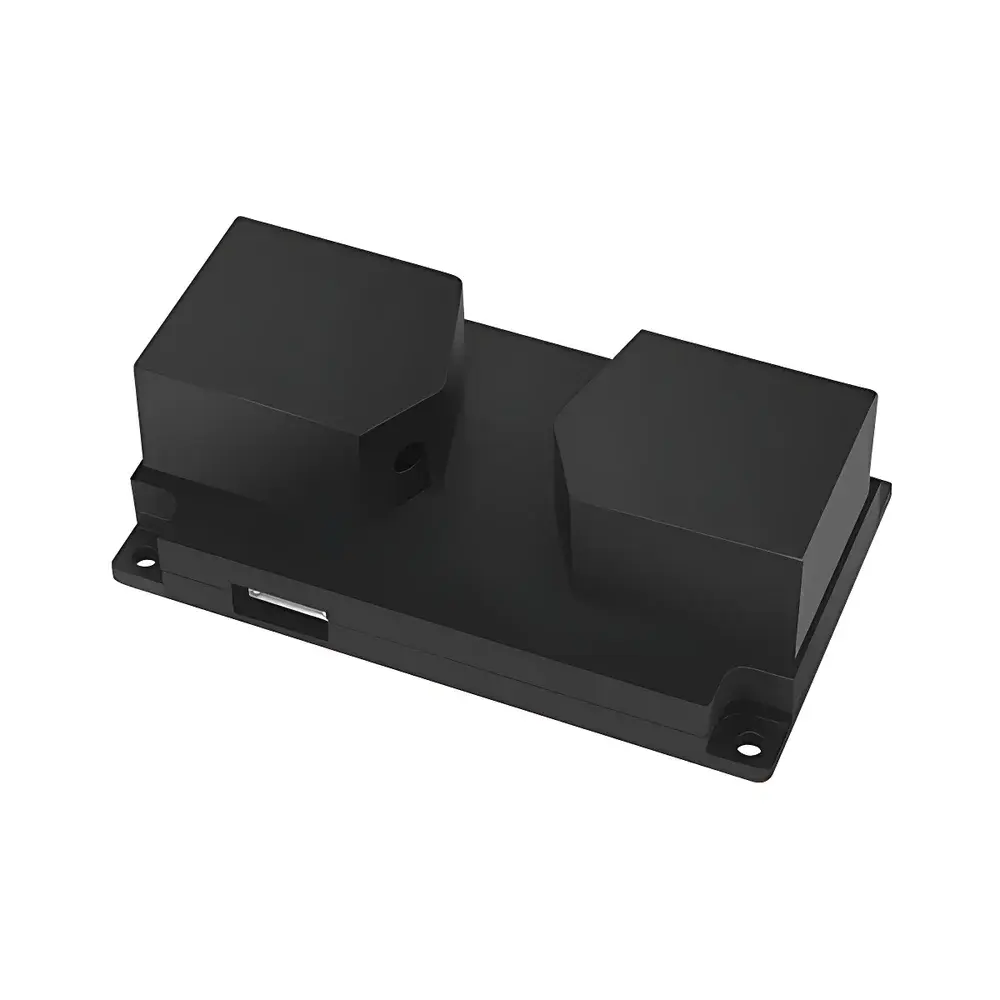
Cubic PM1007 High-Precision Optical Oil Fume Concentration Sensor Module
| Brand | Cubic |
|---|---|
| Origin | Hubei, China |
| Model | PM1007 |
| Detection Principle | Optical Light Scattering (Nephelometry) |
| Measurement Range | 0–5 mg/m³ |
| Accuracy | ±30 µg/m³ or ±30% of reading (at 25±2 °C, 50%±10% RH) |
| Warm-up Time | 8 s |
| Operating Temperature | −20 °C to +75 °C |
| Operating Humidity | 0–95% RH (non-condensing) |
| Storage Conditions | −40 °C to +85 °C, 0–95% RH (non-condensing) |
| Supply Voltage | DC 5 V ±0.2 V (ripple <100 mV) |
| Operating Current | ≤30 mA |
| Output Interfaces | UART (4.5 V logic level), PWM (4.5 V logic level) |
| Dimensions | 66.8 × 38.8 × 21.6 mm (W×H×D) |
| Expected Service Life | ≥5 years |
| Electromagnetic Shielding | Integrated |
| Particle Size Sensitivity | 0.3–10 µm |
| Application Domain | Commercial Kitchen Exhaust Monitoring, Fume Hood Compliance Verification, Local Emission Control Systems |
Overview
The Cubic PM1007 is a compact, OEM-grade optical oil fume concentration sensor module engineered for continuous, real-time monitoring of airborne particulate matter generated during commercial cooking operations. It operates on the principle of near-infrared light scattering (nephelometry), where an integrated 850 nm LED emits collimated light into a defined sampling chamber; suspended particles—primarily submicron to coarse-mode aerosols typical of thermal food preparation (e.g., frying, grilling, wok cooking)—scatter incident photons proportionally to their size distribution and mass loading. A precisely aligned photodiode detects the intensity of scattered light at a fixed angular geometry, enabling quantitative estimation of mass concentration in mg/m³. Unlike electrochemical or metal-oxide semiconductor sensors, the PM1007 avoids drift from volatile organic compound (VOC) cross-sensitivity and delivers stable baseline performance under high-humidity, high-fat aerosol conditions common in kitchen exhaust ducts. Its design targets integration into regulatory-compliant油烟在线监测系统 (oil fume online monitoring systems) mandated by local environmental protection bureaus in China (e.g., DB11/1547–2018, GB/T 16157–1996), while meeting foundational requirements for long-term field deployment in non-laboratory settings.
Key Features
- Optical architecture with built-in infrared LED (850 nm) and low-noise photodetector, optimized for particle size range 0.3–10 µm—covering dominant aerosol modes in cooking emissions
- Integrated electromagnetic shielding to suppress interference from variable-frequency drives (VFDs), induction hobs, and adjacent HVAC control circuits
- Anti-contamination gas channel design featuring hydrophobic surface treatment and laminar flow path geometry, minimizing oil film deposition and extending calibration stability
- Low-power operation (≤30 mA @ 5 VDC) suitable for battery-backed or energy-harvesting edge nodes in distributed monitoring networks
- Rapid thermal stabilization (<8 s warm-up time) and wide operational envelope (−20 °C to +75 °C, 0–95% RH non-condensing) for installation in exhaust stacks, grease traps, and rooftop fan enclosures
- Dual digital output interfaces: UART (TTL-level, 4.5 V logic) for high-resolution serial data streaming and PWM (4.5 V logic) for analog-equivalent pulse-width modulation compatible with legacy PLC inputs
Sample Compatibility & Compliance
The PM1007 is validated for use in complex, high-humidity, high-fat aerosol environments typical of institutional kitchens, restaurant exhaust ducts, and food processing ventilation systems. It does not require sample conditioning (e.g., dilution, heating, or filtration) prior to measurement, reducing system complexity and maintenance burden. While not certified to ISO 12103-1 or EN 15267 for reference-grade particulate monitoring, its performance aligns with functional requirements specified in Chinese environmental standards for kitchen fume emission surveillance (e.g., HJ 629–2011, DB31/844–2022). The sensor’s mechanical housing meets IP54 ingress protection for dust and splashing water resistance, and its PCB layout complies with IEC 61000-4-3 (radiated immunity) and IEC 61000-4-4 (electrical fast transient) test criteria. For GLP/GMP-aligned deployments, raw UART output supports timestamped data logging with external microcontrollers capable of audit-trail generation per FDA 21 CFR Part 11 principles.
Software & Data Management
The PM1007 operates as a smart transducer with no embedded firmware update capability; configuration and data interpretation are handled externally via host MCU or gateway firmware. Standard UART protocol provides ASCII-formatted output at 9600 bps (configurable), including real-time PM mass concentration (mg/m³), internal temperature, relative humidity (if equipped with optional RH sensor), and diagnostic flags (e.g., lens contamination warning, signal saturation). Integration libraries are available for common platforms (Arduino, ESP32, Raspberry Pi Pico) supporting Modbus RTU over UART or custom JSON-over-serial framing. When deployed in networked monitoring systems, time-synchronized data streams feed into SCADA dashboards or cloud-based environmental compliance platforms (e.g., ThingsBoard, AWS IoT Core), enabling trend analysis, threshold alerts, and automated reporting for municipal environmental authorities.
Applications
- Real-time compliance monitoring of kitchen exhaust emissions in restaurants, canteens, and food courts subject to local air quality ordinances
- Feedback control input for variable-speed kitchen exhaust fans and demand-controlled ventilation (DCV) systems
- Embedded sensing in portable handheld fume analyzers used by environmental inspectors during routine audits
- Performance validation of grease filtration units (e.g., electrostatic precipitators, UV-C oxidizers, wet scrubbers) via upstream/downstream differential measurements
- Research-grade particulate characterization in controlled cooking emission studies, particularly for correlation with PAH and aldehyde co-pollutants
FAQ
Is the PM1007 suitable for outdoor ambient air monitoring?
No—it is specifically calibrated and mechanically designed for high-concentration, high-humidity kitchen fume environments. Its dynamic range and optical sensitivity are not optimized for background PM₂.₅/PM₁₀ ambient levels.
Does the sensor require periodic factory recalibration?
Field recalibration is not supported; however, end users may perform zero-point verification using clean, filtered air. Long-term drift is mitigated by anti-fouling channel design and is typically <5% per year under proper installation conditions.
Can the PM1007 be integrated with BACnet or MQTT protocols?
Yes—via external gateway devices or host MCUs that translate UART output into BACnet MS/TP, BACnet/IP, or MQTT payloads. Reference integration schematics and firmware examples are provided in the OEM Design Guide.
What mounting orientation is recommended?
Horizontal orientation with inlet facing downward is preferred to minimize gravitational settling of large droplets into the optical path. Vertical mounting is permissible if the inlet is shielded from direct grease splash.
Is there a version with analog voltage output (e.g., 0–5 V or 4–20 mA)?
Not natively—the PM1007 offers UART and PWM only. However, third-party signal conditioning modules (e.g., UART-to-4–20 mA converters) are widely available and routinely deployed in industrial OEM integrations.







