
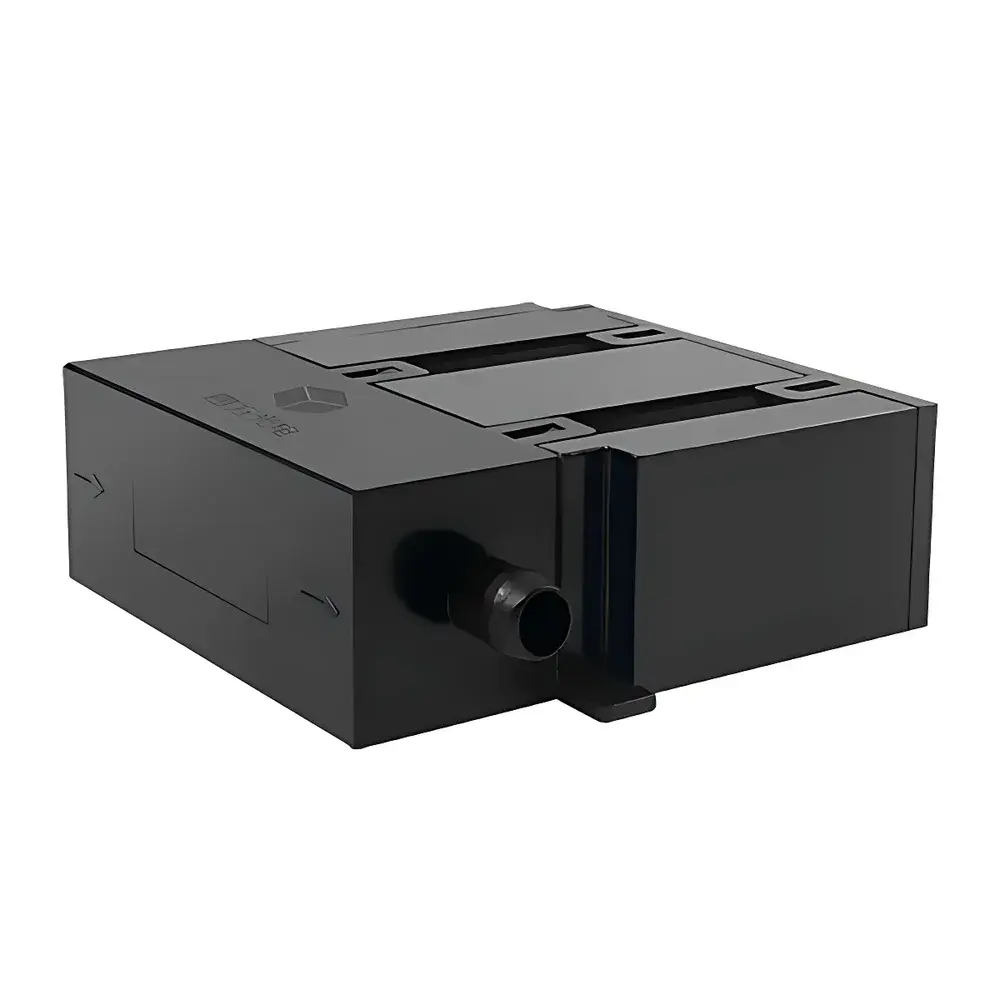
Cubic PM3009BP Oil Fume Concentration Sensor
| Brand | Cubic |
|---|---|
| Origin | Hubei, China |
| Model | PM3009BP |
| Detection Principle | Optical Scattering with Intelligent Particle Recognition Algorithm |
| Mounting Type | Online Fixed Installation |
| Measurement Range | 0–5000 µg/m³ (extended capability up to 50,000 µg/m³) |
| Accuracy | ±15 µg/m³ at ≤100 µg/m³ |
| Sample Flow Requirement | Compatible with external pump (3–9 L/min) |
| Operating Temperature | −20°C to +60°C |
| Storage Temperature | −30°C to +70°C |
| Power Supply | DC 5 V ±0.1 V |
| Max Current Draw | ≤1 A |
| Communication Interfaces | UART, I²C |
| Dimensions | 80.3 mm (W) × 80 mm (H) × 28.3 mm (D) |
| Key Features | Sidestream Sampling Architecture, Integrated Water Mist Removal, Lens Auto-Cleaning Mechanism, Real-Time Particulate Concentration Output, Source-Aware Particle Discrimination |
Overview
The Cubic PM3009BP Oil Fume Concentration Sensor is an online optical particulate sensor engineered for continuous, real-time monitoring of cooking oil fume emissions in commercial kitchen exhaust systems. It operates on the principle of sidestream light scattering—where a representative portion of the exhaust gas stream is drawn through an internal optical chamber and illuminated by a stable light source. Scattered light intensity is detected by a photodiode array and converted into mass concentration (µg/m³) using factory-calibrated transfer functions traceable to reference instruments conforming to EN 13284-1 and ISO 29458 methodologies. Unlike conventional inline sensors, the PM3009BP employs a sidestream sampling architecture that decouples measurement sensitivity from main duct flow velocity fluctuations, enabling stable operation across variable fan speeds and duct configurations. Its design targets regulatory compliance with local environmental ordinances governing VOC and fine particulate (PM₂.₅–PM₁₀) emissions from food service establishments.
Key Features
- Sidestream sampling configuration ensures measurement stability independent of main duct airflow rate variations.
- Integrated water mist removal module mitigates signal interference from condensate and high-humidity exhaust streams typical in steam-rich kitchen environments.
- Lens auto-cleaning mechanism—based on periodic mechanical vibration and hydrophobic surface treatment—prevents optical path fouling caused by sticky oil aerosols, extending calibration interval and operational uptime.
- Intelligent particle recognition algorithm discriminates between cooking oil droplets, soot agglomerates, and non-target airborne particulates (e.g., flour dust or cleaning agent residues), reducing false positives in heterogeneous exhaust matrices.
- Dual digital communication interfaces (UART and I²C) support seamless integration into centralized building management systems (BMS), IoT gateways, or custom data loggers without analog signal conditioning.
- Compact form factor (80.3 × 80 × 28.3 mm) enables retrofit installation in space-constrained exhaust hoods or duct-mounted enclosures.
Sample Compatibility & Compliance
The PM3009BP is validated for use in hot, humid, and chemically aggressive exhaust streams containing submicron triglyceride aerosols, thermal decomposition products (e.g., aldehydes, PAHs), and carbonaceous soot. It meets mechanical and environmental robustness requirements per IEC 60529 (IP54-rated enclosure) and electromagnetic compatibility standards per EN 61326-1. While not certified as a Class I, Division 1 hazardous area device, its DC 5 V power architecture and absence of high-voltage components make it suitable for Zone 2 classified environments when installed downstream of explosion-proof ventilation sections. The sensor’s accuracy specification is referenced to Grimm Aerosol Technik’s 1.108 portable spectrometer under controlled laboratory conditions (ISO/IEC 17025-accredited calibration protocol), supporting traceability for audit-ready environmental reporting.
Software & Data Management
Raw sensor output is delivered as time-stamped digital packets via UART (default 115200 bps, 8N1) or I²C (7-bit address 0x4A). Firmware supports configurable averaging windows (1–60 s), alarm thresholds (programmable upper/lower limits), and diagnostic status flags (e.g., lens contamination warning, flow fault detection). When deployed in networked configurations, data can be ingested into SCADA platforms compliant with OPC UA or MQTT v3.1.1 protocols. For regulatory documentation, the sensor’s internal timestamping and non-volatile event logging satisfy basic GLP-aligned record-keeping requirements—though full 21 CFR Part 11 compliance requires external secure audit trail implementation at the host system level.
Applications
- Continuous emission monitoring (CEM) of cooking oil fumes in restaurant, cafeteria, and hotel kitchen exhaust stacks.
- Feedback control input for variable-frequency drive (VFD) modulation of exhaust fans to optimize energy use while maintaining permissible emission thresholds.
- Preventive maintenance triggering based on cumulative exposure metrics and lens contamination trend analysis.
- Baseline characterization and post-retrofit verification of油烟 purification system efficiency (e.g., UV-photocatalytic, electrostatic precipitator, or wet scrubber performance).
- Research-grade particulate profiling in food science laboratories studying thermal degradation kinetics of edible oils under simulated frying conditions.
FAQ
Does the PM3009BP require periodic recalibration?
Yes—annual field verification against a NIST-traceable reference instrument is recommended. The built-in zero-check function allows for baseline drift assessment during routine maintenance.
Can it operate in ducts with temperatures exceeding 60°C?
No. Prolonged exposure above +60°C may degrade optical alignment and polymer housing integrity. For high-temperature exhaust, install upstream of heat exchangers or use a cooled sample probe assembly.
Is the sensor compatible with Modbus RTU or BACnet MS/TP?
Not natively. Protocol translation requires an external gateway supporting UART-to-Modbus mapping or I²C-to-BACnet bridging firmware.
What maintenance intervals are recommended for the lens cleaning mechanism?
The auto-cleaning cycle activates every 2 hours during active measurement; no manual intervention is required for ≥12 months under typical Chinese urban kitchen duty cycles (per GB 18483-2001 test reports).
How does the water mist removal system affect measurement response time?
The integrated membrane-based dehumidifier introduces <1.2 s additional latency versus dry-air conditions, fully compensated in firmware via dynamic time-constant adjustment.
Related Products







