
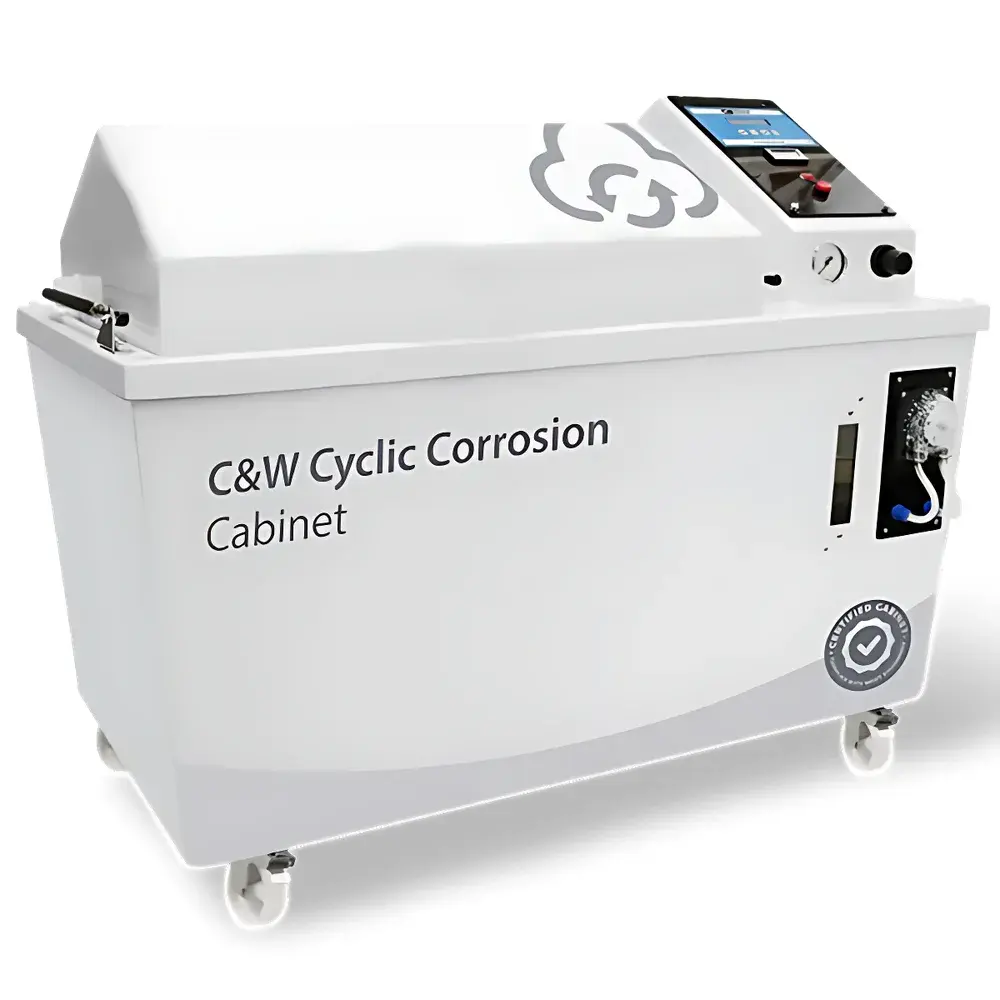
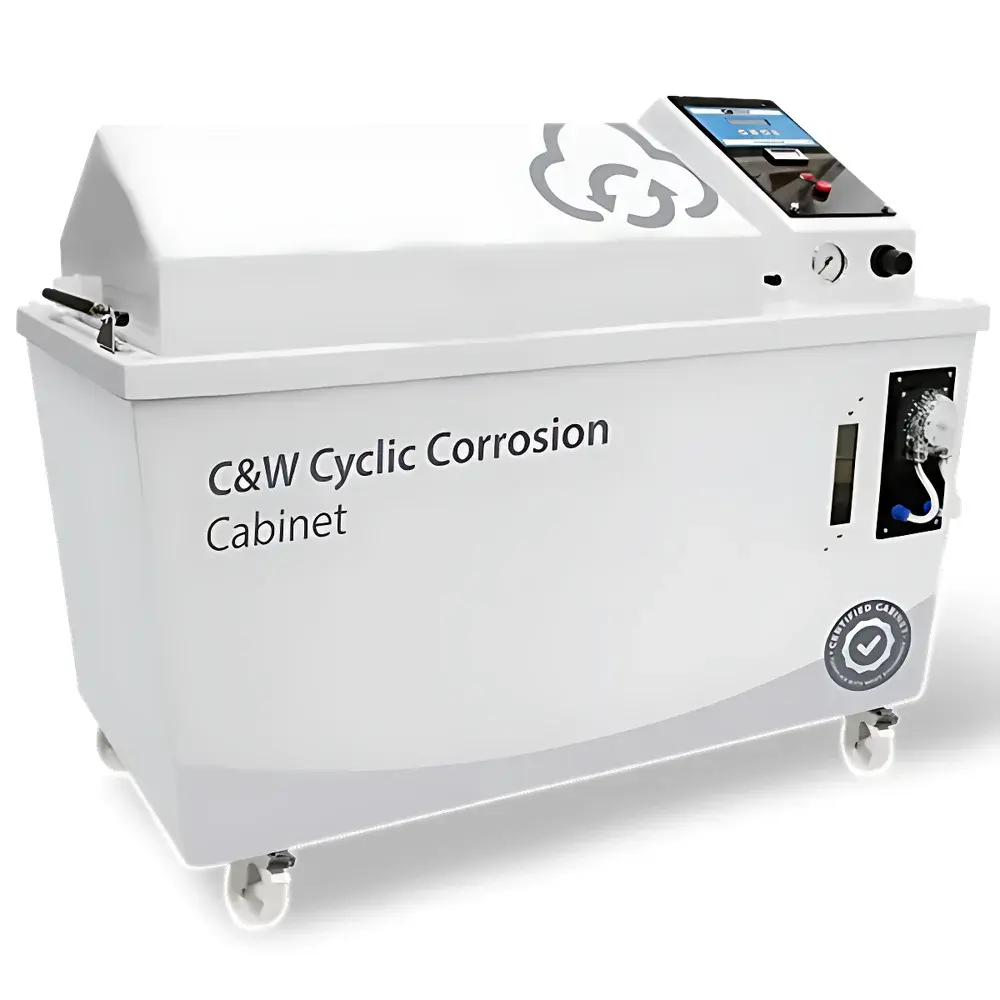
C&W CW4000 Series Cyclic Corrosion Test Chamber
| Brand | C&W |
|---|---|
| Origin | Netherlands |
| Model | CW4000 Series |
| Compliance | ASTM B117, ISO 7253, DIN 50021, JIS K 5600-7, BS 3900 F12, VDA 624-415, VW 1210-C, Ford EU B 153-2, Toyota TSH 1555G, GM 9540P, Nissan M0007, Renault D17 2035, Honda 5100Z, Unichem 692/741 |
| Humidity Range | 15–98% RH (programmable) |
| Temperature Range | Ambient to 70°C (dry heat), 55°C ±1°C (condensation) |
| Salt Solution Delivery | Precision metered via heavy-duty peristaltic pump with flowmeter and adjustable air pressure regulation |
| Air Saturation System | Auto-refilling compressed-air humidifier with integrated filtration |
| Water Supply | Deionized water or tap water ≤50 mg/L TDS |
| Water Pressure | 2–4 bar (30–60 psi) |
| Internal Chamber Dimensions | 500 × 620 × 540 mm (L×W×H) |
| External Brine Tank Capacity | 114 L (≈10 days continuous operation) |
| Power Supply | 230 V, 50/60 Hz, single-phase (custom voltages available) |
| Construction Materials | Flame-retardant GRP (glass-reinforced polyester) with chemical resistance |
| Safety Features | Overheat protection, low-water-level alarm, automatic compressor switchover, algae-inhibiting tank design |
| Standard Accessories | CW4088 Installation Kit, CW4052 Annual Maintenance Kit, CW4035 Fog Collection Set (2 funnels + 2 cylinders), 5 kg certified NaCl, CW5882 Pipe Adaptor, VF7101 Corrosion Testing Handbook |
Overview
The C&W CW4000 Series Cyclic Corrosion Test Chamber is an engineered solution for accelerated environmental corrosion testing under rigorously controlled, programmable multi-phase conditions. Designed in accordance with internationally recognized test standards—including ASTM B117 (salt spray), ISO 7253 (corrosion resistance of coatings), DIN 50021 (cyclic salt mist/dry/humidity), and automotive OEM specifications such as VDA 624-415 and Ford EU B 153-2—the chamber implements a true cyclic exposure methodology grounded in Couette-flow-derived air management, precision humidity modulation, and reproducible salt fog generation. Unlike static salt spray cabinets, the CW4000 series executes defined sequences of salt deposition, high-humidity condensation, drying (via forced-air ventilation), and ambient stabilization—enabling realistic simulation of real-world atmospheric degradation mechanisms in steel, aluminum, galvanized substrates, and coated components. Its microprocessor-based control architecture ensures traceable, repeatable execution of up to seven independent event-driven cycles per program, supporting GLP-compliant validation protocols and long-term inter-laboratory correlation studies.
Key Features
- Programmable multi-stage cycling: dry air, salt fog, high-humidity condensation (up to 98% RH), and forced-air drying—all independently timed and temperature-regulated
- Dual-mode compressed-air saturation system: auto-refilling humidifier with integrated particulate and coalescing filtration for consistent fog droplet size distribution
- Precision brine delivery: heavy-duty peristaltic pump with digital flowmeter and adjustable air pressure regulator (0.5–2.5 bar) to maintain stable fog collection rate per ISO 7253 requirements
- Chemically inert chamber construction: flame-retardant GRP (glass-reinforced polyester) with enhanced resistance to chloride ion permeation, thermal cycling fatigue, and UV-induced polymer degradation
- Ergonomic control interface: touchscreen-enabled microprocessor controller with real-time event logging, cycle counter, and password-protected parameter modification
- Integrated safety architecture: dual thermal cutouts, low-level brine reservoir detection, automatic compressor redundancy switching, and anti-algal tank geometry with easy-clean access ports
- Modular external brine reservoir (114 L capacity): mobile trolley-mounted design with inline deionizer and sediment filter—supports uninterrupted operation for ≥10 days per fill
Sample Compatibility & Compliance
The CW4000 accommodates flat panels, stamped parts, fasteners, electronic enclosures, and assembled subassemblies up to 500 × 620 × 540 mm internal volume. Its uniform fog distribution (validated via ISO 7253 fog collection mapping), calibrated RH control (±2% RH accuracy across 15–98% range), and traceable temperature gradients ensure compliance with both regulatory and OEM-specific test methods. It meets full requirements for ASTM B117 (neutral salt spray), ISO 14993 (cyclic corrosion testing), ISO 9227 (accelerated corrosion tests), and automotive standards including Volkswagen PV1210, General Motors GMW14872, and Renault D17 2035. All units ship with calibration certificates for critical subsystems (humidity sensor, temperature probe, fog collector), and support 21 CFR Part 11–compliant audit trails when paired with optional data acquisition software.
Software & Data Management
The embedded controller supports on-device storage of ≥100 test programs, each configurable with up to seven sequential phases (e.g., 2 h salt spray → 4 h humidity → 1 h drying → 16 h ambient rest). Event-triggered data logging records time-stamped values for chamber temperature, relative humidity, fog collection rate, brine level, and compressor status at user-defined intervals (1 s to 60 min resolution). Exportable CSV logs include cycle completion counters and fault-event timestamps. Optional PC-based C&W CCT Manager software enables remote monitoring, report generation (PDF/Excel), electronic signature workflows, and integration with LIMS platforms via OPC UA or Modbus TCP. All configuration changes are timestamped and attributed to operator ID, fulfilling GLP/GMP documentation requirements for QC laboratories operating under ISO/IEC 17025.
Applications
This chamber is routinely deployed in R&D labs and quality assurance departments across automotive OEMs and Tier-1 suppliers for evaluating paint adhesion, zinc coating performance, cathodic protection efficacy, and sealant durability. It is equally applicable in aerospace (fastener corrosion screening per AMS 2700), marine equipment certification (ISO 12944 C5-M), electronics enclosure validation (IEC 60068-2-52), and packaging material barrier integrity assessment. Its ability to replicate coastal, industrial, and de-icing salt exposure profiles makes it indispensable for materials qualification under harsh service environments—particularly where electrochemical pitting, crevice corrosion, or filiform degradation must be quantified over accelerated timelines.
FAQ
What standards does the CW4000 Series fully comply with?
It satisfies ASTM B117, ISO 7253, ISO 14993, DIN 50021, JIS K 5600-7, BS 3900 F12, and major automotive OEM specifications including VDA 624-415, VW 1210-C, Ford EU B 153-2, Toyota TSH 1555G, and GM 9540P.
Is deionized water mandatory for operation?
Deionized water is strongly recommended; however, potable water with total dissolved solids (TDS) ≤50 mg/L may be used if coupled with the supplied inline deionizer and particulate filter.
How is fog uniformity verified and maintained?
Fog distribution is validated using ISO 7253-compliant collection funnels placed at standardized positions; uniformity is sustained via calibrated air pressure regulation, vortex-free nozzle design, and periodic verification using the included CW4035 collection set.
Can the chamber operate unattended for extended periods?
Yes—its 114 L external brine reservoir, redundant compressor system, automated low-level alarms, and sealed GRP construction enable continuous, monitored operation for up to 10 days without manual intervention.
What maintenance is required for ISO/IEC 17025 compliance?
Annual calibration of humidity and temperature sensors, verification of fog collection rate, and replacement of consumables (filters, tubing, seals) per the CW4052 Maintenance Kit schedule—documented in the VF7101 Corrosion Handbook and supported by C&W’s accredited service network.



