
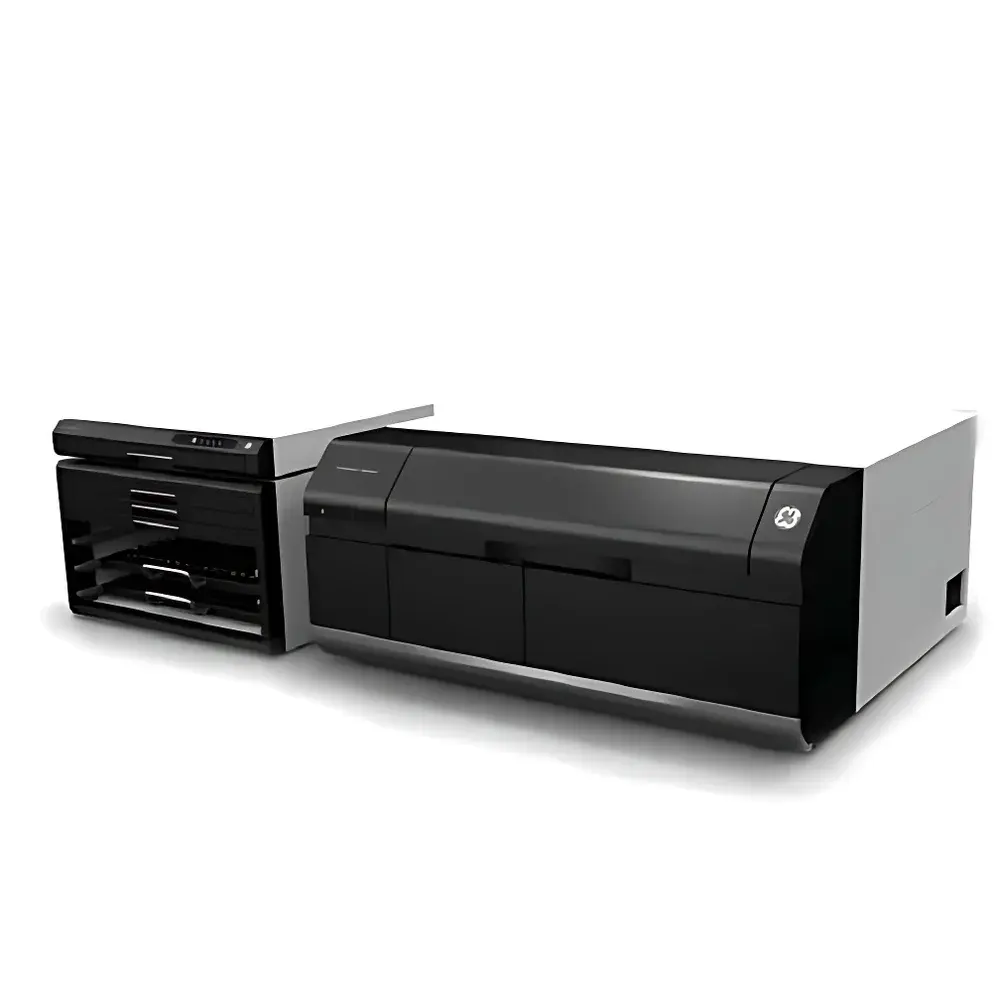
Cytiva Amersham Typhoon NIR/NIR+ Near-Infrared Laser Scanner
| Brand | Cytiva |
|---|---|
| Origin | Japan |
| Model | Amersham Typhoon NIR / NIR+ |
| Instrument Type | Multicolor Fluorescent Gel Imaging System |
| Detection Principle | Confocal Laser Scanning with Dual-NIR Fluorescence Excitation and Emission Filtering |
| Laser Wavelengths | 685 nm, 785 nm |
| Emission Filters | IRshort 720BP20, IRlong 825BP30 |
| Scan Modes | Automatic, Semi-Automatic, Manual |
| Sample Formats | SDS-PAGE gels, agarose gels, nitrocellulose/PVDF membranes, microplates, Petri dishes, glass slides, tissue sections |
| Detector | Enhanced Photomultiplier Tube (PMT) optimized for NIR spectral range |
| Dynamic Range | >4 orders of magnitude (log-linear response) |
| Spatial Resolution | ≤50 µm (pixel size adjustable) |
| Software Platform | ImageQuant TL with GLP-compliant audit trail and 21 CFR Part 11 optional modules |
Overview
The Cytiva Amersham Typhoon NIR/NIR+ Near-Infrared Laser Scanner is a high-performance confocal laser scanning imager engineered for quantitative fluorescence detection in life science applications—particularly Western blotting, nucleic acid analysis, and multiplexed protein expression profiling. Unlike chemiluminescent systems requiring enzymatic substrate development and film exposure, the Typhoon NIR leverages dual-wavelength near-infrared (NIR) excitation (685 nm and 785 nm) coupled with spectrally matched bandpass emission filters (IRshort 720BP20 and IRlong 825BP30) to enable direct, substrate-free detection of IRDye®- or LI-COR®-labeled secondary antibodies. This optical architecture minimizes autofluorescence from membranes, gels, and plastic supports—yielding superior signal-to-noise ratios and enabling reliable quantification across four orders of magnitude of linear dynamic range. Its core confocal scanning principle ensures spatially resolved photon collection: only light emitted precisely at the focal plane is transmitted through the pinhole aperture, rejecting out-of-focus background and delivering high-fidelity, reproducible digital images suitable for publication-grade data.
Key Features
- Confocal laser scanning architecture with motorized XYZ stage and precision galvanometric mirror positioning for uniform excitation fluence across the entire sample surface
- Dual NIR laser sources (685 nm and 785 nm) with independently controllable power output and real-time intensity calibration
- Enhanced photomultiplier tube (PMT) detector optimized for quantum efficiency in the 700–850 nm range, delivering high gain stability and low dark current
- Adjustable pixel resolution (10–500 µm) and scan speed settings to balance sensitivity, throughput, and spatial fidelity
- Modular optical path supporting interchangeable emission filters, laser modules, and sample holders without recalibration
- Integrated thermal management system maintaining PMT and laser diode operating temperatures within ±0.5°C for long-term signal consistency
Sample Compatibility & Compliance
The Typhoon NIR/NIR+ accommodates a broad spectrum of life science substrates—including wet or dried polyacrylamide and agarose gels, nitrocellulose and PVDF transfer membranes, 96- and 384-well microplates, standard microscope slides, Petri dishes, and frozen or FFPE tissue sections mounted on glass. All sample carriers are designed for repeatable mechanical registration and minimal vibration-induced blur during scanning. The system complies with ISO/IEC 17025 requirements for analytical instrument qualification and supports IQ/OQ documentation packages. When configured with ImageQuant TL v8.3 or later and enabled audit-trail logging, it meets FDA 21 CFR Part 11 criteria for electronic records and signatures in regulated environments (e.g., clinical assay development, biopharmaceutical QC). Routine operation adheres to ASTM E2594–22 standards for fluorescence imaging system performance verification.
Software & Data Management
ImageQuant TL software provides a validated, workflow-driven interface for acquisition, processing, and statistical analysis. Key capabilities include automatic lane and band detection with adaptive thresholding, background subtraction using rolling-ball or morphological algorithms, integrated molecular weight calibration, and ratio-metric normalization across dual-channel acquisitions. Raw image data (16-bit TIFF) is stored with embedded metadata (laser power, PMT voltage, filter ID, date/time stamp, user ID), ensuring full traceability. Batch processing supports multi-file alignment, inter-gel normalization, and export to CSV, Excel, or MIAME-compliant formats. Optional modules include GLP audit trail logging, electronic signature workflows, and secure role-based access control aligned with GxP laboratory practices.
Applications
- Quantitative Western blotting with simultaneous detection of target and loading control proteins on a single membrane—eliminating stripping/reprobing cycles and preserving epitope integrity
- Phosphoprotein profiling via differential labeling of total vs. phospho-specific antibodies in parallel NIR channels
- Two-color nucleic acid hybridization on nylon membranes (e.g., Northern/Southern blots)
- High-sensitivity detection of low-abundance proteins in co-immunoprecipitation eluates or subcellular fractions
- Digital documentation of electrophoretic separations for regulatory submissions under ICH M10 or USP
- Longitudinal monitoring of protein expression changes in time-course or dose-response experiments
FAQ
What distinguishes the Typhoon NIR from traditional chemiluminescent detection systems?
It replaces enzymatic substrate development and X-ray film exposure with direct NIR fluorescence detection—enabling faster turnaround, wider dynamic range, and improved inter-lane quantification accuracy.
Can the Typhoon NIR/NIR+ be upgraded to support visible fluorescence or chemiluminescence?
Yes—the modular design allows retrofitting with optional visible lasers (488 nm, 532 nm), CCD detectors, or chemiluminescence-compatible optics via factory-certified upgrade kits.
Is ImageQuant TL compliant with 21 CFR Part 11 for use in regulated laboratories?
When deployed with audit trail logging enabled and appropriate administrative controls (e.g., password policies, electronic signatures), it satisfies Part 11 requirements for electronic records and signatures.
How is linearity and sensitivity verified across the dynamic range?
Cytiva provides NIST-traceable fluorescence reference standards and a built-in calibration protocol that validates PMT response linearity from 10² to 10⁶ arbitrary units per pixel.
What maintenance is required to sustain optimal NIR detection performance?
Annual PMT gain calibration and laser power validation are recommended; optical components require cleaning only if particulate contamination is observed—no routine alignment is necessary due to monolithic optical bench construction.
Related Products





