
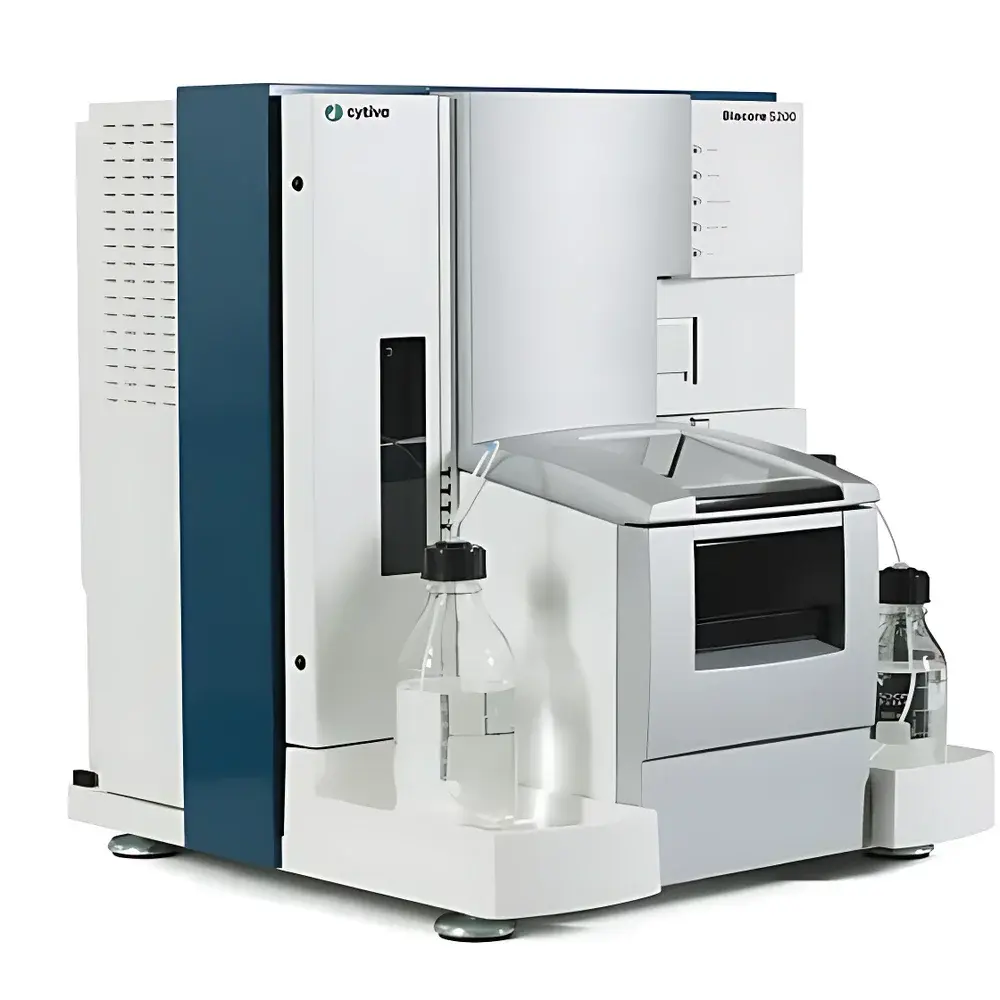
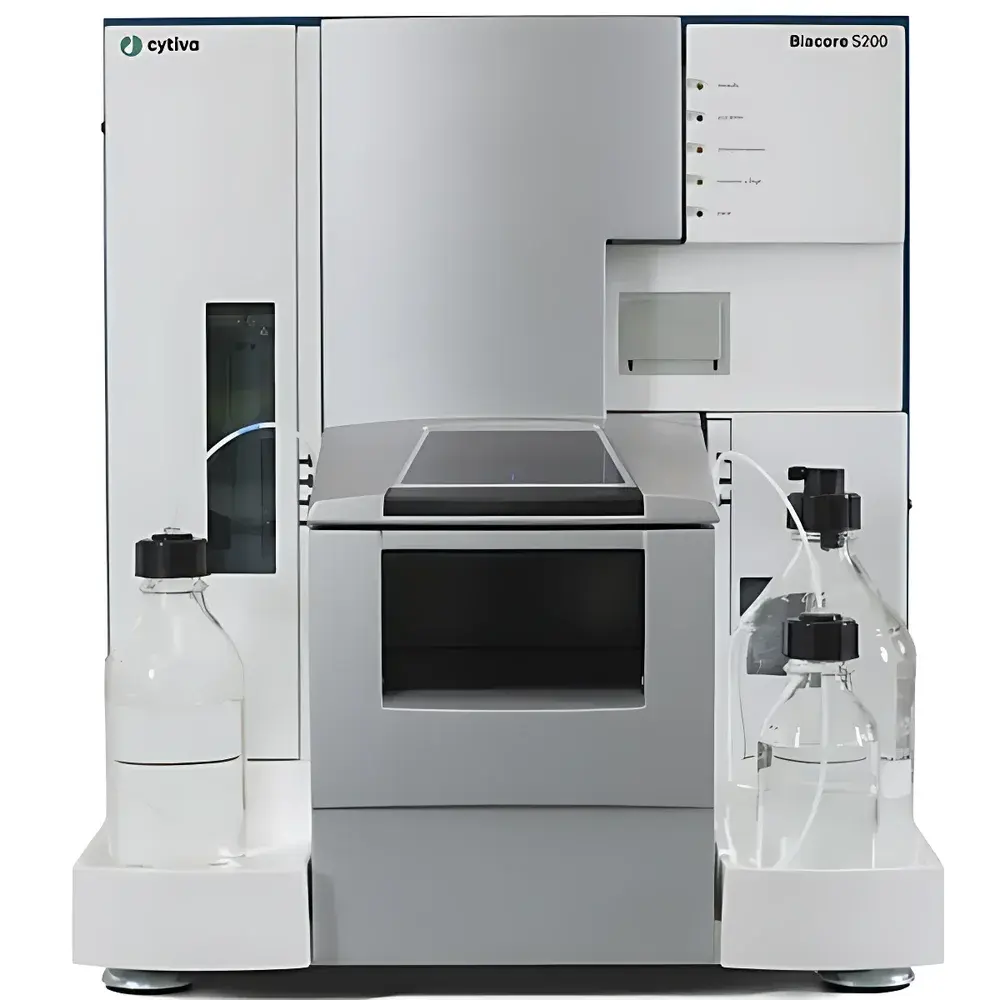
Cytiva Biacore S200 High-Throughput Surface Plasmon Resonance (SPR) System
| Brand | Cytiva |
|---|---|
| Origin | Sweden |
| Model | Biacore S200 |
| Instrument Type | Label-Free Molecular Interaction Analyzer |
| Application Focus | Fragment-Based Drug Discovery (FBDD), Kinetic & Affinity Analysis, Epitope Mapping, Competitive Binding Assays |
| Regulatory Context | Designed for GLP-compliant workflows |
Overview
The Cytiva Biacore S200 is a label-free, surface plasmon resonance (SPR)-based molecular interaction analyzer engineered for high-throughput, quantitative characterization of biomolecular interactions in early-stage drug discovery. Operating on the physical principle of evanescent wave coupling at a gold sensor surface, the system detects real-time changes in refractive index induced by mass accumulation during binding events—enabling direct measurement of association (ka), dissociation (kd), and equilibrium dissociation constants (KD) without fluorescent or radioactive labeling. Its optical architecture delivers sub-pg/mm² mass sensitivity, making it uniquely suited for low-molecular-weight (LMW) fragment screening where signal amplitude is inherently limited. The instrument is optimized for robust performance across diverse target classes—including membrane proteins, kinases, and challenging epitopes—with minimal sample consumption (typically ≤10 µL per injection at nanomolar concentrations). Designed for integration into automated laboratory environments, the Biacore S200 supports unattended operation over extended periods, enabling full 384-well fragment screening campaigns within a single 16-hour run cycle.
Key Features
- Ultra-high SPR sensitivity: Capable of detecting binding responses from fragments as small as 100–300 Da with high signal-to-noise ratio, even under low-immobilization-density conditions.
- High-throughput fragment screening: Executes up to 384 single-concentration binding assays per run using pre-configured microplate-based fluidics and integrated autosampler.
- Comprehensive kinetic profiling: Generates high-fidelity ka, kd, and KD values across wide affinity ranges (pM to mM), validated against orthogonal techniques including ITC and MST.
- Competitive and sandwich assay support: Enables binding-site mapping, epitope binning, and validation of orthosteric vs. allosteric inhibition through customizable competition formats.
- Predictive assay templating: Includes application-specific method templates (e.g., “Fragment Affinity Screen”, “Kinetic Titration”, “Competition Validation”) with pre-optimized flow rates, contact times, regeneration protocols, and data processing algorithms.
- Modular sensor chip compatibility: Supports CM5, SA, NTA, and CAP chips for covalent amine coupling, streptavidin-biotin capture, His-tag immobilization, and antibody orientation—ensuring flexibility across target formats.
Sample Compatibility & Compliance
The Biacore S200 accommodates a broad range of analytes and ligands, including recombinant proteins, peptides, antibodies, nucleic acids, carbohydrates, and synthetic small molecules. It is routinely employed in studies involving GPCRs reconstituted in nanodiscs or liposomes, extracellular domains of multi-pass transmembrane proteins, and low-solubility fragments solubilized in DMSO-containing buffers (with on-line dilution). From a regulatory standpoint, the system’s hardware design and firmware architecture comply with ISO 9001 and IEC 61010-1 safety standards. When operated with Biacore Evaluation Software v5.0 or later and configured with audit trail, electronic signature, and user access control modules, it meets the technical requirements for data integrity under FDA 21 CFR Part 11 and EU Annex 11. All assay methods can be documented in accordance with ICH M10 guidelines for bioanalytical method validation.
Software & Data Management
Biacore Evaluation Software provides an integrated environment for experimental design, real-time monitoring, global fitting, and report generation. It includes built-in quality metrics such as χ² residuals, parameter correlation analysis, and replicate consistency scoring to support data-driven decision-making. Raw sensorgrams are stored in vendor-neutral .txt format alongside metadata-rich .bic files, ensuring long-term archival compliance. The software supports export to CSV, Excel, and XML for downstream integration with LIMS (e.g., LabVantage, STARLIMS) and cheminformatics platforms (e.g., Dotmatics, IDBS E-WorkBook). Optional Biacore Insight add-on enables machine-learning-assisted hit triage and SAR trend visualization across fragment libraries. All software updates are distributed via Cytiva’s secure regulatory support portal, which also hosts Change Control Notifications (CCN)—a web-based subscription service delivering formal documentation of firmware, software, or consumable modifications impacting analytical performance or compliance status.
Applications
- Fragment-based drug discovery (FBDD): Primary screening of >1,000-member fragment libraries using clean-screen and affinity-tiered workflows.
- Lead optimization: Quantitative comparison of analog series to establish structure–kinetics relationships (SKR) beyond static affinity.
- Binding mechanism elucidation: Discrimination between monovalent, bivalent, and avidity-driven interactions via stoichiometric analysis and mass transport correction.
- Thermodynamic profiling: Combined with variable-temperature experiments, enables derivation of ΔH° and ΔS° via van’t Hoff analysis.
- Biosimilar characterization: Comparative assessment of binding kinetics and epitope specificity relative to reference biologics.
- QC release testing: Validated methods for lot-to-lot consistency evaluation of therapeutic proteins and conjugates.
FAQ
What is the minimum analyte concentration required for reliable kinetic analysis on the Biacore S200?
Typical working ranges span 10 nM to 10 µM for fragments and 0.1–100 nM for proteins—dependent on immobilization level, molecular weight, and binding kinetics.
Can the Biacore S200 be integrated with robotic liquid handlers?
Yes—it features standard RS-232 and Ethernet interfaces compatible with third-party automation controllers (e.g., Tecan Fluent, Hamilton VANTAGE) via Cytiva’s Automation Integration Kit.
Is regeneration protocol development supported out-of-the-box?
The software includes a Regeneration Scout wizard that systematically tests pH, ionic strength, and chaotropic agents while monitoring surface stability and activity retention.
How does the system handle DMSO-tolerant screening?
On-chip dilution capability maintains final DMSO concentration below 2% v/v, minimizing nonspecific effects while preserving fragment solubility and target integrity.
What service plans are available for lifecycle management?
Cytiva OptiRun offers tiered support options—from preventive maintenance and calibration to remote diagnostics, application troubleshooting, and dedicated scientist consultation—aligned with ISO/IEC 17025 laboratory accreditation requirements.




