
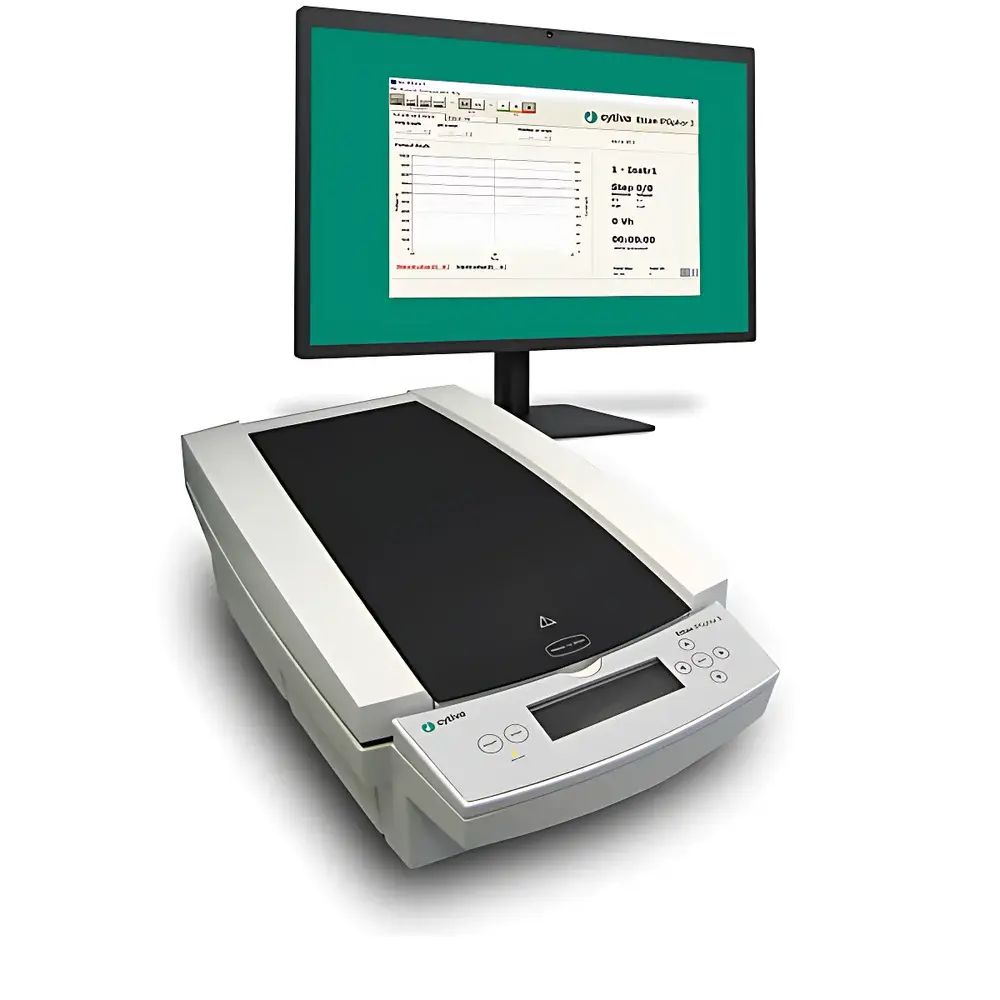
Cytiva Ettan IPGphor 3 Isoelectric Focusing Electrophoresis System
| Brand | Cytiva |
|---|---|
| Origin | Sweden |
| Model | Ettan IPGphor 3 |
| Instrument Type | Isoelectric Focusing (IEF) Electrophoresis System |
| Gel Format Compatibility | IPG strips (7 cm, 11 cm, 13 cm, 18 cm, 24 cm) |
| Sample Capacity | Up to 12 IPG strips per run (with standard manifold) or single IPG strip with Ettan IPGphor Manifold |
| Voltage Range | 0–10,000 V (programmable ramping and stepwise control) |
| Current Limit | 0–100 µA–100 mA (auto-adjusting) |
| Temperature Control Range | 15–30 °C (±0.1 °C stability) |
| Dimensions (W×D×H) | 278 × 160 × 471 mm |
| On-device Method Storage | 10 methods (9 steps each) |
| PC Software Control | Ettan IPGphor 3 Control Software (supports up to 4 instruments simultaneously) |
| Data Logging | Real-time voltage, current, and kV·h monitoring with graphical export |
Overview
The Cytiva Ettan IPGphor 3 Isoelectric Focusing Electrophoresis System is a fully integrated, microprocessor-controlled instrument engineered for high-resolution, reproducible isoelectric focusing (IEF) of proteins in immobilized pH gradient (IPG) strips. Based on the principle of electrophoretic separation under an established pH gradient, the system applies precisely regulated electric fields across IPG strips to migrate amphoteric molecules—primarily proteins—to their isoelectric points (pI), where net charge equals zero and migration ceases. Designed for both routine and advanced proteomics workflows, the Ettan IPGphor 3 delivers enhanced thermal stability, programmable voltage ramping, and real-time electrical parameter monitoring—critical for achieving consistent first-dimension resolution in two-dimensional gel electrophoresis (2-DE) and fluorescence-based differential gel electrophoresis (2-D DIGE). Its solid-state semiconductor temperature regulation ensures minimal thermal drift during extended IEF runs (up to 24 h), directly supporting the integrity of light-sensitive samples such as CyDye™-labeled proteins.
Key Features
- Integrated solid-state temperature control (15–30 °C, ±0.1 °C stability) optimized for sensitive fluorescent labeling protocols and long-duration IEF runs
- Programmable voltage, current, and time parameters with multi-step ramping profiles—including voltage stepping, linear ramping, and constant voltage phases
- Dual operation modes: standalone use via intuitive front-panel interface with 4-line digital display, or networked PC control via Ettan IPGphor 3 Control Software
- On-instrument method storage for up to 10 user-defined protocols (each supporting up to 9 discrete steps), enabling rapid recall and in-situ editing
- Real-time monitoring and graphical logging of voltage (V), current (mA), and accumulated kV·h—exportable as CSV or XML for downstream analysis and audit compliance
- Scalable deployment: one PC workstation can concurrently manage up to four Ettan IPGphor 3 units, each executing independent IEF programs
- Enhanced safety architecture including over-current protection, arc detection, and hardware-enforced voltage interlocks compliant with IEC 61010-1
Sample Compatibility & Compliance
The Ettan IPGphor 3 accommodates all commercially available IPG strips from Cytiva (formerly GE Healthcare), including 7 cm, 11 cm, 13 cm, 18 cm, and 24 cm formats. It supports both standard 1–12-strip configurations using the Ettan IPGphor Strip Holder and single-strip focusing with the Ettan IPGphor Manifold—ideal for low-abundance or precious samples. The system is validated for use with CyDye™ DIGE fluors, Alexa Fluor® dyes, and other photo-labile reagents, owing to its minimized UV exposure design and thermally stable chamber. From a regulatory perspective, the instrument’s data logging, method versioning, and electronic signature support align with GLP and GMP documentation requirements. While not inherently 21 CFR Part 11–compliant out-of-the-box, the Ettan IPGphor 3 Control Software may be deployed within validated IT environments meeting FDA and EMA expectations for electronic records in preclinical proteomics studies.
Software & Data Management
The Ettan IPGphor 3 Control Software (Windows-based) serves as the central hub for protocol development, instrument orchestration, and data traceability. Users can create, store, and organize unlimited IEF methods—including pre-configured settings matched to specific IPG strip pI ranges and lengths. Each method retains full metadata: operator ID, date/time stamp, environmental conditions, and real-time electrical logs. Export functions generate standardized reports compatible with LIMS integration and statistical analysis platforms (e.g., R, Python pandas). Audit trails record all method modifications, instrument start/stop events, and user logins—supporting ISO/IEC 17025 and ISO 9001 quality system documentation. All logged data are stored in non-proprietary formats (CSV, XML), ensuring long-term accessibility without vendor lock-in.
Applications
- First-dimension separation in 2-DE workflows for global proteome profiling, biomarker discovery, and post-translational modification analysis
- High-reproducibility sample preparation for 2-D DIGE experiments requiring precise pI alignment across multiple gels
- Optimization of IEF conditions for challenging samples (e.g., membrane proteins, basic proteins, or low-input clinical specimens)
- Method transfer and validation studies in academic core facilities and contract research organizations (CROs)
- Quality control of recombinant protein preparations, where pI heterogeneity reflects glycosylation or deamidation variants
FAQ
What IPG strip lengths does the Ettan IPGphor 3 support?
The system supports 7 cm, 11 cm, 13 cm, 18 cm, and 24 cm IPG strips via interchangeable holders and manifolds.
Can the instrument operate without a connected computer?
Yes—the front-panel interface allows full standalone operation, including method selection, parameter adjustment, and run initiation.
Is temperature calibration traceable to national standards?
The semiconductor sensor is factory-calibrated; users may perform verification using NIST-traceable thermistors per internal SOPs.
How is data integrity ensured during power interruption?
The system writes logs continuously to non-volatile memory and resumes from last valid state upon reboot—no data loss occurs during brief outages.
Does the software support automated report generation for regulatory submissions?
While the software exports raw and summary data in open formats, final report formatting must be performed externally using validated templates per organizational QA requirements.




