
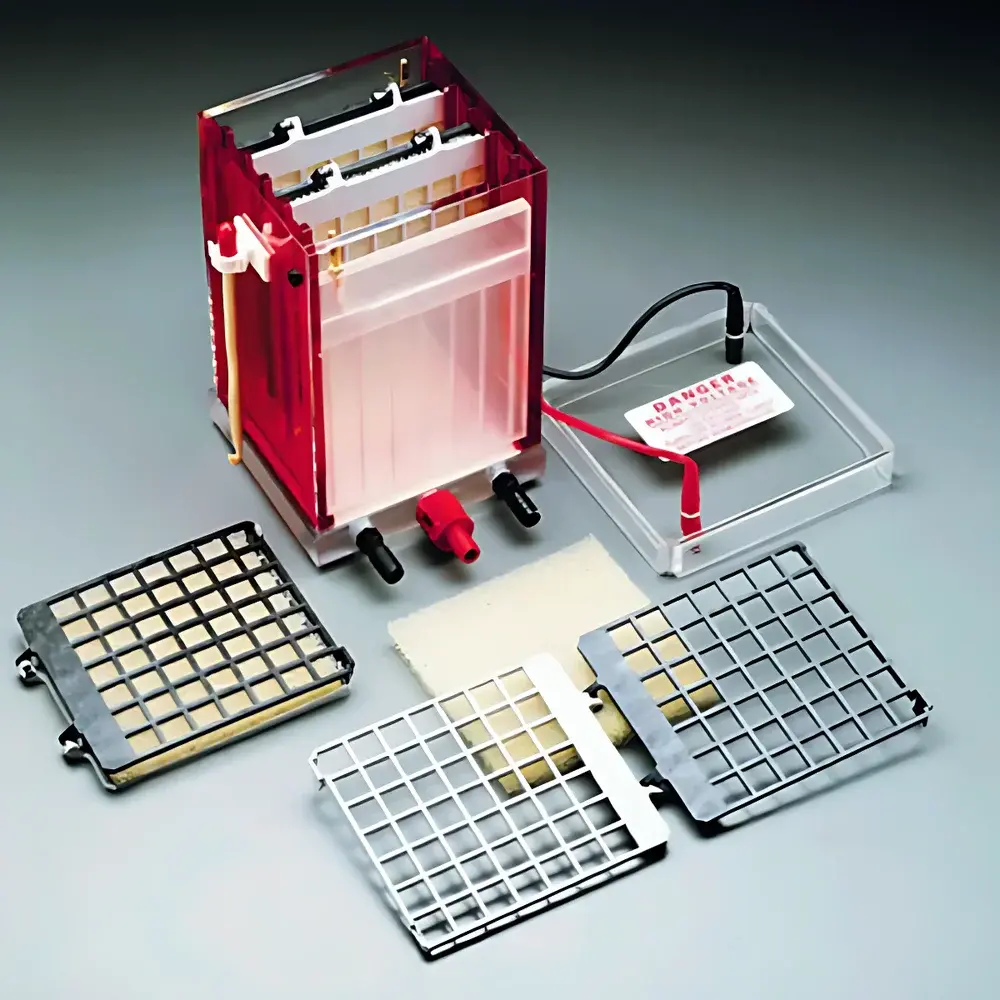
Cytiva TE22 Mini Wet Transfer Unit
| Brand | Cytiva |
|---|---|
| Origin | Sweden |
| Model | TE22 |
| Instrument Type | Wet Protein Electrophoretic Transfer System |
| Gel Capacity | Up to 4 × 9 cm × 10 cm gels per run |
| Cooling System | Integrated aluminum heat exchanger with recirculating buffer cooling |
| Temperature Rise | ≤5°C during standard transfer |
| Buffer Volume Requirement | 1 L per full-load run (4 gels) |
| Cassette Design | Open-mesh gel clamp for uniform pressure, gel/membrane alignment, and prevention of gel wrinkling or drying |
| Compliance | Designed for compatibility with standard SDS-PAGE and Western blotting workflows per ISO/IEC 17025-aligned laboratory practices |
Overview
The Cytiva TE22 Mini Wet Transfer Unit is an engineered solution for efficient, reproducible, and temperature-controlled electrophoretic transfer of proteins from polyacrylamide or agarose gels to solid supports—including nitrocellulose, PVDF, and nylon membranes. Based on the principle of constant-voltage or constant-current electrophoretic migration in a buffered aqueous environment, the TE22 operates under fully submerged (wet) conditions—ensuring optimal protein integrity, high transfer efficiency (>95% for proteins <100 kDa), and minimal thermal denaturation. Its compact footprint (220 × 180 × 160 mm) and modular cassette architecture make it especially suitable for core facilities, teaching laboratories, and resource-constrained research environments where space, reagent economy, and operational consistency are critical.
Key Features
- Simultaneous transfer of up to four 9 cm × 10 cm gels in a single run—enabling parallel processing without cross-contamination or positional bias.
- Integrated aluminum heat exchanger coupled with a low-flow recirculating buffer system maintains thermal stability; measured temperature rise remains ≤5°C over 60-minute transfers at standard operating voltages (typically 25–30 V DC).
- Open-mesh stainless-steel cassette design ensures uniform electrode contact, consistent clamping pressure across the entire gel–membrane stack, and elimination of air pockets—reducing edge artifacts and preventing gel dehydration or wrinkling.
- Optimized fluid dynamics require only 1 L of transfer buffer per full-capacity run—significantly reducing consumption of methanol, SDS, Tris–glycine, or CAPS-based buffers compared to conventional tank systems.
- Chemically resistant housing (ABS + polycarbonate) and corrosion-resistant electrodes support long-term use with common transfer buffers, including high-methanol and low-pH formulations.
- No external pump or chiller required—buffer recirculation and thermal management are self-contained within the unit’s sealed loop.
Sample Compatibility & Compliance
The TE22 accommodates standard slab gels cast in mini-format glass plates (e.g., Cytiva Hoefer SE260, Bio-Rad Mini-PROTEAN), as well as hand-cast gels up to 10 cm wide and 9 cm tall. It supports both standard and low-fluorescence membranes and is validated for downstream applications including chemiluminescent, fluorescent, and colorimetric detection. The system complies with general laboratory safety standards (IEC 61010-1) and is designed to meet documentation requirements for GLP-compliant Western blotting workflows. While the TE22 itself does not generate electronic records, its operation is compatible with lab-wide SOPs aligned with ISO/IEC 17025 and FDA 21 CFR Part 11 when integrated into traceable experimental protocols.
Software & Data Management
The TE22 is a hardware-only, manually operated instrument with no embedded microprocessor or digital interface. All operational parameters—including voltage, current, time, and buffer composition—are set externally via compatible power supplies (e.g., Cytiva EPS 601, Bio-Rad PowerPac Basic). Users maintain full procedural control and documentation through lab notebooks or LIMS-integrated electronic protocols. This analog architecture eliminates firmware validation burdens and ensures long-term interoperability with legacy and next-generation detection platforms.
Applications
- Routine Western blotting for target protein validation in cell lysates, tissue homogenates, and purified fractions.
- High-throughput screening of antibody specificity across multiple gel lanes or replicates.
- Teaching laboratory instruction in protein biochemistry—demonstrating electrophoretic mobility, transfer kinetics, and membrane binding principles.
- Preparative transfer for mass spectrometry sample recovery from excised membrane regions.
- Method development for challenging targets (e.g., high-MW proteins, hydrophobic membrane proteins) using optimized buffer systems and timed transfer protocols.
FAQ
What power supply is recommended for the TE22?
A programmable DC power supply capable of delivering 0–100 V and 0–1 A is recommended; typical transfer conditions use 25–30 V constant voltage for 60 minutes.
Can the TE22 be used for DNA/RNA transfer?
While primarily optimized for protein transfer, the unit supports nucleic acid transfer (e.g., Southern/Northern blotting) when paired with appropriate alkaline or capillary-compatible buffers and positively charged membranes.
Is the cassette reusable?
Yes—the stainless-steel open-mesh cassette and acrylic frame are autoclavable and chemically inert, supporting repeated use over thousands of runs with proper cleaning between applications.
Does the TE22 require calibration?
No routine calibration is specified; performance verification is conducted via control protein transfer efficiency assays (e.g., Ponceau S staining, prestained ladder tracking) as part of user-established QC procedures.
How should I clean the unit after use?
Rinse all wetted parts—including the cassette, buffer chamber, and heat exchanger channels—with deionized water, followed by 70% ethanol; air-dry vertically to prevent residual condensation.
Related Products




