
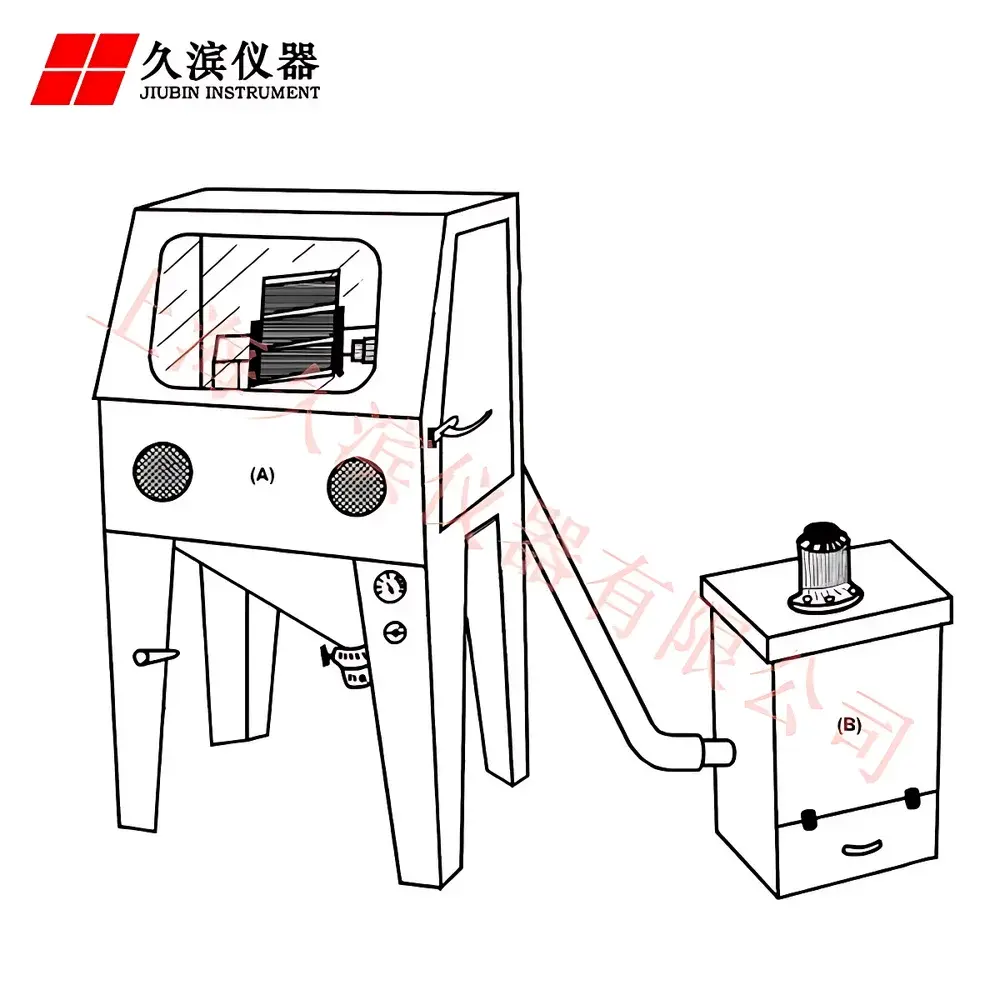
D14 1428 Shot Blasting Tester (JB-PSA14)
| Brand | Jiubin Instruments |
|---|---|
| Origin | Shanghai, China |
| Manufacturer Type | Authorized Distributor |
| Country of Origin | China |
| Model | JB-PSA14 |
| Quotation | Available Upon Request |
| Chamber Internal Dimensions | 710 × 540 × 600 mm (W×D×H) |
| Specimen Size | 120 × 200 mm (custom sizes available) |
| Air Pressure Range | 0–0.8 MPa (adjustable) |
| Nozzle Bore Diameter | 10.0 ± 0.1 mm |
| Air Orifice Diameter | 4 mm |
| Nozzle Assembly Length (incl. diffuser tube) | 111 mm |
| Distance from Nozzle Tip to Top Cover | 115 mm |
| Specimen Mounting Angle | 30° (flat-panel configuration) |
| Dust Extraction Fan | 370 W, 220 V, 50 Hz |
| Dust Collection Bin | 1 unit |
| Spray Gun | 1 unit |
| Observation Window | 1 unit |
Overview
The D14 1428 Shot Blasting Tester (model JB-PSA14), engineered by Jiubin Instruments, is a standardized laboratory-scale impact resistance evaluation system designed for quantitative assessment of stone-chip resistance in protective coatings, polymer substrates, and elastomeric materials. It operates on the principle of controlled pneumatic propulsion of calibrated abrasive particles—typically angular steel grit or conditioned silica—against a test specimen mounted at a fixed 30° incidence angle. This geometry replicates real-world road-debris impact dynamics observed in automotive underbody, wheel arch, and chassis component applications. The system conforms conceptually to the functional requirements of ASTM D3170 / D3170M (Standard Test Method for Chipping Resistance of Coatings), ISO 20567-1 (Paints and varnishes — Determination of stone-chip resistance — Part 1: Multi-impact test), and SAE J400 (Measuring Abrasion Resistance of Automotive Coatings). Unlike high-energy mechanical impact testers, this device delivers repeatable, low-velocity particle impact energy profiles ideal for evaluating cohesive/adhesive failure thresholds, delamination onset, and localized coating erosion under cumulative exposure.
Key Features
- Robust welded steel chamber (710 × 540 × 600 mm internal volume) with reinforced viewing window for real-time observation and post-test inspection
- Precision-machined nozzle assembly featuring a 10.0 ± 0.1 mm bore diameter and integrated 111 mm diffuser tube to ensure consistent particle dispersion pattern and impact velocity profile
- Adjustable regulated air supply (0–0.8 MPa) enabling precise control over kinetic energy input—critical for method transferability across material classes
- Dedicated 370 W dust extraction system with single-bin collection ensures operator safety and maintains chamber cleanliness between cycles, minimizing cross-contamination risk
- Modular specimen holder accommodates standard 120 × 200 mm panels at 30° tilt; custom fixtures support non-standard geometries including curved automotive trim parts and injection-molded housings
- Integrated air orifice (4 mm diameter) upstream of the nozzle enables stable airflow conditioning, reducing turbulence-induced variability in particle trajectory
Sample Compatibility & Compliance
The JB-PSA14 supports testing of coated metallic substrates (e.g., cold-rolled steel, aluminum alloys), thermoplastic and thermoset polymers (PP, ABS, PC/ABS blends), vulcanized rubber compounds, and multi-layer anti-chip systems such as PVC-based undercoatings and polyurethane spray-on liners. Specimens are affixed using non-reactive clamping mechanisms to prevent edge deformation or stress concentration. The instrument satisfies foundational prerequisites for GLP-compliant laboratories conducting coating qualification per OEM specifications (e.g., Ford WSS-M2P177-B, GMW14872, VW TL-226). While not certified to ISO/IEC 17025 out-of-the-box, its mechanical repeatability and traceable pressure regulation allow integration into validated test protocols requiring documented uncertainty budgets.
Software & Data Management
The JB-PSA14 operates as a manually controlled benchtop system without embedded microprocessor or digital interface. All operational parameters—including pressure setpoint, exposure duration, and environmental conditions—are recorded externally via laboratory notebooks or LIMS-integrated electronic worksheets. Users are advised to implement standardized reporting templates aligned with ASTM D3170 Annex A1 (quantitative rating scale) or ISO 20567-1 grading criteria (e.g., chip density per cm², maximum crater diameter, area of substrate exposure). For audit readiness, raw test images, weight loss measurements (pre-/post-test gravimetry), and adhesion pull-off data should be archived alongside pressure calibration certificates and nozzle wear logs.
Applications
- Qualification of anti-stone-chip coatings for automotive OEM and Tier-1 suppliers
- Formulation development and batch-to-batch consistency verification of PVC plastisols and reactive polyurethane systems
- Comparative evaluation of surface hardening treatments on engineering plastics used in exterior vehicle modules
- Failure mode analysis of coating-substrate interfaces following thermal cycling or humidity exposure preconditioning
- Supporting technical documentation for PPAP submissions requiring empirical chip-resistance evidence
FAQ
What types of abrasive media are compatible with the JB-PSA14?
Standardized steel grit (G18–G25 per SAE J827) or conditioned silica sand (ISO 11126-6, grain size 0.3–0.6 mm) are recommended. Media must be dried and sieved prior to use to ensure flow consistency.
Is the 30° test angle adjustable?
No—the fixture is mechanically fixed at 30° to maintain compliance with ISO 20567-1 and SAE J400. Custom-angle adapters are not supplied but may be fabricated per client specification.
Does the system include pressure calibration documentation?
The unit ships with a factory-set analog pressure gauge. Users must perform periodic verification using a NIST-traceable deadweight tester or calibrated digital manometer per internal QA schedule.
Can the JB-PSA14 be integrated into an automated test cell?
Not natively. It lacks electrical I/O ports or communication protocols (e.g., RS-232, Ethernet/IP). Retrofitting requires third-party pneumatic control modules and safety interlock redesign.
What maintenance intervals are recommended for the nozzle assembly?
Inspect for bore wear after every 50 test cycles; replace if diameter exceeds 10.15 mm or exhibits asymmetric erosion. Clean diffuser tube weekly with compressed air and isopropyl alcohol.



