
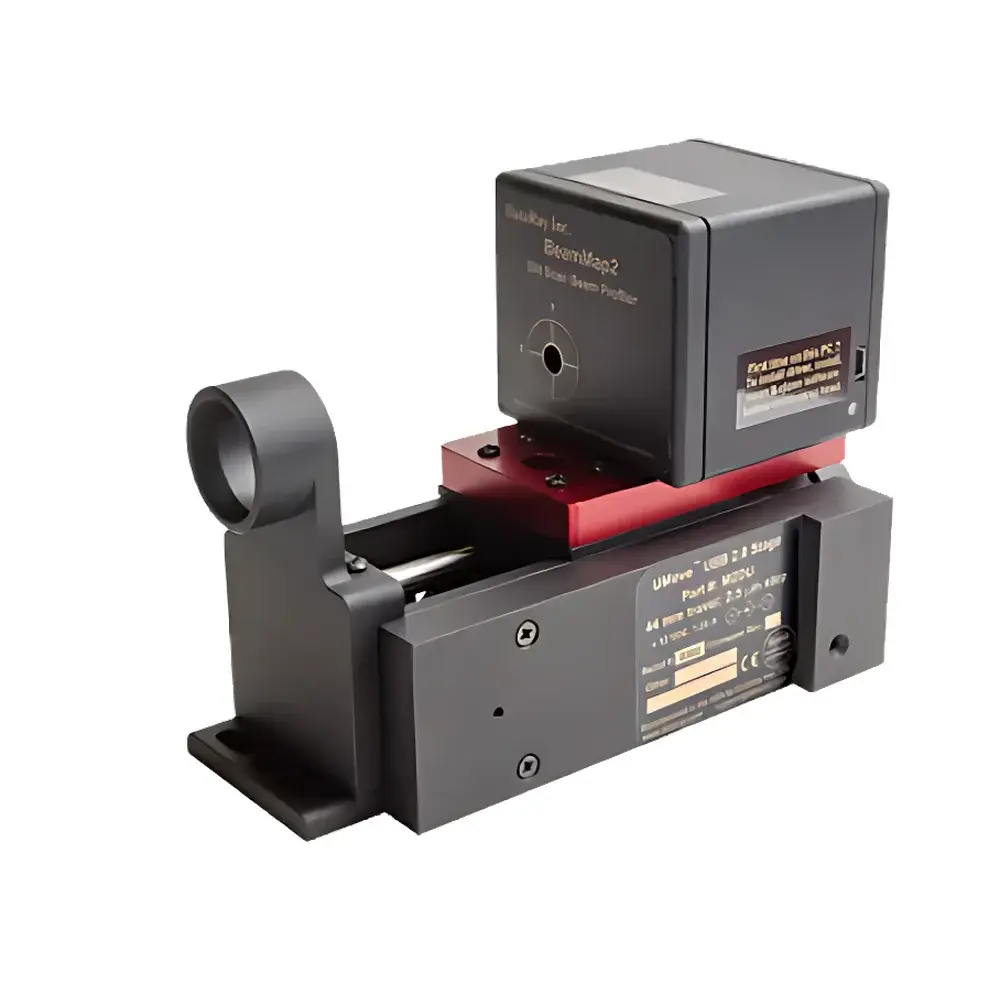
DataRay M² Measurement System
| Brand | DataRay |
|---|---|
| Origin | USA |
| Model | M2DU-WCD, M2DU-BR, WinCamD M² Stage |
| Wavelength Range | 190 nm – 16 µm |
| Translation Stage Travel | 50 mm or 200 mm |
| M² Measurement Range | 1–50 |
| M² Accuracy | ±5% |
| M² Repeatability | ±2% |
| Beam Profiling Method | CCD-based 2D/3D intensity mapping (M2DU-WCD), slit-scanning (M2DU-BR) |
| Compatible Laser Types | CW and pulsed lasers, including diode, solid-state, fiber, and ultrafast sources |
Overview
The DataRay M² Measurement System is a fully automated, ISO 11146-compliant instrument engineered for precise quantification of laser beam quality parameters. It implements the standardized knife-edge or scanning-slit (M2DU-BR) and camera-based (M2DU-WCD, WinCamD M² Stage) methodologies to determine the beam propagation ratio (M²), beam waist diameter and position, divergence angle, Rayleigh length, and confocal parameter. Designed in accordance with ISO 11146-1:2021 (Lasers and laser-related equipment — Test methods for laser beam widths, divergence angles and beam propagation ratios), the system delivers traceable, repeatable measurements across ultraviolet (190 nm), visible, near-infrared, and mid-infrared spectra (up to 16 µm). Its modular architecture enables seamless integration with DataRay’s WinCamD series beam profilers and Beam’R2 slit scanners, supporting both collimated and focused beam characterization under laboratory, production, and field-deployable conditions.
Key Features
- Fully automated measurement sequence compliant with ISO 11146—completed in under 120 seconds per acquisition
- Modular platform supporting interchangeable beam profiling sensors: high-resolution CCD/CMOS cameras (WinCamD series) for 2D/3D intensity mapping, or motorized slit-scanning detectors (Beam’R2) for high-dynamic-range applications
- Motorized precision translation stage with selectable travel lengths (50 mm or 200 mm), calibrated linear encoder feedback, and sub-micron positioning repeatability
- Wide spectral coverage from 190 nm to 16 µm—achieved via interchangeable sensor heads with appropriate coatings and window materials (e.g., fused silica, CaF₂, ZnSe)
- Real-time beam diagnostics including centroid tracking, ellipticity analysis, kurtosis (M⁴), and peak-to-background ratio calculation
- Support for both continuous-wave (CW) and pulsed lasers—including nanosecond, picosecond, and femtosecond sources—with adjustable integration gating and external trigger synchronization
Sample Compatibility & Compliance
The system accommodates free-space beams up to Ø25 mm (with optional beam expanders) and is compatible with industrial-grade laser sources used in semiconductor manufacturing, medical laser systems (e.g., ophthalmic and dermatological platforms), LIDAR development, optical communications, and additive manufacturing. All firmware and calibration data are stored onboard with NIST-traceable reference files. The hardware and software architecture meet requirements for GLP-compliant environments, including audit trail logging, user access control, and electronic signature support (aligned with FDA 21 CFR Part 11 when operated with validated software configurations). Mechanical design complies with IEC 61000-6-2 (EMC immunity) and IEC 61000-6-3 (EMC emissions) standards.
Software & Data Management
DataRay’s proprietary WinCamD-UCD software provides full control over measurement workflows, real-time visualization, and export of ISO-compliant reports. Raw beam profiles and derived M² datasets are saved in HDF5 format, ensuring long-term archival integrity and interoperability with MATLAB, Python (via h5py), and LabVIEW. The software supports batch processing of multiple acquisitions, statistical trending over time, and comparative analysis between reference and test lasers. Calibration certificates include uncertainty budgets calculated per ISO/IEC 17025 guidelines. Optional SDKs enable integration into custom QC dashboards or factory automation systems (SECS/GEM, OPC UA).
Applications
- Laser source qualification and acceptance testing in OEM manufacturing lines
- Process validation for laser welding, cutting, and surface treatment systems
- Beam delivery system alignment and optimization in medical laser consoles (e.g., excimer, Nd:YAG, Er:YAG)
- R&D of ultrafast amplifiers and frequency-conversion setups requiring M² stability monitoring
- Characterization of VCSEL arrays and multimode fiber-coupled emitters for LiDAR and 3D sensing
- Calibration reference for national metrology institutes and accredited test labs
FAQ
What standards does the DataRay M² system comply with?
It conforms to ISO 11146-1:2021 and ISO 11146-2:2021 for beam width, divergence, and M² determination, and supports traceable calibration per ISO/IEC 17025 requirements.
Can the system measure ultrafast pulsed lasers?
Yes—when configured with gated detection and external trigger synchronization, it supports pulse durations down to <100 fs and repetition rates up to 10 MHz.
Is the software compliant with FDA 21 CFR Part 11?
The WinCamD-UCD software includes optional 21 CFR Part 11 modules for electronic records and signatures, validated upon customer request.
How is M² repeatability achieved at ±2%?
Through thermally stabilized optics, vibration-isolated stage mechanics, real-time centroid correction algorithms, and multi-point beam fitting using Levenberg-Marquardt nonlinear regression.
Can the beam profiler be used independently of the M² stage?
Yes—the WinCamD and Beam’R2 sensors are fully functional as standalone beam analysis tools with identical software interface and export capabilities.





