
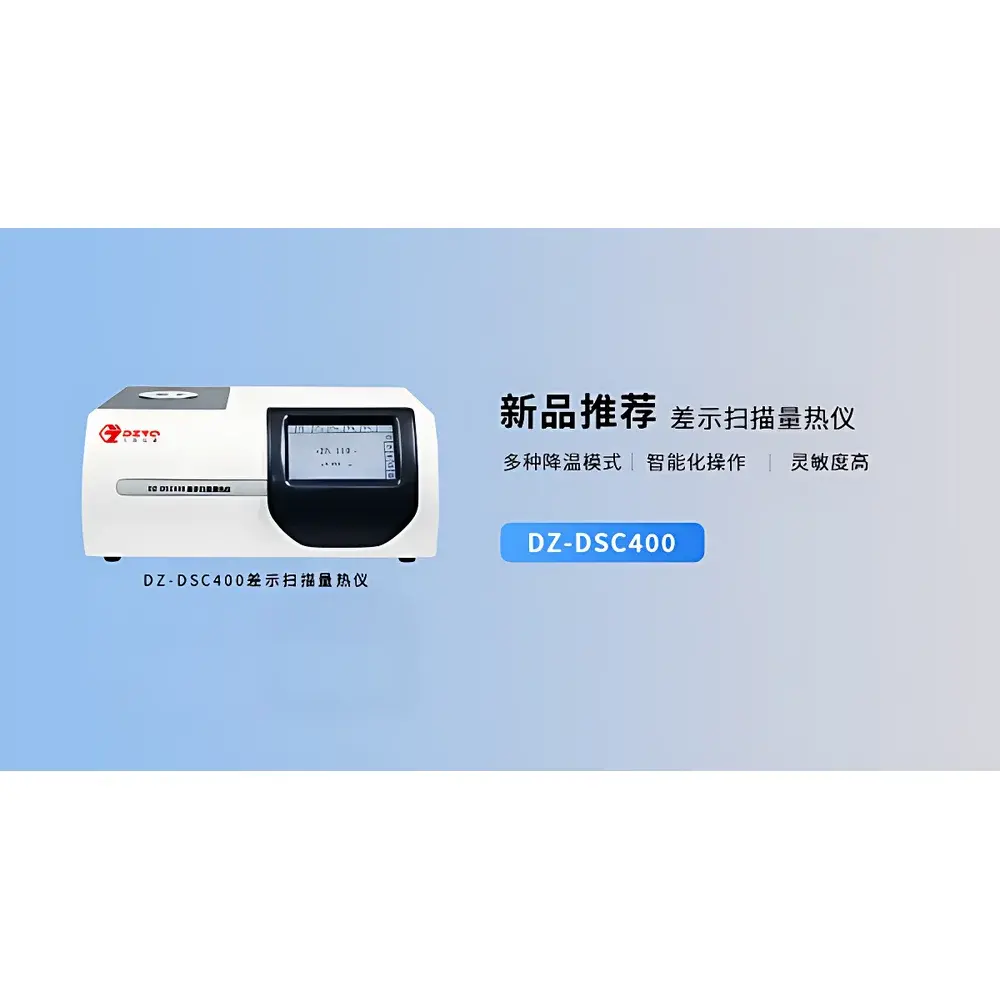
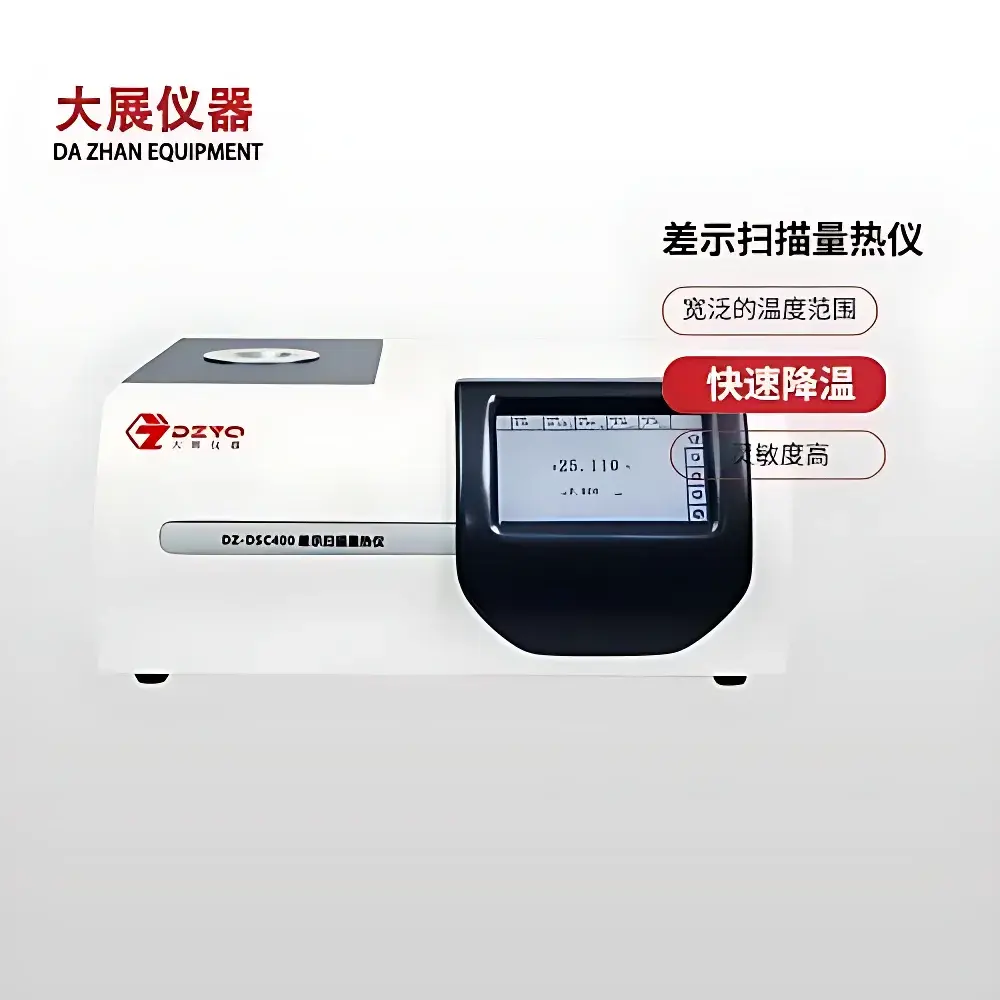
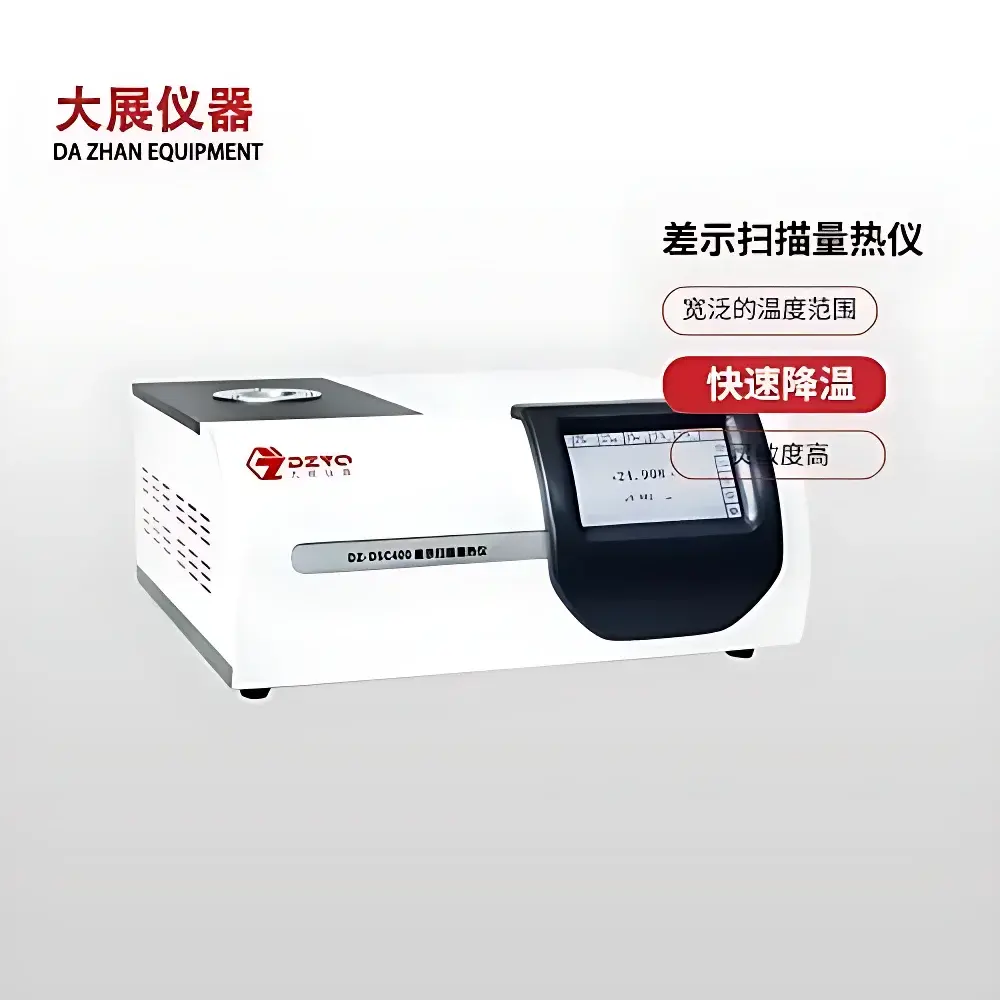
DAZHAN DZ-DSC400 Advanced Thermal Flow-Type Differential Scanning Calorimeter
| Brand | DAZHAN |
|---|---|
| Origin | Jiangsu, China |
| Model | DZ-DSC400 |
| Instrument Type | Heat-Flux DSC |
| Temperature Range | Ambient to 600 °C |
| Temperature Accuracy | ±0.001 °C |
| Heating/Cooling Rate | 0.1–100 °C/min (heating), −0.1–20 °C/min (cooling, air-cooled variant) |
| DSC Sensitivity | 0.0001 mW |
| Temperature Resolution | 0.001 °C |
| Atmosphere Control | Dual mass-flow-controlled gas channels + auxiliary purge line |
| Cooling Options | Air cooling, Peltier, mechanical refrigeration, or liquid nitrogen (model-dependent) |
| Software | Integrated GLP-compliant data acquisition and analysis suite with audit trail capability |
Overview
The DAZHAN DZ-DSC400 is a high-performance heat-flux differential scanning calorimeter engineered for precision thermal characterization of solid and semi-crystalline materials across academic, industrial, and quality control laboratories. Based on the fundamental principle of measuring differential heat flow between a sample and inert reference under controlled temperature programs, the DZ-DSC400 delivers quantitative thermodynamic data—including glass transition temperature (Tg), melting point (Tm), crystallization onset (Tc), enthalpy changes (ΔH), oxidative induction time (OIT), and curing kinetics—under reproducible, traceable conditions. Its modular furnace architecture employs indirect conductive heating to minimize thermal gradients and electromagnetic interference, resulting in exceptional baseline stability and long-term signal fidelity. The system operates within a standard temperature range of ambient to 600 °C, with optional low-temperature variants extending down to −170 °C using cryogenic cooling.
Key Features
- Optimized heat-flux sensor design with corrosion-resistant, EMI-shielded construction for extended service life and sub-microwatt sensitivity (0.0001 mW)
- Intelligent PID temperature control incorporating dynamic-static hybrid algorithms, auto-tuning, and memory-based profile optimization for ±0.001 °C accuracy
- Multi-mode cooling architecture: selectable air cooling, Peltier, mechanical refrigeration, or liquid nitrogen integration—enabling programmable cooling rates up to 80 °C/min in low-temperature configurations
- Dual independent mass flow controllers (MFCs) with fast-switching valve manifold for precise, repeatable atmosphere switching (e.g., N2/O2) and simultaneous inert purge gas delivery
- Modular furnace geometry with improved thermal uniformity and reduced radiative pulsation versus conventional resistive coil designs
- Comprehensive hardware diagnostics and real-time thermal drift compensation embedded in firmware
Sample Compatibility & Compliance
The DZ-DSC400 accommodates standard aluminum, gold, platinum, and hermetic high-pressure crucibles (up to 10 MPa), supporting solids, powders, films, fibers, and viscous pastes in single-sample configuration. All operational parameters—including temperature ramp rate, hold duration, gas flow setpoints, and calibration history—are logged with timestamped metadata to support GLP and GMP compliance. The instrument’s software architecture conforms to FDA 21 CFR Part 11 requirements for electronic records and signatures, including role-based access control, full audit trail, and non-erasable raw data archiving. Calibration protocols align with ISO 11357-1 and ASTM E794 for melting point verification and ASTM E1269 for heat capacity determination.
Software & Data Management
The proprietary DZ-ThermalSuite™ software provides integrated instrument control, real-time visualization, and post-run analysis in a single interface. It supports multi-step temperature programs (ramp/hold/iso-rate), automatic peak detection with customizable baseline fitting (tangent, linear, sigmoidal), and quantitative calculation of Tg (midpoint/onset), ΔH (via area integration), OIT (ASTM D3895), and kinetic parameters (Ozawa-Flynn-Wall, Kissinger). Raw data files are stored in vendor-neutral HDF5 format with embedded metadata, enabling interoperability with third-party tools such as OriginLab, MATLAB, or Python-based analysis pipelines. Data export options include CSV, PDF reports with configurable templates, and XML for LIMS integration.
Applications
- Thermoplastic and thermoset polymer characterization: Tg, cold crystallization, melt enthalpy, crosslink density estimation
- Pharmaceutical solid-state analysis: polymorph screening, amorphous content quantification, excipient compatibility assessment
- Metallurgy and alloy development: solidus/liquidus determination, phase transformation mapping, aging behavior evaluation
- Food science: starch gelatinization, fat crystallization, moisture migration kinetics
- Electrochemical materials: thermal stability of battery cathodes/anodes, SEI layer formation enthalpy
- Quality assurance: batch-to-batch consistency testing, shelf-life prediction via accelerated aging studies
FAQ
What temperature calibration standards are supported?
Certified indium, tin, zinc, and lead standards are recommended per ISO 11357-1; calibration certificates traceable to NIST or equivalent national metrology institutes are available upon request.
Is remote monitoring and control possible?
Yes—DZ-ThermalSuite™ supports secure LAN/WAN connectivity with TLS-encrypted communication, enabling supervised operation from offsite locations while maintaining audit trail integrity.
Can the DZ-DSC400 be integrated into automated lab workflows?
The instrument features RS-232, USB, and Ethernet interfaces with SCPI-compatible command set and optional OPC UA server module for seamless integration into MES or LIMS platforms.
What maintenance intervals are recommended?
Sensor and furnace calibration verification every 6 months; MFC recalibration annually; crucible cleaning after each run with volatile organics; full system performance qualification (SPQ) recommended biannually per ISO/IEC 17025 guidelines.
Does the system comply with ICH Q5C stability testing requirements?
Yes—the DZ-DSC400 meets ICH Q5C thermal stability assessment criteria when operated within validated temperature and atmosphere protocols, with documented uncertainty budgets for all reported values.



