
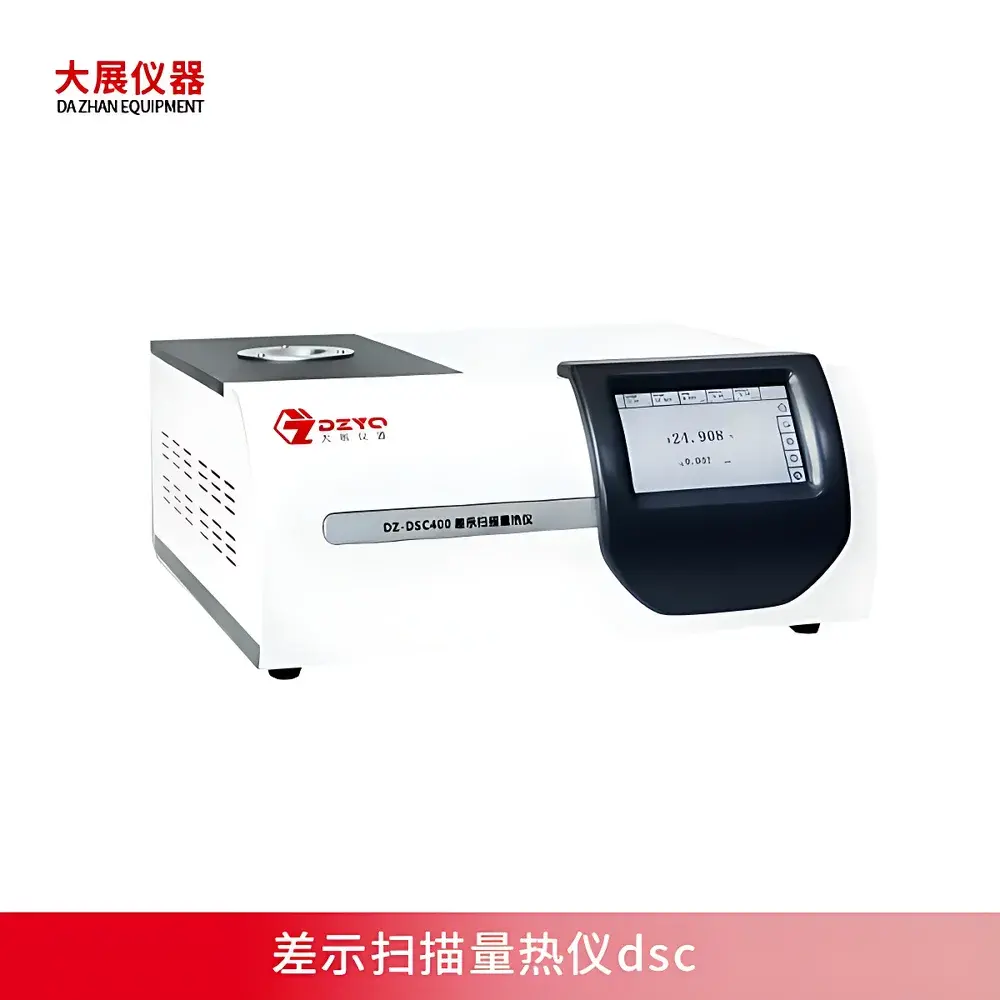
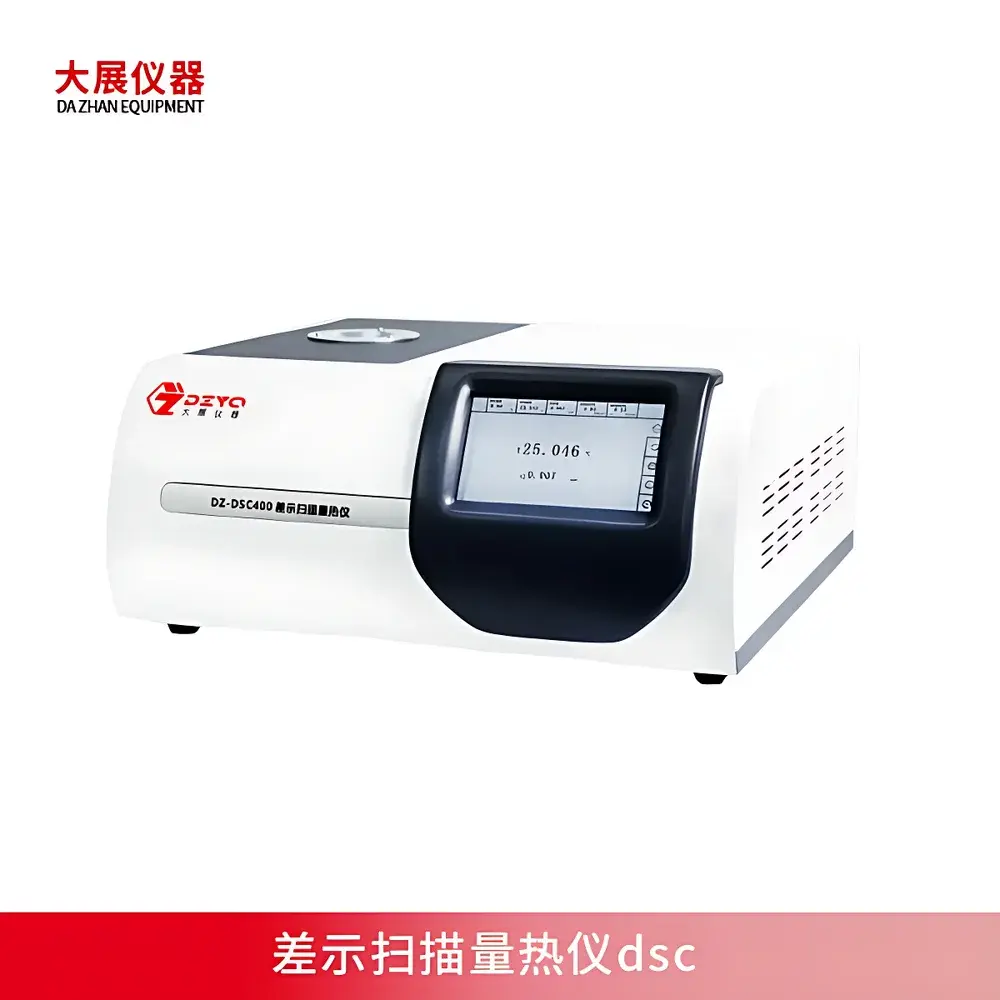
DAZHAN DZ-DSC400 Differential Scanning Calorimeter with Multi-Mode Cooling and Intelligent PID Temperature Control
| Brand | DAZHAN |
|---|---|
| Origin | Jiangsu, China |
| Manufacturer Type | Authorized Distributor |
| Country of Origin | China |
| Model | DZ-DSC400 |
| Sample Capacity | Single |
| Instrument Type | Differential Scanning Calorimeter (DSC) |
| Temperature Range | Ambient to 600 °C |
| Programmable Temperature Control | Intelligent PID Algorithm |
| Temperature Accuracy | ±0.001 °C |
| Heating/Cooling Rate | 0.1–100 K/min (heating), –0.1 to –20 K/min (cooling) |
| Temperature Precision | ±0.001 °C |
| DSC Signal Range | ±1000 mW |
| Temperature Stability | ±0.1 °C |
| DSC Sensitivity | 0.0001 mW |
| Temperature Resolution | 0.001 °C |
| Cooling Options | Forced-air, Peltier, Mechanical Refrigeration, Liquid Nitrogen |
| Atmosphere Control | Dual independent mass-flow-controlled gas channels + dedicated purge gas inlet |
| Sensor Type | Corrosion-resistant, EMI-shielded thermocouple array |
Overview
The DAZHAN DZ-DSC400 is a high-performance differential scanning calorimeter engineered for precise thermal characterization of solid and semi-crystalline materials across research, quality control, and regulatory environments. It operates on the principle of heat-flux DSC, measuring the difference in heat flow between a sample and an inert reference as both are subjected to identical, precisely controlled temperature programs. This enables quantitative determination of endothermic and exothermic transitions—including glass transition (Tg), melting point (Tm), crystallization onset (Tc), enthalpy changes (ΔH), oxidative induction time (OIT), and cure kinetics—under programmable heating, cooling, or isothermal conditions. Designed for reproducibility and long-term stability, the instrument features an optimized furnace architecture with indirect conductive heating to minimize thermal gradients and radiative pulsation, resulting in superior baseline flatness and signal-to-noise ratio compared to conventional resistive coil systems.
Key Features
- Intelligent PID-based temperature control delivering ±0.001 °C accuracy and ±0.1 °C stability over the full ambient-to-600 °C operating range
- Multi-mode active cooling system supporting forced-air, Peltier, mechanical refrigeration, and liquid nitrogen options—enabling cooling rates up to –20 K/min and rapid thermal cycling
- Dual independent mass-flow controllers (MFCs) for precise, automated switching between two reactive or inert atmospheres, with sub-second stabilization and a dedicated third channel for inert purge gas
- EMI-hardened, corrosion-resistant sensor assembly with enhanced thermal coupling and low-drift thermocouple configuration for improved sensitivity (0.0001 mW) and long-term calibration retention
- Modular furnace design minimizing thermal inertia and improving response linearity during dynamic ramp segments
- Integrated real-time data acquisition at ≥10 Hz sampling rate, synchronized with temperature, gas flow, and event markers
Sample Compatibility & Compliance
The DZ-DSC400 accommodates standard hermetic and vented aluminum, gold-plated, or stainless-steel crucibles (typically 25–50 µL volume), supporting solids, powders, films, gels, and small-volume viscous liquids. Its thermal design ensures minimal sample degradation during extended high-temperature holds up to 600 °C. The instrument complies with core thermal analysis standards including ASTM E794 (melting point), ASTM E1356 (Tg determination), ISO 11357 series (polymer characterization), and USP (thermal analysis in pharmaceutical development). Data integrity is maintained through audit-trail-enabled software meeting FDA 21 CFR Part 11 requirements for electronic records and signatures, supporting GLP and GMP laboratory workflows.
Software & Data Management
The proprietary DSC Analysis Suite provides intuitive method setup, real-time visualization, and post-run evaluation tools including peak deconvolution, baseline correction (tangent, sigmoidal, polynomial), kinetic modeling (Ozawa-Flynn-Wall, Kissinger), and multi-curve overlay with statistical comparison. All raw data (temperature, heat flow, time, gas flow, event logs) are stored in vendor-neutral ASCII or HDF5 format. The software supports automated report generation compliant with ISO/IEC 17025 documentation requirements, including metadata stamping (operator ID, instrument serial number, calibration date, environmental conditions). Remote monitoring and method sharing across networked instruments are enabled via secure HTTPS API endpoints.
Applications
- Materials Science: Polymer crystallinity assessment, Tg mapping of copolymers, filler-matrix interaction analysis, thermal stability screening of composites and nanomaterials
- Pharmaceuticals: Polymorph identification, amorphous content quantification, excipient compatibility studies, lyophilized product stability profiling
- Food Science: Fat crystallization behavior, starch gelatinization enthalpy, shelf-life prediction via OIT under accelerated oxidation conditions
- Chemicals & Adhesives: Cure onset temperature and degree of conversion in thermosets, crosslink density estimation, reaction enthalpy of epoxy formulations
- Energy Materials: Phase-change material (PCM) enthalpy capacity verification, battery electrode thermal runaway onset detection, catalyst deactivation kinetics
FAQ
What cooling methods are supported, and how do they affect minimum achievable temperature?
The DZ-DSC400 supports four distinct cooling configurations: forced-air (down to ~0 °C), Peltier (–20 °C), mechanical refrigeration (–40 °C), and liquid nitrogen (–100 °C). Minimum temperature depends on selected hardware option—not firmware—and must be specified at time of order.
Is the instrument compatible with ASTM E1356-compliant calibration protocols?
Yes. The system includes preloaded calibration routines for indium, zinc, tin, and lead reference standards, with automated drift correction and uncertainty propagation per ASTM E1356 Annex A1.
Can the software generate 21 CFR Part 11-compliant audit trails?
Yes. Full electronic audit trail functionality—including user login/logout timestamps, parameter change history, raw data immutability flags, and digital signature capture—is enabled by default and configurable per site-specific SOPs.
Does the dual-gas system support simultaneous flow control of oxidizing and inert gases?
No. The two MFC channels operate independently but not concurrently on the same sample pan; switching between atmospheres occurs sequentially with <2 s stabilization time, verified by integrated pressure and flow sensors.
What is the recommended recalibration interval for routine QC use?
Under continuous operation in regulated environments, annual recalibration against NIST-traceable standards is advised, with intermediate verification using certified reference materials every 30 operational days.



