
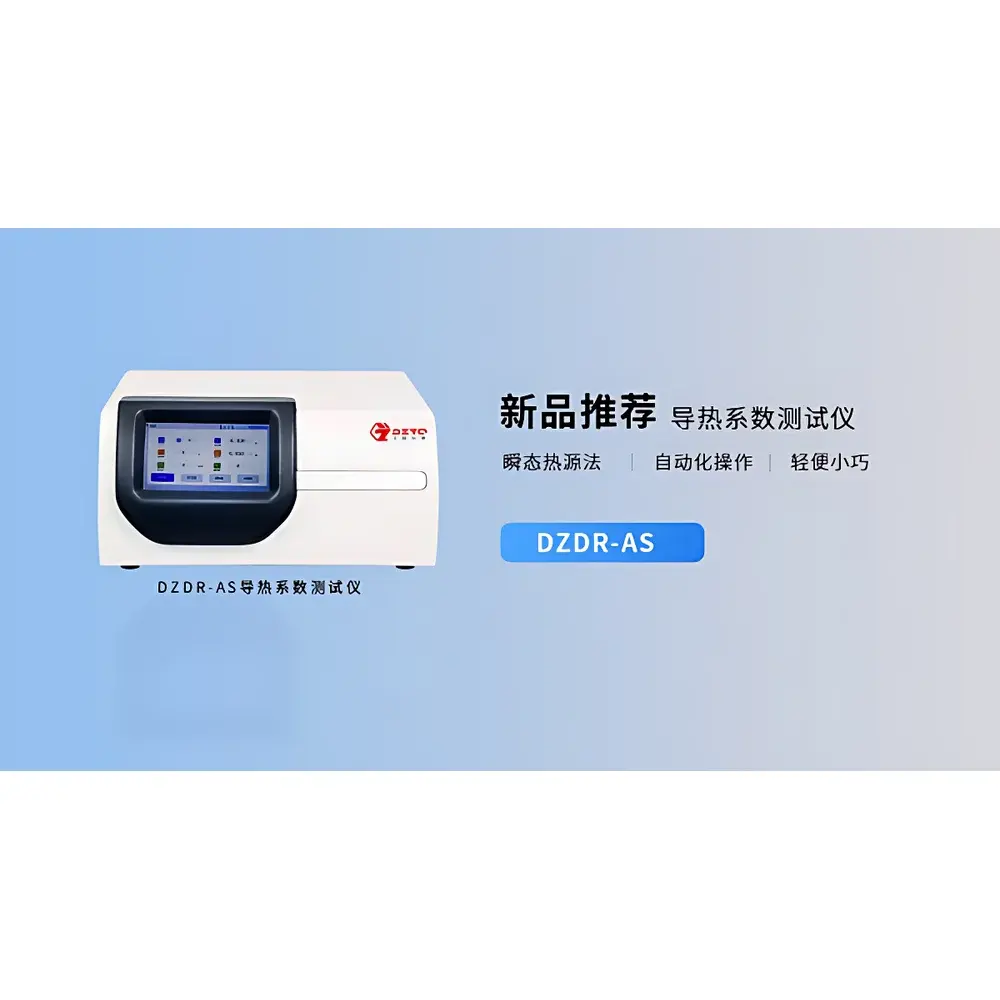
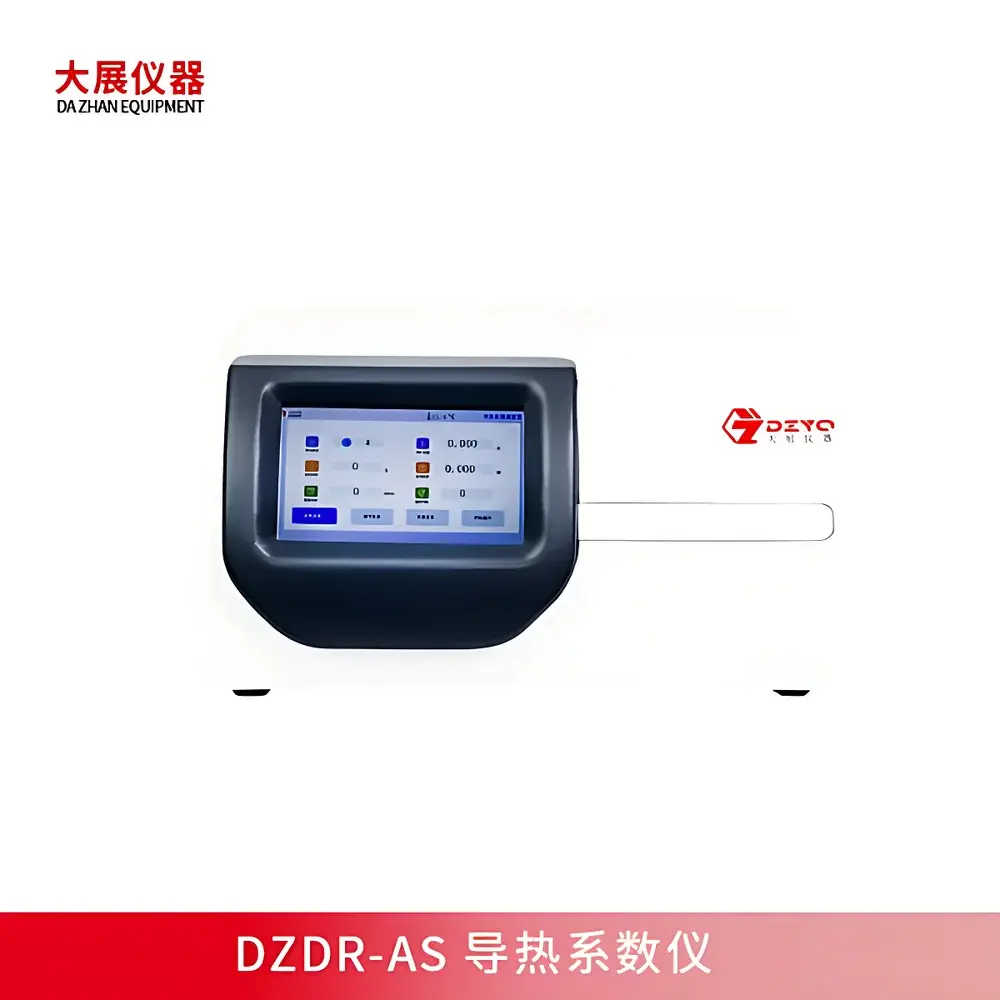
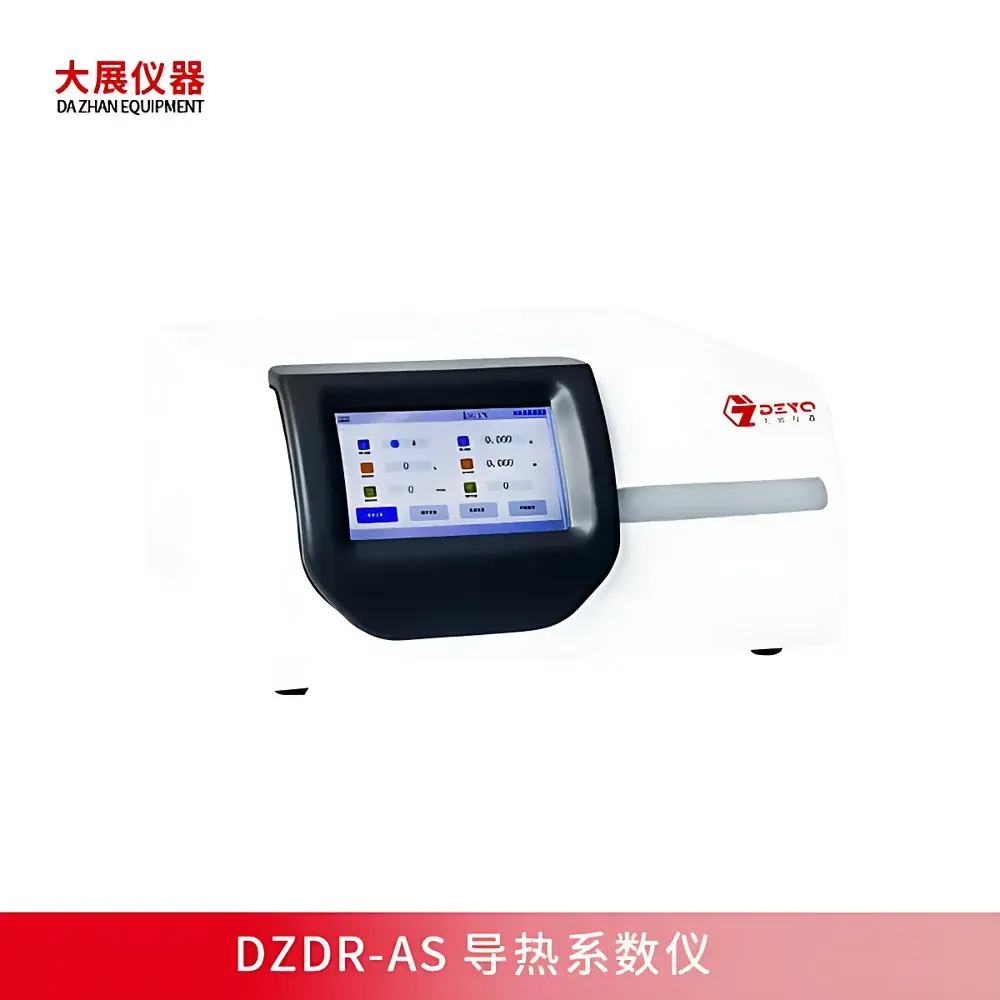
DAZHAN DZDR-AS Portable Transient Plane Source (TPS) Thermal Conductivity Analyzer
| Brand | DAZHAN |
|---|---|
| Origin | Jiangsu, China |
| Model | DZDR-AS |
| Measurement Principle | Transient Plane Source (TPS) Method |
| Thermal Conductivity Range | 0.0001–50 W/(m·K) |
| Temperature Range | −40 °C to 200 °C |
| Accuracy | ±0.0001 W/(m·K) |
| Repeatability | ≤1% |
| Measurement Time | ≤160 s |
| Sample Forms | Solids (blocks, metals, films), Liquids, Powders, Gels, Pastes, and Insulating Materials |
| Sample Requirements | Surface must be flat and smooth |
| Probe Configuration | Dual high-precision TPS sensors (standard) |
| Power Consumption | <300 W |
| Solid Sample Dimensions (Probe #1) | ≥15 mm × 15 mm × 3.75 mm |
| Solid Sample Dimensions (Probe #2) | ≥30 mm × 30 mm × 7.5 mm |
| Liquid/Powder Sample Volume | 18 mL (with dedicated fixture) |
Overview
The DAZHAN DZDR-AS Portable Transient Plane Source (TPS) Thermal Conductivity Analyzer is an engineered solution for rapid, accurate, and versatile thermal property characterization across academic, industrial R&D, and quality control laboratories. It operates on the internationally standardized transient plane source method—defined in ISO 22007-2 and ASTM D7984—where a thin, sandwiched sensor acts simultaneously as a heat source and temperature sensor. Upon application of a short-duration constant-power pulse, the sensor induces a transient temperature rise in the adjacent sample material. By analyzing the time-dependent temperature response—specifically the logarithmic relationship between temperature increase and square root of time—the system calculates thermal conductivity (λ), thermal diffusivity (α), and, via integration with density data, specific heat capacity (Cp). This first-principles-based approach eliminates steady-state equilibration delays, enabling full-property determination in under 160 seconds per measurement with no requirement for vacuum or inert gas environments.
Key Features
- Portable, integrated benchtop architecture designed for mobility between labs, pilot lines, and field testing sites—unit weight and footprint optimized for transport without compromising mechanical stability.
- Automated baseline calibration and dynamic power adjustment: real-time feedback loop adjusts heating pulse magnitude based on initial thermal resistance detection, minimizing user intervention and reducing operator-induced variability.
- Dual-sensor probe configuration supports broad sample adaptability—Probe #1 optimized for small-volume solids and thin films; Probe #2 configured for higher thermal mass materials including metals, ceramics, and insulating composites.
- Full-color capacitive touchscreen interface with intuitive icon-driven navigation—supports multilingual UI (English default), offline operation, and local data storage (≥10,000 test records).
- Bidirectional control architecture: instrument can be operated standalone or fully synchronized with PC-based software via USB 2.0 or Ethernet, enabling remote monitoring, script-based batch testing, and automated report generation.
- Thermal chamber compatibility: optional Peltier-controlled stage extends operational range to −40 °C–200 °C, validated per IEC 60068-2-1/2/14 for thermal cycling integrity.
Sample Compatibility & Compliance
The DZDR-AS accommodates heterogeneous material classes without preprocessing: rigid solids (metals, polymers, graphite), compliant solids (foams, elastomers), particulates (ceramic powders, battery cathode blends), dispersions (coolants, nanofluids), and semi-solids (thermal greases, phase-change materials). Sample preparation requires only macroscopic surface planarity—no polishing, coating, or interfacial grease is necessary due to the self-calibrating nature of the TPS sensor. All measurements comply with ISO 22007-2:2015 for plastics and composites, and align with ASTM D7984-20 for general-purpose thermal conductivity determination. For regulated environments, audit trail functionality—including user login, parameter change logs, timestamped raw thermograms, and electronic signatures—meets GLP and FDA 21 CFR Part 11 requirements when used with validated software configurations.
Software & Data Management
The bundled DAZHAN ThermalStudio v3.2 software provides ISO-compliant data acquisition, multi-curve fitting (including nonlinear regression against theoretical TPS models), and export-ready reporting in PDF, CSV, and XML formats. Advanced modules enable calculation of volumetric heat capacity (ρCp) from λ and α outputs, comparative trend analysis across temperature ramps, and statistical process control (SPC) charting for production lot verification. Raw voltage-vs.-time datasets are preserved with metadata (ambient RH/T, probe serial ID, operator ID), supporting retrospective reanalysis and third-party validation. Software updates are delivered via secure HTTPS channel with SHA-256 signature verification.
Applications
- Thermal interface material (TIM) qualification for electronics packaging—validating performance under thermal cycling stress.
- R&D of battery electrode slurries and solid-state electrolytes—correlating microstructure (via SEM/XRD) with bulk λ values.
- QC screening of polymer composites in automotive lightweighting programs—ensuring batch-to-batch consistency within ±0.5% λ tolerance.
- Insulation material certification for building envelope standards (e.g., EN 12667, ASTM C518).
- Academic studies of phonon transport mechanisms in 2D materials and metamaterials using ultra-low-λ (<0.01 W/(m·K)) measurement mode.
FAQ
What standards does the DZDR-AS comply with for thermal conductivity measurement?
It conforms to ISO 22007-2:2015 and ASTM D7984-20 for transient plane source methodology, with traceable calibration against NIST SRM 1470a (fused quartz) and certified reference materials from LNE (France) and NPL (UK).
Can the instrument measure anisotropic materials?
Yes—by orienting the sample so the TPS sensor contacts the desired principal axis (e.g., through-plane vs. in-plane), directional λ values can be determined; however, isotropic assumption is applied in default calculation unless user specifies tensor mode.
Is density input required for specific heat capacity calculation?
Yes—Cp derivation requires user-entered or imported bulk density (kg/m³); the software does not measure density in situ.
How is probe contamination mitigated during powder or paste testing?
Each probe includes removable, chemically inert ceramic insulation layers; cleaning protocols (IPA wipe + low-temperature bake) are documented in the maintenance manual and validated for ≥500 cycles.
Does the system support automated temperature ramping during measurement?
Not natively—the base unit operates at ambient or fixed-setpoint temperature; however, integration with external environmental chambers (via analog I/O or Modbus TCP) enables scripted multi-point λ(T) profiling.



