
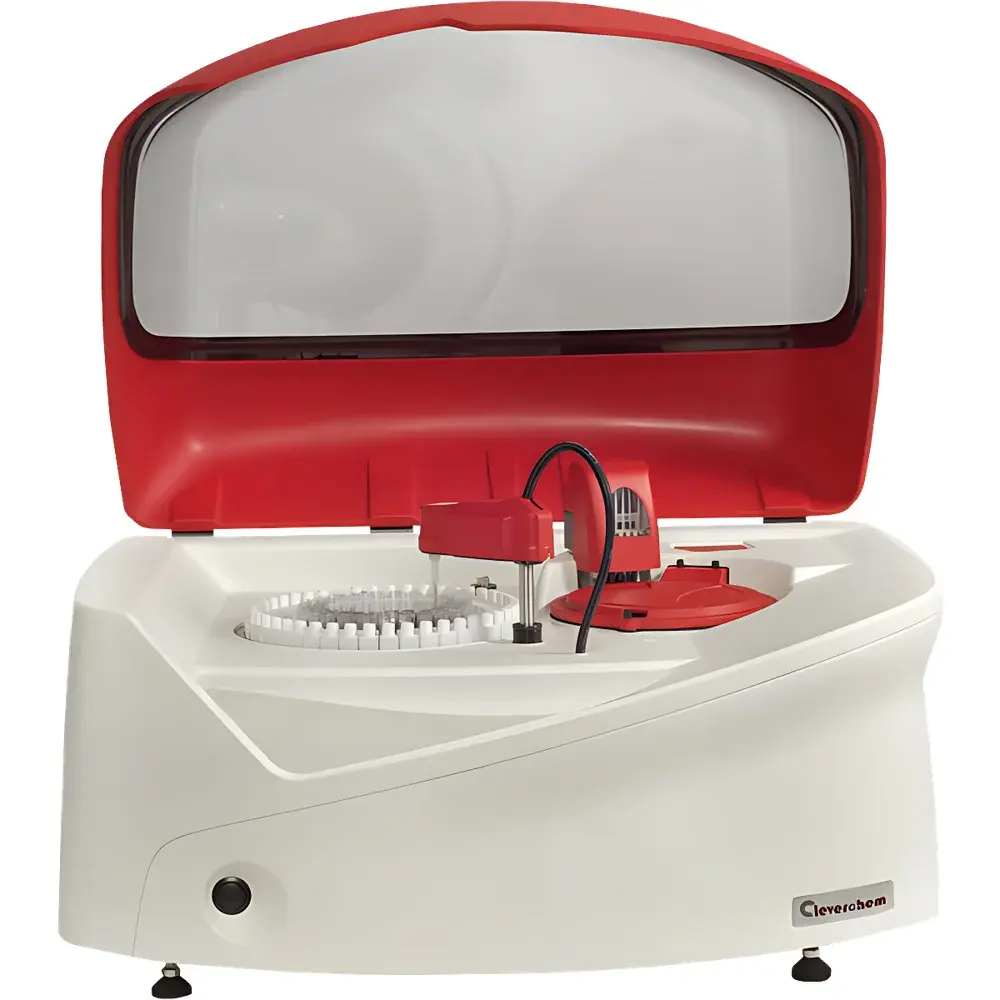
DeChem-Tech CleverChem-Anna Automated Discrete Analyzer for Seawater Nutrient Analysis
| Brand | DeChem-Tech |
|---|---|
| Origin | Germany |
| Model | CleverChem-Anna |
| Instrument Type | Laboratory Water Quality Analyzer |
| Detection Parameters | Nitrate, Nitrite, Ammonia-N, Total Nitrogen, Orthophosphate, Total Phosphorus, Silicate, Sulfate, Sulfide, Chloride, Hexavalent Chromium, Alkalinity, Iron, Zinc, Fluoride, Acidity, Hardness, Manganese, Aluminum, Copper, Magnesium, Cyanide, Phenols, and more |
| Sample Capacity | 49 positions |
| Reagent Positions | 31 (with optional refrigerated storage) |
| Throughput | Up to 200 samples per hour |
| Optical Cell | Reusable 64-position quartz cuvette carousel, 1 cm pathlength |
| Washing Protocol | 7-step automated cleaning with optical validation |
| Software | Dual-language (English/Chinese), supports true sample blanking and reagent blanking |
| Interface | USB |
| Compliance | Designed for ISO 15586, ASTM D3867, EPA 365.4, USP <643>, and GLP/GMP-aligned data integrity workflows |
Overview
The DeChem-Tech CleverChem-Anna is a fully automated discrete analyzer engineered for high-precision, multi-parameter nutrient and inorganic ion analysis in marine and freshwater matrices. It implements standardized wet-chemistry methodologies—specifically segmented flow and discrete reaction kinetics—via programmable microfluidic handling and photometric detection. Unlike continuous-flow analyzers, the CleverChem-Anna performs individual, isolated reactions in reusable quartz cuvettes, replicating manual colorimetric protocols with strict adherence to international standard methods (e.g., ISO 15586 for phosphate, ASTM D3867 for nitrate/nitrite, EPA Method 365.4 for orthophosphate). Each measurement cycle includes precise metering of microliter-scale sample and reagent volumes, controlled incubation, kinetic or endpoint color development, 1-cm-pathlength photometric quantification at user-selectable wavelengths (340–880 nm), and rigorous post-analysis cuvette validation. This architecture ensures minimal cross-contamination, exceptional reproducibility (<2% RSD for routine seawater nutrients), and full traceability per GLP/GMP requirements.
Key Features
- Discrete reaction architecture with 64-position quartz cuvette carousel—optically verified before each use following a 7-step automated cleaning sequence
- High-throughput operation: up to 200 determinations per hour across 49 sample positions, supporting simultaneous quantification of ≥12 parameters per run
- Micro-volume chemistry: typical sample consumption of 10–100 µL and reagent usage of 50–200 µL per test—reducing consumables cost and hazardous waste generation by >70% vs. conventional batch systems
- Integrated refrigerated reagent compartment (4–8 °C) with 31 independently addressable reagent ports; temperature monitoring logged with audit trail
- Real-time waste management: sealed, sensor-monitored waste collection system with overflow and vapor containment—designed to comply with OSHA HCS and EU CLP labeling requirements
- Dual-language control software with built-in calibration curve management, drift correction algorithms, and automatic blank subtraction (sample blank + reagent blank)
- USB-based communication with native export to CSV, PDF, and LIMS-compatible formats; full electronic signature support for 21 CFR Part 11 compliance
Sample Compatibility & Compliance
The CleverChem-Anna is validated for direct analysis of unfiltered or filtered seawater, estuarine water, wastewater effluents, drinking water, and groundwater without matrix-specific hardware modification. Its robust fluidics tolerate salinities up to 45 ppt and suspended solids ≤50 mg/L. All default methods are aligned with ISO, ASTM, and EPA regulatory frameworks—including ISO 15586 (phosphorus), ISO 14429 (nitrate), ASTM D129 (sulfate), and EPA 379.1 (cyanide). System validation documentation supports IQ/OQ/PQ execution, and raw data files include timestamped metadata (operator ID, method version, cuvette ID, photometric raw absorbance, temperature logs) required for FDA and EMA inspection readiness.
Software & Data Management
The embedded Windows-based software provides method editor, sequence scheduler, real-time status dashboard, and integrated QC module (Levey-Jennings charts, Westgard rules, recovery spike tracking). Audit trails record all user actions—including method edits, calibration updates, and result overrides—with immutable timestamps and operator authentication. Data export conforms to ASTM E1467 and ISO/IEC 17025:2017 reporting templates. Optional LIMS integration via HL7 or REST API enables bidirectional sample assignment and result ingestion. Electronic signatures meet 21 CFR Part 11 Subpart B requirements for closed systems, including role-based access control and biometric or token-based authentication.
Applications
Primary deployment domains include marine environmental monitoring programs (e.g., OSPAR, HELCOM, IOC-UNESCO), coastal zone management agencies, accredited water testing laboratories (ISO/IEC 17025 certified), and university research groups conducting biogeochemical cycling studies. Typical use cases encompass long-term nutrient time-series in open-ocean buoys, rapid screening of eutrophication indicators in estuaries, compliance testing for discharge permits (e.g., EU Urban Wastewater Treatment Directive), and method validation studies requiring trace-level sensitivity (e.g., sub-µg/L nitrite detection in oligotrophic seawater).
FAQ
Does the CleverChem-Anna require method development for each new parameter?
No—pre-validated, standards-compliant methods are included for all listed analytes; users may modify only reaction timing, wavelength, or dilution factors within defined safety margins.
Can it analyze turbid or particulate-rich seawater samples?
Yes—integrated centrifugation or filtration modules (optional accessories) are available; the base system accepts pre-filtered samples down to 0.45 µm.
Is remote monitoring and diagnostics supported?
Yes—via secure HTTPS web interface with live instrument status, error logs, and predictive maintenance alerts based on pump cycles and cuvette wear metrics.
What is the expected lifetime of the quartz cuvettes?
Under normal operation and proper washing protocol, the 64-position quartz carousel exceeds 10,000 reaction cycles with no measurable optical degradation.
How is calibration traceability maintained?
Certified reference materials (CRMs) from NIST, BAM, or LGC are directly supported; calibration curves store CRM lot numbers, expiration dates, and uncertainty budgets in metadata.
Related Products







