
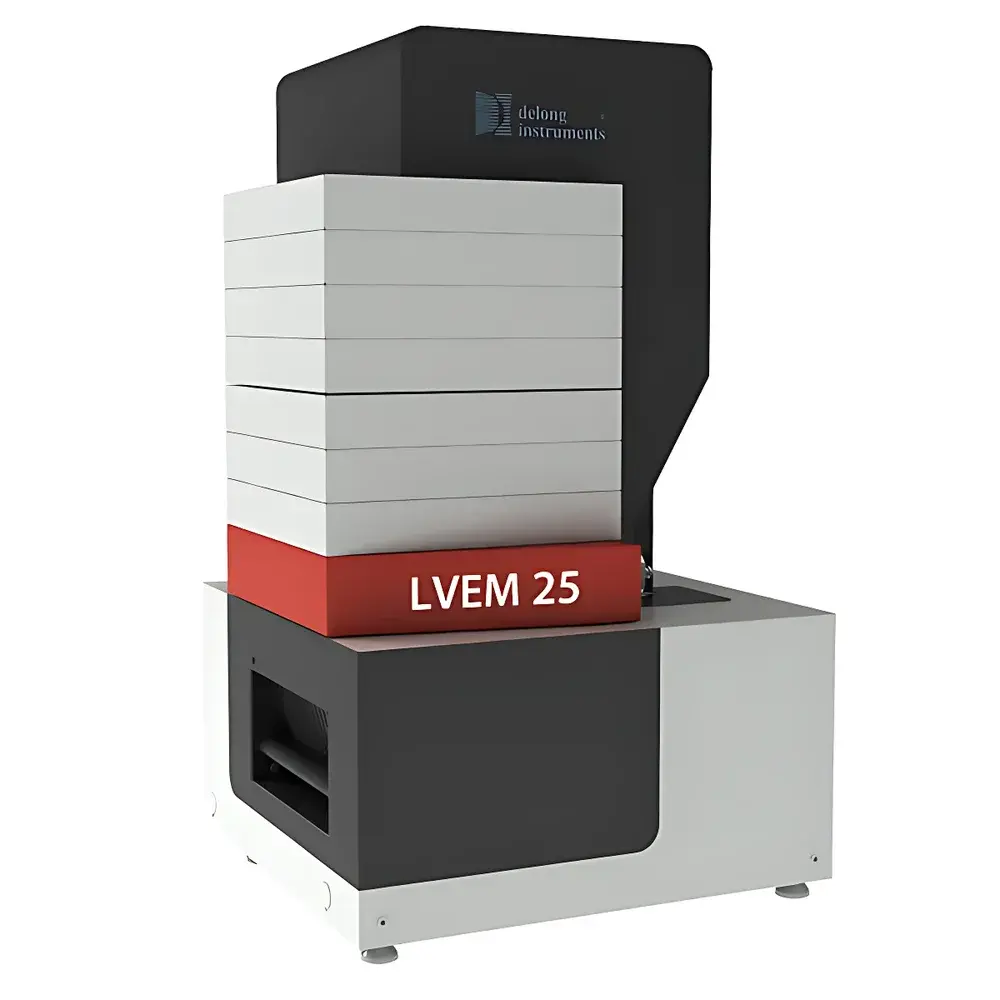
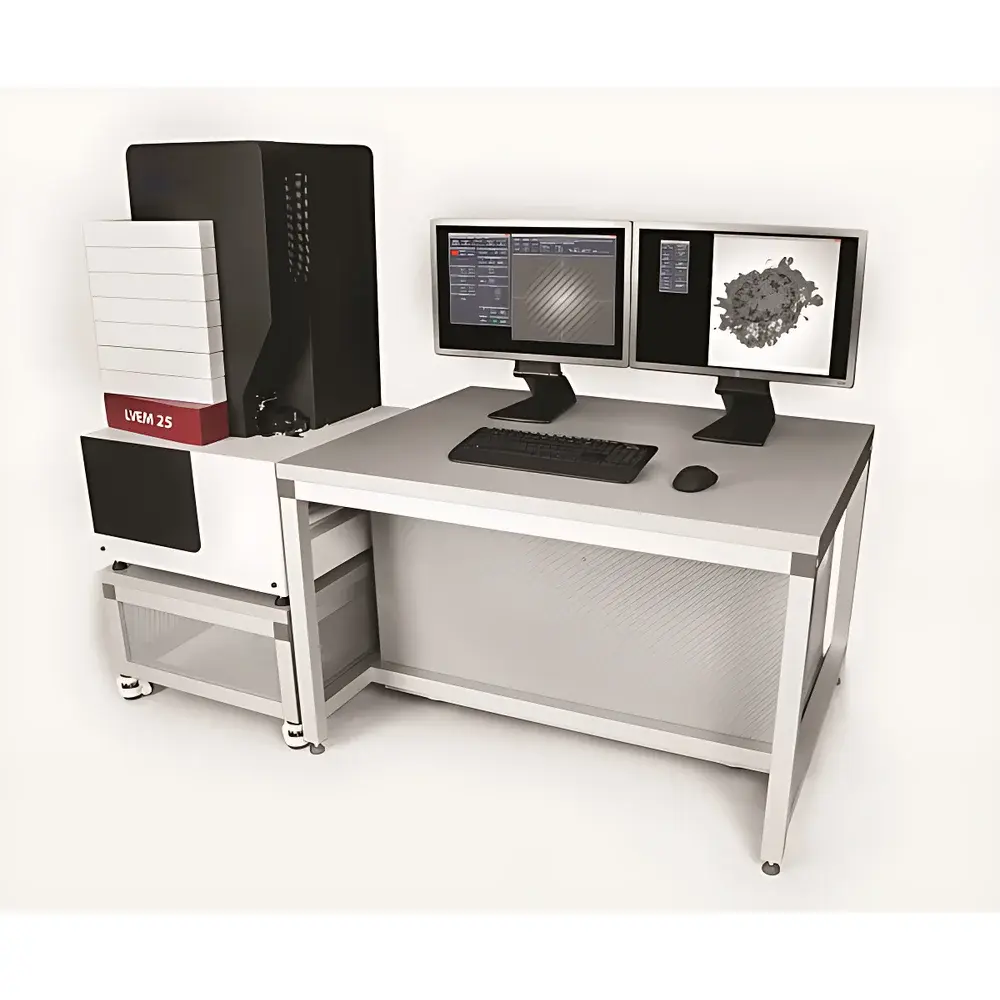
Delong Instruments LVEM25 Benchtop Low-Voltage Transmission Electron Microscope
| Brand | Delong Instruments |
|---|---|
| Origin | Canada |
| Model | LVEM25 |
| Acceleration Voltages | 10, 15, 25 kV |
| Magnification Range | 1,000× – 470,000× |
| Spatial Resolution | 1 nm |
| Imaging Modes | TEM, SEM, Electron Diffraction (ED) |
| Vacuum System | Ion Pumps at Gun & Specimen Chambers |
| Electron Source | Schottky Field Emission Gun |
| Footprint | Benchtop |
| Power Requirements | Standard 120/240 V AC, No Chilled Water or Cryogens Required |
Overview
The Delong Instruments LVEM25 is a benchtop low-voltage transmission electron microscope engineered for high-contrast imaging of beam-sensitive, light-element-rich materials—particularly biological macromolecules, polymers, nanomaterials, and hydrated or unstained soft matter. Unlike conventional high-voltage TEMs (80–300 kV), the LVEM25 operates at three discrete acceleration voltages—10 kV, 15 kV, and 25 kV—leveraging the increased electron scattering cross-section at lower energies to deliver exceptional mass-thickness contrast without heavy-metal staining. This physical principle enables direct visualization of native-state biological structures—including viruses, membrane proteins, and extracellular vesicles—at sub-nanometer resolution (≤1 nm), while eliminating the artifacts and preparation complexity associated with osmium tetroxide or uranyl acetate staining protocols.
Key Features
- Benchtop form factor with footprint under 1 m²—requires no dedicated EM suite, magnetic shielding, active vibration isolation, or structural reinforcement.
- Schottky field emission electron gun delivering stable, high-brightness illumination with superior spatial coherence and long-term emission stability (>3,000 h mean time between failures).
- Dual-ion-pump vacuum architecture maintaining ultra-high vacuum (UHV) conditions (<1×10⁻⁸ mbar) directly at the electron gun and specimen chamber—minimizing contamination, reducing drift, and enabling rapid sample exchange in ≤3 minutes via auto-locking airlock.
- Integrated triple-mode operation: high-resolution TEM imaging, scanning electron microscopy (SEM) mode with backscattered electron detection, and selected-area electron diffraction (SAED) for crystallographic analysis—all accessible from a single platform.
- Permanent-magnet electron lens system—eliminating external power supplies, current drift, and thermal instability inherent in electromagnetic lenses; enhances reproducibility and reduces calibration frequency.
- Standard AC power input (120/240 V, 50/60 Hz); no chilled water, liquid nitrogen, or high-current circuits required—compatible with standard laboratory electrical infrastructure.
Sample Compatibility & Compliance
The LVEM25 is optimized for specimens containing low-atomic-number elements (C, H, O, N, S, P), including cryo-TEM grids, resin-embedded ultrathin sections (50–100 nm), carbon-film-supported nanoparticles, and freeze-dried biomolecular assemblies. Its 25 kV operating mode balances penetration depth and contrast—permitting routine imaging of conventionally sectioned biological samples without thickness compensation algorithms or dose fractionation. The system complies with ISO 14644-1 Class 8 cleanroom ambient requirements and supports GLP-compliant documentation workflows. While not FDA-cleared as a diagnostic device, its imaging output meets ASTM E2932-22 guidelines for electron microscopy characterization of nanomaterials and is routinely cited in peer-reviewed structural biology publications adhering to ICMJE and COPE standards.
Software & Data Management
Acquisition and analysis are managed via the proprietary LVEM Control Suite, a Windows-based application supporting real-time image capture, multi-modal alignment (TEM/SEM/ED), digital diffraction indexing, and non-linear drift correction. All image metadata—including kV setting, magnification, exposure time, lens currents, and vacuum status—is embedded in TIFF/DM3 formats and exportable in FAIR-compliant JSON-LD schema. Audit trails record user logins, parameter changes, and acquisition timestamps—enabling full traceability per 21 CFR Part 11 Annex 11 requirements when deployed in regulated QC environments. Raw data archives are compatible with open-source platforms including DigitalMicrograph (Gatan), IMOD, and RELION for downstream tomography or single-particle analysis.
Applications
- Structural validation of liposomes, exosomes, and virus-like particles in pharmaceutical development.
- In situ observation of polymer phase separation, block copolymer self-assembly, and nanocomposite dispersion homogeneity.
- Rapid screening of catalyst nanoparticle size distribution and crystallinity in R&D labs.
- Teaching laboratories: hands-on TEM instruction without facility overhead or radiation safety licensing.
- Quality control of filtration membranes, battery electrode coatings, and thin-film semiconductor layers.
FAQ
What is the minimum sample thickness suitable for high-contrast imaging at 25 kV?
For optimal signal-to-noise ratio and minimal multiple scattering, we recommend 50–100 nm thick sections for biological specimens and ≤200 nm for inorganic nanomaterials.
Can the LVEM25 perform energy-dispersive X-ray spectroscopy (EDS)?
No—the LVEM25 does not integrate an EDS detector; however, its SAED patterns support qualitative lattice parameter identification and phase mapping when coupled with reference databases such as ICDD PDF-4+.
Is remote operation supported?
Yes—via secure RDP or VNC over local network; full instrument control, including lens tuning and stage navigation, is available remotely without latency or feature limitation.
How often does the Schottky emitter require replacement or refurbishment?
Under typical usage (≤4 hrs/day, 5 days/week), the emitter maintains specification performance for ≥18 months; annual preventive maintenance includes ion pump regeneration and aperture cleaning.
Does the system meet CE or UL safety certification?
Yes—the LVEM25 carries CE marking (2014/30/EU EMC Directive, 2014/35/EU LVD Directive) and UL 61010-1 certification for laboratory electrical equipment.






