
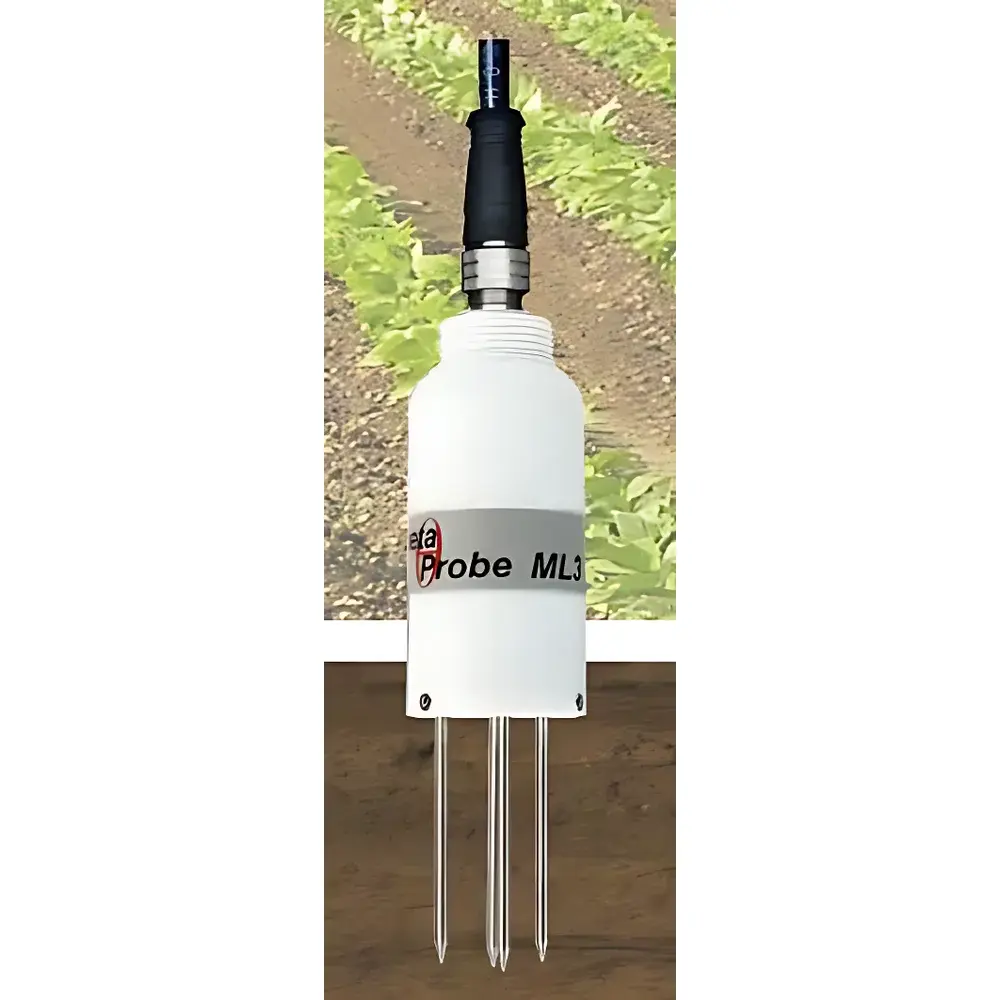
Delta-T Devices ML3 ThetaProbe Portable Soil Moisture Sensor
| Brand | Delta-T Devices |
|---|---|
| Origin | United Kingdom |
| Model | ML3 ThetaProbe |
| Instrument Type | Soil Moisture Sensor (FDR-based) |
| Measurement Range | 0–100% vol |
| Accuracy | ±1% vol (0–50% vol, 0–40°C) |
| Salinity Error | ≤3.5% (50–500 mS/m, 0–40% vol) |
| Output Signal | 0–1 V differential (nominal 0–60% vol) |
| Sensing Volume | 55 mm (H) × 70 mm (Ø) |
| Standard Cable Length | 5 m (extendable to 25 m) |
| Power Supply | 5–14 V DC, ~18 mA per 1-s measurement |
| Operating Temperature | −20°C to +60°C |
| Enclosure Rating | IP68 |
| Dimensions (Sensor) | 143 mm (H) × 40 mm (Ø) |
| HH2 Moisture Meter Range | 0–1500 mV (corresponding to 0–saturation) |
| HH2 Accuracy | ±(0.13% of reading + 1.0 mV) |
| HH2 Resolution | 1 mV |
| HH2 Memory | 227–2186 readings |
| HH2 Power | 9 V alkaline battery (~6500 measurements typical) |
| HH2 Enclosure Rating | IP52 |
| HH2 Operating Temperature | 0–40°C |
| HH2 Drop Test | ~1 m |
| HH2 EMC Compliance | Meets EU EMC Directive |
| HH2 Dimensions | 150 × 80 × 40 mm |
| HH2 Weight | 450 g |
| HH2 Display | 16×2 character LCD |
| HH2 Keypad | 7-button interface |
| HH2 Interface | 25-pin D-sub port (sensor & RS232 adapter) |
| Software | HH2Read (Windows-compatible data retrieval and visualization) |
Overview
The Delta-T Devices ML3 ThetaProbe is a field-deployable, time-domain independent frequency domain reflectometry (FDR) sensor system engineered for rapid, non-destructive quantification of volumetric soil water content (θv) in situ. Unlike time-domain transmission (TDT) or time-domain reflectometry (TDR) systems, the ML3 employs a fixed-frequency (30 MHz) electromagnetic oscillator integrated into its three-rod stainless-steel probe. The sensor measures the real component of soil complex permittivity—primarily governed by water’s high dielectric constant (~80)—and converts this dielectric response into a linear voltage output proportional to θv. This FDR architecture eliminates waveform interpretation complexity, reduces susceptibility to signal dispersion in heterogeneous or saline soils, and enables robust operation across diverse textural classes—from sandy loams to heavy clays—without requiring site-specific calibration under standard conditions. The system comprises two interoperable hardware modules: the IP68-rated ML3 ThetaProbe sensor and the handheld HH2 moisture meter, which serves as both power source, signal conditioner, and data logger.
Key Features
- FDR-based measurement principle with 30 MHz excitation frequency, optimized for stability in variable salinity and temperature environments
- IP68-rated stainless-steel probe (143 mm × 40 mm Ø) with calibrated three-rod geometry ensuring consistent sensing volume (55 mm H × 70 mm Ø)
- Differential 0–1 V analog output (nominally scaled to 0–60% vol), compatible with third-party data loggers via standard 5–14 V DC supply
- Extended cable option (up to 25 m) with shielded twisted-pair construction to maintain signal integrity in electrically noisy field settings
- HH2 meter featuring 16×2 LCD display, 7-button navigation, and on-device memory storage (227–2186 readings depending on logging interval)
- Integrated RS232 interface (via optional adapter) enabling direct PC connectivity and automated data export using HH2Read software
- Battery-powered operation (9 V alkaline) supporting >6,000 discrete measurements per charge—validated for multi-day unattended monitoring campaigns
Sample Compatibility & Compliance
The ML3 ThetaProbe is validated for mineral soils with bulk electrical conductivity up to 500 mS/m and operating temperatures from −20°C to +60°C. Its accuracy specification of ±1% vol (0–50% vol, 0–40°C) meets the performance benchmarks referenced in ISO 11274:2020 (soil physical properties — determination of water retention curves) and aligns with FAO-recommended uncertainty thresholds for field-scale irrigation scheduling. While not certified to GLP or GMP standards per se, the HH2 meter’s deterministic analog-to-digital conversion, traceable voltage calibration, and absence of volatile memory ensure data integrity suitable for regulatory environmental monitoring programs. The system complies with EU Electromagnetic Compatibility Directive 2014/30/EU and carries CE marking for unrestricted use within EEA member states.
Software & Data Management
HH2Read is a Windows-based desktop application supplied with every ML3 system. It supports bidirectional communication with the HH2 meter via USB-to-RS232 adapter, enabling firmware updates, configuration of logging intervals (1 s to 24 h), and batch download of stored readings. Data are exported in CSV format with timestamp, sensor ID, raw mV value, and user-defined metadata fields—facilitating integration into LIMS, GIS, or statistical analysis platforms (e.g., R, Python pandas). The software includes basic visualization tools (line plots, scatter matrices) and allows manual or auto-scaling of voltage-to-moisture conversion using factory calibration coefficients embedded in each probe’s EEPROM. No cloud dependency or subscription model is required; all processing occurs locally, preserving data sovereignty and auditability.
Applications
- Real-time irrigation scheduling in precision agriculture and horticultural nurseries
- Long-term vadose zone monitoring in hydrological research and watershed modeling
- Validation of satellite-derived soil moisture products (e.g., SMAP, Sentinel-1)
- In situ calibration of neutron probe access tubes and cosmic-ray neutron sensors
- Soil physics experiments involving infiltration, evaporation, and hydraulic conductivity estimation
- Environmental impact assessments for landfill leachate plume tracking and remediation verification
FAQ
Does the ML3 ThetaProbe require soil-specific calibration?
Factory calibration is provided for mineral soils with EC 250 mS/m) or organic substrates (e.g., peat, compost), empirical calibration using gravimetric sampling is recommended to correct for dielectric dispersion effects.
Can multiple ML3 probes be connected to a single HH2 meter?
No—the HH2 supports only one sensor per measurement cycle. For multi-point networks, users deploy individual HH2 units or integrate ML3 sensors directly with external data loggers (e.g., Campbell Scientific CR1000X) via the 0–1 V analog output.
What is the expected service life of the ML3 probe in aggressive field conditions?
With proper cleaning after each use and avoidance of mechanical abrasion against rocks or gravel, the stainless-steel probe typically exceeds 10 years of continuous deployment. The epoxy-sealed electronics are rated for indefinite immersion (IP68), though cable jacket integrity should be inspected annually in UV-exposed installations.
Related Products







