
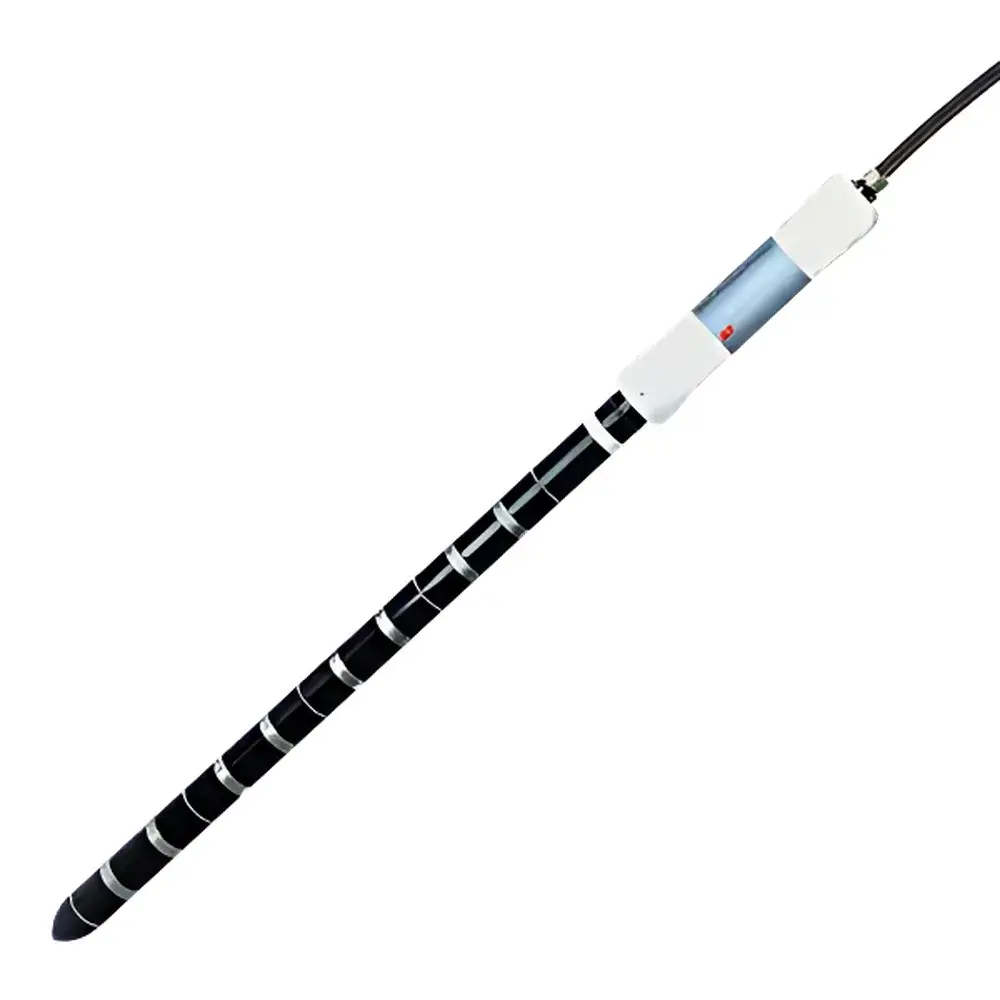
DELTA-T PR2/4 Soil Profile Moisture Probe
| Brand | DELTA-T |
|---|---|
| Origin | United Kingdom |
| Model | PR2/4 |
| Instrument Type | Soil Volumetric Water Content Profiler |
| Measurement Depths | 10, 20, 30, 40 cm |
| Output Options | SDI-12 or 4 × Analog Voltage (0–1 V, scalable to 0–0.6 m³·m⁻³) |
| Accuracy | ±0.04 m³·m⁻³ (0–0.4 m³·m⁻³, factory soil-specific calibration, 0–40 °C) |
| Full-Scale Accuracy | ±0.06 m³·m⁻³ (0–1 m³·m⁻³, generic calibration, 0–40 °C) |
| Salinity Range | 50–400 mS·m⁻¹ (pore water electrical conductivity) |
| Sensor Volume Sensitivity | Cylindrical volume of 250 mm diameter × 125 mm height (95% measurement sensitivity confined within this zone) |
| Operating Temperature | 0–40 °C |
| IP Rating | IP67 |
| Response Time | ≤1 s |
| Power Supply | 5.5–15 V DC (voltage dependent on cable length: min. 5.5 V @ 2 m |
| Current Draw | <80 mA |
| Cable Options | Standard 5 m |
| Housing Material | Polycarbonate and stainless steel |
| Dimensions | 750 mm (L) × 25.4 mm (Ø) |
| Weight | 0.6 kg |
Overview
The DELTA-T PR2/4 Soil Profile Moisture Probe is a precision-engineered, multi-depth time-domain transmission (TDT) sensor designed for continuous, in-situ monitoring of volumetric water content (θv) across standardized soil horizons. Developed by DELTA-T Devices Ltd. — a Cambridge-based environmental instrumentation specialist established in 1971 — the PR2/4 implements a calibrated TDT principle, where high-frequency electromagnetic pulses propagate along parallel stainless-steel rods embedded within a rigid polycarbonate probe body. Pulse travel time is directly correlated to the dielectric permittivity of the surrounding soil matrix, enabling robust θv quantification without reliance on empirical regression models sensitive to bulk density or texture variation. Unlike capacitance-based alternatives, the PR2/4’s TDT architecture minimizes signal drift under varying salinity conditions and eliminates hysteresis effects associated with frequency-domain techniques. Its four discrete sensing zones — fixed at 10, 20, 30, and 40 cm depths — provide vertically resolved data critical for root-zone water balance modeling, infiltration studies, and vadose zone hydrological process validation.
Key Features
- Four independent, factory-calibrated TDT sensing segments at precisely spaced depths (10 / 20 / 30 / 40 cm), ensuring vertical profile integrity and minimizing inter-zone crosstalk.
- Soil-specific calibration traceable to gravimetric and neutron probe reference methods, delivering ±0.04 m³·m⁻³ accuracy over the biologically relevant range (0–0.4 m³·m⁻³) at 0–40 °C.
- Robust IP67-rated housing constructed from UV-stabilized polycarbonate and marine-grade stainless steel, validated for long-term burial in agricultural, forest, and semi-arid soils.
- Dual-output interface: SDI-12 protocol for direct integration with industry-standard dataloggers (e.g., Campbell Scientific CR series, Onset HOBO, Delta-T DL6), plus four isolated analog voltage outputs (0–1 V) configurable per depth.
- Low-power operation (<80 mA peak draw) compatible with solar-recharged battery systems; supports cable runs up to 100 m without signal degradation.
- Defined measurement volume (250 mm Ø × 125 mm H cylinder) ensures spatially representative sampling while enabling rigorous experimental design — e.g., exclusion of roots, stones, or metallic debris within the sensitive zone.
Sample Compatibility & Compliance
The PR2/4 is validated for use in mineral soils ranging from sandy loam to clay loam textures, with pore-water electrical conductivity (ECp) between 50 and 400 mS·m⁻¹ — covering typical field conditions in irrigated agriculture, managed grasslands, and temperate forest soils. It is not recommended for highly organic substrates (e.g., peat >30% organic matter) or saturated, anaerobic sediments where dielectric behavior deviates significantly from calibration assumptions. The probe complies with IEC 60529 (IP67 ingress protection), EN 61326-1 (EMC for laboratory and industrial environments), and meets mechanical durability requirements outlined in ASTM D5088–22 (Standard Practice for Installation of Soil Moisture Sensors). Data generated supports GLP-compliant field trials when paired with audit-trail-capable dataloggers and documented calibration records.
Software & Data Management
No proprietary software is required for basic operation; raw SDI-12 responses are human-readable ASCII strings containing depth-indexed θv values and diagnostic flags (e.g., temperature, signal quality). DELTA-T provides free configuration utilities (PR2 Config Tool) for setting measurement intervals, output scaling, and firmware updates. For advanced analysis, data integrates natively into common environmental data platforms including Edaphic’s ECH2O Software, Campbell Scientific LoggerNet, and open-source tools such as R (via soilphysics and dataRetrieval packages) and Python (using pyserial and pandas). All analog outputs support 16-bit ADC resolution on compatible loggers, enabling sub-0.001 m³·m⁻³ effective resolution under stable power conditions. Audit-ready metadata (probe ID, installation date, depth offsets, calibration certificate ID) can be embedded in data headers per ISO 11464:2020 guidelines for soil physical property reporting.
Applications
- Long-term soil water budgeting in eddy covariance flux towers and AmeriFlux/ICOS sites.
- Evaluation of irrigation efficiency and deep drainage in precision agriculture trials.
- Calibration and validation of numerical models (e.g., HYDRUS-1D, SWAP, APSIM) simulating unsaturated zone flow and solute transport.
- Root-zone moisture stress assessment in drought-tolerant crop breeding programs.
- Hydrological response analysis in catchment-scale ecohydrology studies, particularly where shallow groundwater interaction is significant.
- Regulatory monitoring for soil moisture criteria in landfill cover systems and engineered barrier performance verification (per EPA Method 9081B).
FAQ
How does the PR2/4 differ from time-domain reflectometry (TDR) probes?
The PR2/4 uses time-domain transmission (TDT), not TDR. TDT measures pulse propagation time between transmitter and receiver rods, avoiding impedance-mismatch artifacts inherent in single-ended TDR configurations. This yields higher signal-to-noise ratio and improved low-moisture sensitivity below 0.05 m³·m⁻³.
Can the PR2/4 be installed horizontally or only vertically?
It is engineered for vertical insertion into undisturbed soil cores. Horizontal placement compromises the defined cylindrical measurement volume and violates the geometric assumptions of the calibration model.
Is recalibration required after long-term deployment?
Factory calibration remains stable for ≥5 years under normal field conditions. Annual verification against gravimetric samples is recommended for GLP/GMP applications; DELTA-T offers traceable recalibration services with NIST-traceable reference standards.
What datalogger compatibility should be verified prior to purchase?
Confirm SDI-12 v1.3 compliance and support for multi-drop addressing. For analog mode, ensure the logger provides isolated 0–1 V inputs with ≥1 MΩ input impedance and programmable excitation voltage matching the PR2/4’s supply requirements.
Does the probe require soil-specific calibration for every installation site?
No — the standard factory calibration (based on loam-textured reference soils) is suitable for most agronomic and ecological applications. Site-specific calibration is optional and advised only for research requiring sub-±0.02 m³·m⁻³ uncertainty in atypical soils (e.g., volcanic ash, calcareous sands, or high-OM histosols).
Related Products







