
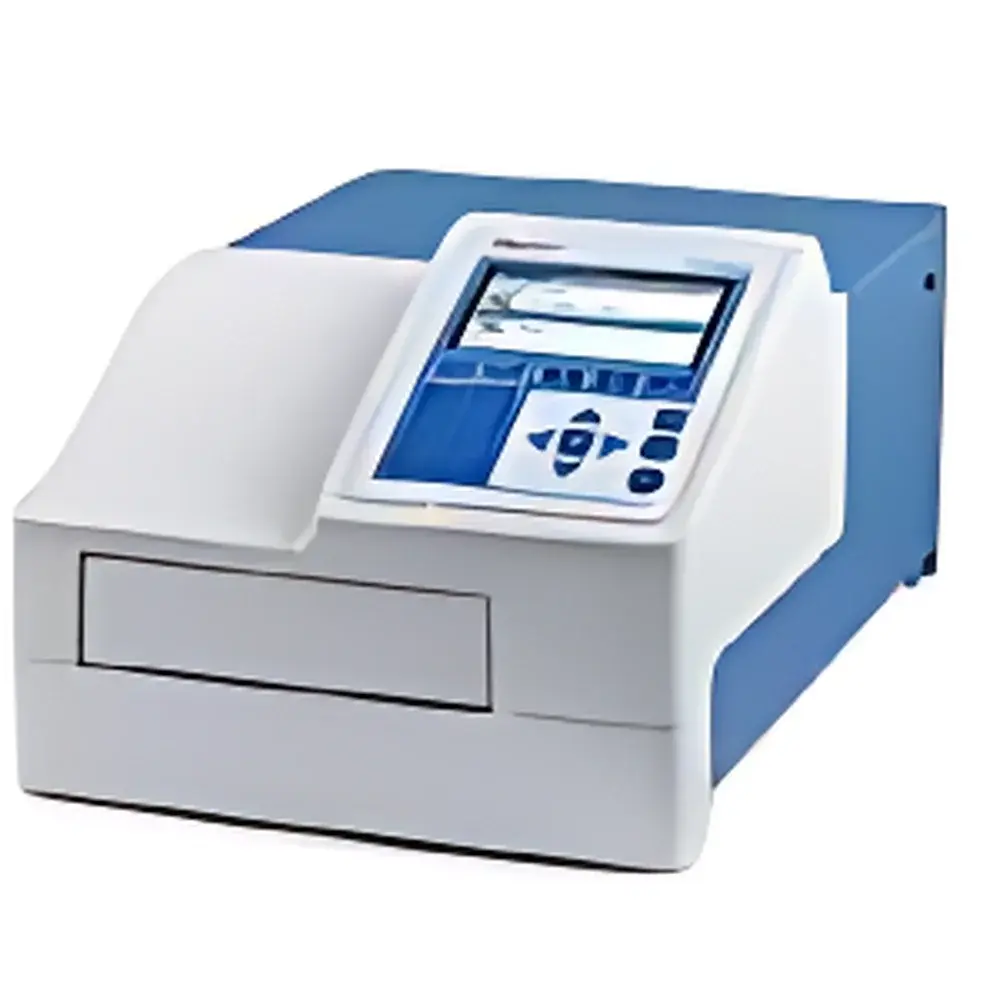
Thermo Scientific Multiskan FC Microplate Reader
| Brand | Thermo Fisher Scientific |
|---|---|
| Origin | USA |
| Model | Multiskan FC |
| Light Source | Quartz Halogen Lamp |
| Wavelength Range | 340–850 nm |
| Filter Wheel | 8-position, standard filters at 405 nm, 450 nm, and 620 nm |
| Filter Bandwidth | 3–9 nm |
| Absorbance Range | 0–6 Abs |
| Linearity (450 nm) | 0–4 Abs ±1% (96-well, standard mode) |
| Resolution | 0.001 Abs |
| Accuracy (405 nm) | ±1% (0–3 Abs), ±2% (3–4 Abs) |
| Precision (405 nm) | CV ≤ 0.2% (0–3 Abs), CV ≤ 1.0% (3–4 Abs) |
| Read Time | 6 s (96-well, fast mode), 11 s (96-well, standard mode) |
| Incubator (optional) | Ambient +4°C to 50°C |
| Shaker | Linear, 3-speed selectable |
| Automation Compatibility | Yes |
| Display | High-resolution color LCD |
| Onboard Memory | 100 protocols + 100 results (96-well) |
| Interfaces | 3 × USB (PC, printer, USB storage) |
| Software | Built-in multilingual interface (including English & Chinese) + SkanIt PC software |
Overview
The Thermo Scientific Multiskan FC is a high-performance, filter-based microplate reader engineered for precision absorbance measurements in life science research and clinical diagnostics laboratories. Based on a patented optical path design (U.S. Patent No. US6111636), the instrument delivers exceptional photometric stability and reproducibility across a broad spectral range of 340–850 nm. Its quartz halogen light source ensures consistent intensity and long-term output stability, while the 8-position filter wheel enables rapid, precise wavelength selection—critical for ELISA, enzyme kinetics, cell viability assays (e.g., MTT, CCK-8), and nucleic acid/protein quantification. The system performs comprehensive self-diagnostics at startup—including plate position verification, lamp intensity calibration, and filter alignment validation—to guarantee measurement integrity prior to each run. Designed for robust daily operation in regulated environments, the Multiskan FC supports traceable workflows aligned with GLP and basic GMP documentation requirements.
Key Features
- Patented optical architecture ensuring high photometric accuracy and minimal stray light interference
- Standard 3-filter configuration (405 nm, 450 nm, 620 nm) with optional additional filters (3–9 nm bandwidth) for assay flexibility
- Onboard linear shaker with three programmable speeds for uniform mixing during kinetic or endpoint assays
- Optional integrated incubator (ambient +4°C to 50°C) enabling temperature-controlled enzymatic reactions and cell-based assays
- Intuitive user interface with high-resolution color LCD and tactile keypad—no external computer required for routine operation
- Internal memory stores up to 100 measurement protocols and 100 full 96-well datasets; data export via USB flash drive in CSV or XML format
- Three dedicated USB ports: one for PC connectivity (SkanIt software control), one for direct printing, and one for portable storage
- Fully compatible with laboratory automation systems via standardized mechanical arm interface protocols
Sample Compatibility & Compliance
The Multiskan FC accommodates standard 96-well and 384-well microplates—including clear, white, black, and UV-transparent formats—as well as cuvette adapters for single-sample verification. Its optical design minimizes edge effects and well-to-well variability, supporting compliance with ASTM E275 and ISO 15197 guidelines for photometric performance validation. While not pre-certified for IVD use under FDA 21 CFR Part 820 or CE-IVD, the system’s audit-ready features—including timestamped result logs, user-accessible calibration history, and protocol versioning—facilitate internal quality system alignment with ISO 13485 and CLIA-mandated documentation practices. All firmware updates are version-controlled and distributed through Thermo Fisher’s secure support portal.
Software & Data Management
The onboard software provides multilingual support (English, Chinese, Spanish, German, French, Japanese), allowing seamless adoption across international research teams. Predefined assay templates (e.g., 4-parameter logistic curve fitting, kinetic slope calculation, reference subtraction) reduce setup time and operator error. For advanced analysis and instrument orchestration, SkanIt PC software offers expanded capabilities: multi-plate batch processing, custom algorithm scripting (via Python API), automated report generation compliant with ALCOA+ principles, and optional 21 CFR Part 11 module (electronic signatures, audit trail, role-based access control). Raw absorbance values, metadata (wavelength, integration time, shaking parameters), and instrument diagnostics are stored in vendor-neutral formats to ensure long-term data accessibility.
Applications
- Quantitative ELISA and immunoassay development and validation
- Enzyme activity profiling (e.g., LDH, alkaline phosphatase, β-galactosidase) under controlled thermal conditions
- Cell proliferation, cytotoxicity, and apoptosis assays (MTT, XTT, Resazurin)
- Protein concentration determination (Bradford, BCA, Lowry)
- Nucleic acid quantification (dsDNA, RNA, oligonucleotides) at 260/280 nm
- Kinetic monitoring of chromogenic substrate turnover (e.g., pNPP hydrolysis)
- High-throughput screening (HTS) support when integrated into robotic workcells
FAQ
Does the Multiskan FC support wavelength scanning?
No—the Multiskan FC is a fixed-wavelength, filter-based reader. It does not perform continuous spectral scans. For spectral acquisition, consider the Thermo Scientific Varioskan LUX or Spark series.
Can I validate the instrument’s photometric performance in-house?
Yes. The system includes built-in photometric verification routines using NIST-traceable neutral density filters. Users may also perform linearity checks per CLSI EP6-A guidelines using serial dilutions of potassium dichromate.
Is SkanIt software included with the instrument?
Yes—SkanIt PC software is provided free of charge with every Multiskan FC purchase and receives regular feature updates via Thermo Fisher’s software portal.
What is the maximum recommended ambient operating temperature?
The instrument is rated for operation at 15–30°C ambient temperature with ≤70% non-condensing relative humidity. Performance specifications assume stable environmental conditions within this range.
Are service contracts and preventive maintenance plans available?
Yes. Thermo Fisher offers globally supported service agreements including annual calibration verification, optical path cleaning, and priority technical support—fully documented for regulatory audit readiness.



