
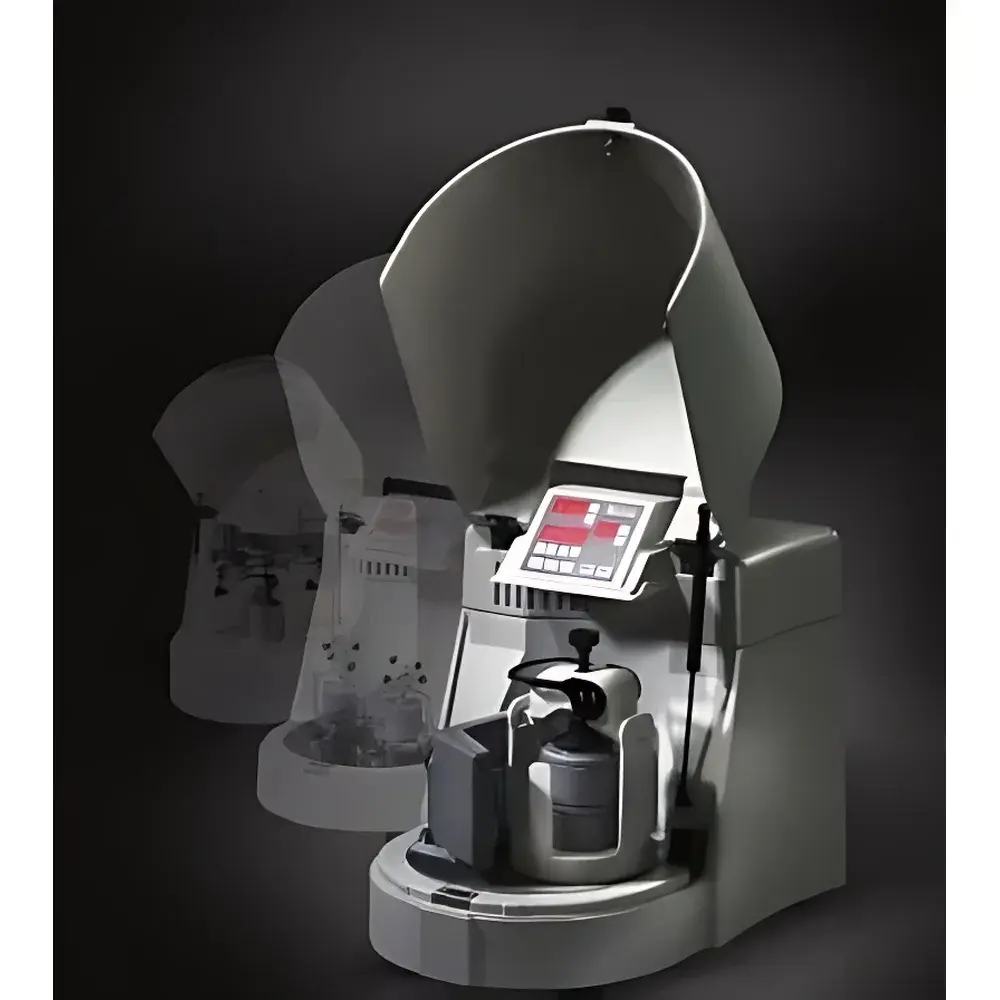
Fritsch Pulverisette 7 Premium Planetary Micro Mill
| Brand | Fritsch |
|---|---|
| Origin | Germany |
| Model | Pulverisette 7 |
| Maximum Bowl Speed | 100–800 rpm |
| Final Particle Size | < 1 µm |
| Max. Sample Volume | 40 mL |
| Max. Feed Size | 5 mm (material-dependent) |
| Input Power | 880 W |
| Voltage | 100–120 / 200–240 V, 50–60 Hz |
| Dimensions (W×D×H) | 37 × 53 × 50 cm |
| Net Weight | 35 kg |
| Gross Weight | 53 kg |
| Grinding Modes | Dry & Wet |
| Programmable Cycles | Up to 99 |
| Interface | RS232 |
| Safety Certification | CE |
| Warranty | 1 year |
Overview
The Fritsch Pulverisette 7 Premium Planetary Micro Mill is a high-energy laboratory grinding instrument engineered for precision particle size reduction of solid, suspended, or pasty samples down to the sub-micron range (< 1 µm). It operates on the principle of planetary ball milling—where grinding bowls rotate on their own axes while simultaneously revolving around a central sun wheel in opposite directions. This dual rotational motion generates high-frequency impact, shear, and compressive forces between grinding media and sample material. The resulting kinetic energy transfer far exceeds conventional horizontal or vibratory mills, enabling rapid, reproducible comminution with minimal thermal load and negligible cross-contamination. Designed for rigorous R&D and quality control environments, the Pulverisette 7 delivers consistent mechanical activation, homogenization, and dispersion performance across diverse material classes—including brittle minerals, soft polymers, fibrous botanicals, hydrated gels, and abrasive ceramics.
Key Features
- Variable bowl speed control from 100 to 800 rpm, allowing optimization of energy input for sensitive or refractory materials
- Programmable operation with up to 99 sequential grinding cycles, each independently configurable for speed, time, pause intervals, and direction reversal
- RS232 serial interface for external data logging, remote parameter setting, and integration into automated lab workflows
- Eight certified grinding vessel and media material options—including agate, zirconium oxide, stainless steel, tungsten carbide, silicon nitride, PTFE, hardened steel, and sintered corundum—to ensure chemical inertness and trace-level purity compliance
- Patented centrifugal locking mechanism with integrated safety interlock and CE-certified enclosure for operator protection during high-speed operation
- Quick-release bowl clamping system enabling tool-free installation and removal of grinding jars within seconds
- Low-profile, rigid cast-aluminum base structure with vibration-dampening feet for stable operation at maximum rotational speeds
Sample Compatibility & Compliance
The Pulverisette 7 accommodates a broad spectrum of sample types: dry powders, wet suspensions, emulsions, slurries, and semi-solid pastes. It is routinely employed in laboratories requiring adherence to ISO 13320 (laser diffraction particle size analysis), ASTM C117 (material fineness testing), USP (pharmaceutical particle size distribution), and EN 15309 (sludge and sediment characterization). Its closed-system design supports GLP-compliant documentation when paired with validated software protocols, and its non-reactive grinding media options meet stringent requirements for elemental analysis (e.g., XRF, ICP-MS) and pharmaceutical excipient processing under GMP Annex 15 guidelines. All components conform to RoHS and REACH directives; electrical systems comply with IEC 61000-6-2/6-4 EMC standards.
Software & Data Management
While the Pulverisette 7 operates via an intuitive front-panel membrane keypad and LCD display, its RS232 interface enables bidirectional communication with third-party LIMS or ELN platforms. Users may export cycle parameters—including start/stop timestamps, actual rpm profiles, total run duration, and error logs—for audit trail generation. When integrated with Fritsch’s optional LabSoft software (sold separately), full traceability is achieved—including electronic signatures, user access levels, and 21 CFR Part 11–compliant audit trails for regulated environments. Raw cycle data can be exported as CSV for statistical process control (SPC) analysis or correlation with downstream analytical results.
Applications
This mill serves critical roles across academic, industrial, and regulatory laboratories. In geoscience, it prepares homogeneous rock digests for multi-element ICP-OES analysis. In battery R&D, it homogenizes cathode precursors (e.g., NMC, LFP) without phase degradation. Pharmaceutical labs use it for amorphous solid dispersion development and API micronization prior to dissolution testing. Ceramic engineers rely on it for controlled attrition milling of zirconia or alumina nanopowders. Environmental labs apply it to soil and sediment homogenization for heavy metal leaching studies (TCLP, SPLP). Additionally, it supports mechanochemical synthesis, catalyst precursor activation, and nanocomposite formulation where stoichiometric uniformity and interfacial energy control are essential.
FAQ
What sample volume capacities does the Pulverisette 7 support?
Standard grinding bowls range from 0.5 mL to 40 mL nominal capacity, with optimal loading at 10–30% fill volume to ensure effective energy transfer and avoid overpacking.
Can the instrument handle heat-sensitive biological samples?
Yes—by selecting low-thermal-conductivity media (e.g., agate or PTFE) and implementing intermittent grinding protocols with cooling pauses, thermal degradation of proteins or nucleic acids can be minimized.
Is cryogenic grinding supported?
The standard unit is not liquid-nitrogen compatible; however, optional cryo-adapted bowls with integrated cooling jackets are available for sub-zero operation upon request.
How is method reproducibility ensured across different operators?
Each saved program stores absolute rotational parameters, eliminating manual speed/time entry errors; combined with calibrated torque monitoring and bowl-specific calibration offsets, inter-operator CV remains below 3% for median particle size (x50) in repeated trials.
Does Fritsch provide validation documentation for GxP environments?
Yes—IQ/OQ documentation packages, including factory calibration certificates, test protocols, and traceable reference standards, are available upon order confirmation for regulated users.



