
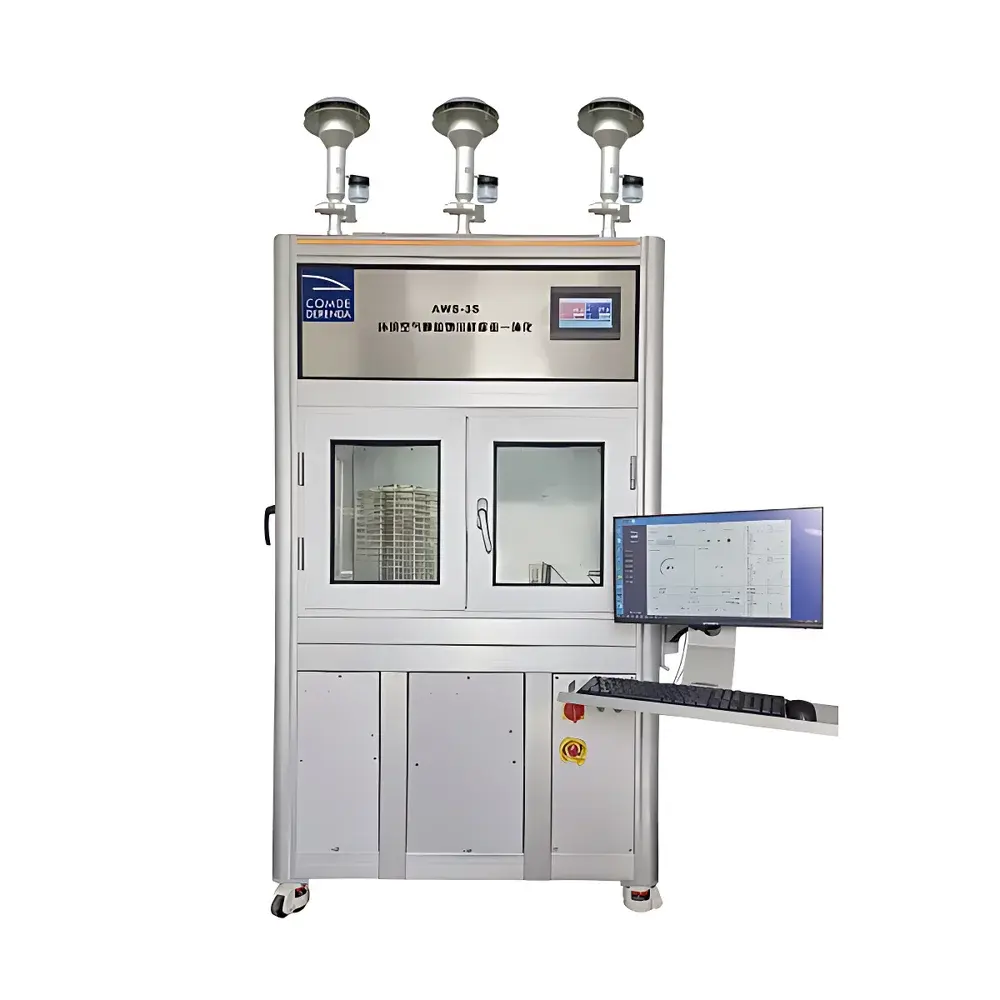
Derenda AWS-3S Integrated Environmental Air Particulate Matter (PM2.5/PM10) Sampling and Automated Gravimetric Weighing System
| Brand | Derenda |
|---|---|
| Origin | Jiangsu, China |
| Model | AWS-3S |
| Flow Range | 1–3.5 m³/h |
| Pump Pressure Resistance | >50 kPa at 1.0 m³/h |
| Flow Stability | 16.7 L/min (1 m³/h) |
| Max Flow Deviation | ≤2.0% over 24 h |
| Operating Duration per Cycle | 1 min to 999 h |
| Filter Capacity | 98 × 47 mm filters (7 trays × 14 positions) |
| Balance Resolution | 1 µg (10⁻⁶ g) |
| Temperature Control Range | 15–30 °C (±0.1 °C resolution) |
| Stability | ≤±0.5 °C over full weighing cycle |
| Humidity Control Range | 40–60 %RH (±0.1 %RH resolution) |
| Stability | ≤5 %RH over full cycle |
| Airflow Velocity in Chamber | ≤0.2 m/s (software-adjustable) |
| Cleanroom Class | ISO 14644 Class 6 |
| Robotic Positioning Accuracy | ±0.05 mm |
| Electrostatic Dissipation Time | ≤20 s (adjustable) |
| Vibration Isolation | Four-stage passive damping |
| Power Supply | 220 V ±10%, 50 Hz |
| Total Power Consumption | ≤3 kW |
| Weight | ≤700 kg |
Overview
The Derenda AWS-3S Integrated Environmental Air Particulate Matter (PM2.5/PM10) Sampling and Automated Gravimetric Weighing System is an engineered solution for regulatory-grade, reference-method compliant monitoring of ambient airborne particulate mass concentration. Designed in strict accordance with the U.S. EPA Reference Method equivalency framework and Chinese national standards—including HJ 618-2011, HJ 656-2013, HJ 93-2013, and HJ 653-2013—the AWS-3S implements a fully automated gravimetric workflow grounded in the principle of controlled environmental conditioning followed by ultra-precise microgram-level mass determination. The system integrates three independent, parallel sampling inlets with calibrated orifice plate flowmeters, a Class 6 cleanroom weighing chamber, a 1-µg resolution analytical balance housed on a vibration-isolated granite-sand platform, and a four-axis robotic handling system. Unlike conventional manual or semi-automated workflows, the AWS-3S eliminates inter-step contamination risks—such as transport-induced particle loss, static charge accumulation, or hygroscopic mass drift—by performing filter equilibration, electrostatic neutralization, and gravimetric analysis within a single, sealed, climate-stabilized environment.
Key Features
- Triple independent sampling inlets with individually controllable flow paths, enabling simultaneous co-location comparison against continuous ambient monitors (e.g., beta attenuation or TEOM instruments) per HJ 653-2013 requirements.
- Patented orifice plate flowmeter design with integrated high-accuracy temperature sensing; certified for ≥14-day calibration interval stability and zero maintenance over operational lifetime.
- Automated 98-filter capacity (7 trays × 14 positions), supporting unattended operation for ≥30 days under typical 24-hr sampling cycles.
- ISO 14644 Class 6 cleanroom weighing chamber featuring active temperature (15–30 °C, ±0.1 °C) and humidity (40–60 %RH, ±0.1 %RH) control, with programmable pre-conditioning start to optimize energy use.
- 1-µg resolution analytical balance mounted on a dynamically decoupled, 50-kg quartz-sand–weighted support island; achieves ≤0.005 mg repeatability at full scale and ≤5 s stabilization time.
- Four-axis robotic arm with ±0.05 mm repeatability, anti-drop gripper mechanism, and selective task assignment—enabling targeted weighing, de-staticizing, or tray-level operations without full-system activation.
- Full process automation: sample loading → environmental equilibration → electrostatic discharge (≤20 s, adjustable) → microgram-scale weighing → PM2.5/PM10 concentration calculation per HJ 618-2011 equations.
Sample Compatibility & Compliance
The AWS-3S accepts standard 47 mm diameter filters of any commercially available material (e.g., quartz fiber, Teflon®, cellulose ester, PVC), with no restriction on supplier or coating chemistry. All internal handling surfaces are non-reactive stainless steel or anodized aluminum, minimizing adsorption artifacts. The system meets the physical and procedural requirements of multiple regulatory frameworks: it satisfies the “reference method” definition under HJ 653-2013 for PM2.5/PM10 continuous monitor validation; fulfills the gravimetric accuracy, environmental control, and documentation traceability stipulated in HJ 656-2013; and conforms to metrological verification standards per JJG 1036-2022 (electronic balance calibration) and HJC-ZY-91 (automated filter weighing system performance testing). Optional factory-issued balance calibration certificates and NIST-traceable temperature/humidity sensor calibration reports are available for GLP/GMP-aligned laboratories.
Software & Data Management
The embedded control software provides role-based access, full audit trail logging (per FDA 21 CFR Part 11 principles), and timestamped records for every operational event—including flow calibration history, chamber environmental logs, balance diagnostics, robot motion sequences, and final gravimetric results. Raw mass data (tare, gross, net) and derived PM concentrations are exportable in CSV and XML formats compatible with national air quality data platforms (e.g., CNEMC’s AQMS). Remote monitoring via secure HTTPS interface enables real-time status checks and alarm notifications (e.g., door open, humidity excursion, balance drift). All data files include cryptographic hash signatures to ensure integrity and prevent post-acquisition tampering.
Applications
- Primary reference method deployment for national and provincial environmental monitoring stations conducting official PM2.5/PM10 compliance reporting.
- Co-location validation and performance evaluation of continuous ambient PM analyzers (e.g., BAM-1020, SHARP 5030, FH62C14) per HJ 653-2013 Annex B protocols.
- Long-term trend analysis requiring high inter-laboratory reproducibility and minimal operator-dependent variability.
- Method development and intercomparison studies involving novel filter substrates or low-concentration urban/rural background sites.
- Quality assurance/quality control (QA/QC) auditing of routine field sampling programs where manual handling introduces unacceptable uncertainty.
FAQ
Does the AWS-3S comply with U.S. EPA Federal Reference Method (FRM) or Federal Equivalent Method (FEM) criteria?
While not formally designated as an EPA FRM/FEM device, the AWS-3S implements all core technical requirements of EPA Method IO-PM-2.2 (gravimetric PM2.5) and ISO 12103-1 (ambient aerosol sampling), including flow accuracy, environmental control, and balance performance specifications. Its architecture aligns with the functional equivalence principles used in international method validation.
Can the system operate unattended for extended periods without manual intervention?
Yes. With its 98-filter magazine, self-calibrating flow system, and scheduled chamber preconditioning, the AWS-3S supports fully autonomous operation for up to 30 consecutive days under standard 24-hour sampling cycles.
Is the 1-µg balance internally verified during operation?
The system performs automated balance linearity and repeatability checks at user-defined intervals (e.g., before/after each weighing batch) using certified test weights traceable to national metrology institutes.
How does the system mitigate electrostatic interference during weighing?
Each filter undergoes programmable ionized air exposure (≤20 s) immediately prior to weighing, with real-time feedback from integrated surface potential sensors ensuring complete charge neutralization before mass acquisition.
What maintenance is required for long-term reliability?
The orifice plate flowmeter requires no periodic replacement; only routine cleaning of inlet filters and annual verification of temperature/humidity sensors and balance calibration are recommended per HJC-ZY-91 guidance.
Related Products







