
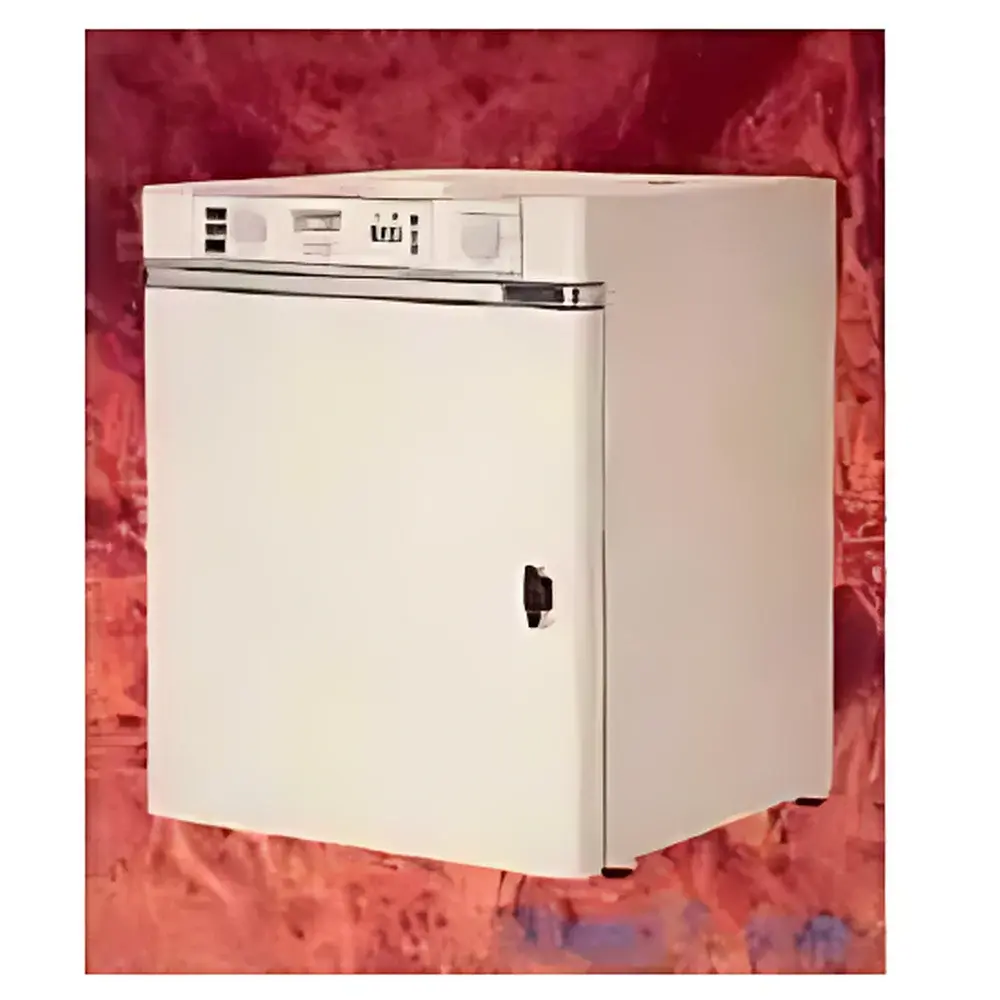
Designer Series Forced-Air Drying Oven
| Origin | New Zealand |
|---|---|
| Manufacturer Type | Authorized Distributor |
| Origin Category | Imported |
| Model | Designer Series |
| Instrument Type | High-Temperature Drying Oven |
| Temperature Range | +5°C to 260°C |
| Temperature Uniformity | ±2.5°C (at 105°C) |
| Temperature Stability | ±0.2°C |
| External Dimensions (W×D×H) | 550×530×550 mm |
| Internal Chamber Dimensions (W×D×H) | 400×360×420 mm |
| Power Supply | 230 V, 50 Hz |
| Safety Compliance | AS/NZS 3350, IEC 60335, CE Marked |
Overview
The Designer Series Forced-Air Drying Oven is a precision-engineered laboratory drying system designed for consistent thermal processing across research, quality control, and industrial validation environments. Utilizing forced convection via a high-efficiency axial fan and optimized airflow ducting, the oven ensures rapid heat transfer and uniform temperature distribution throughout the chamber—critical for applications requiring reproducible drying, curing, sterilization, or moisture loss quantification. Its microprocessor-based controller delivers stable setpoint maintenance within ±0.2°C, while the chamber’s double-wall construction—featuring 50 mm of high-density mineral wool insulation and polished stainless-steel interior surfaces—minimizes thermal leakage and supports long-term calibration integrity. Designed and assembled in New Zealand under strict adherence to international electrical safety standards (AS/NZS 3350 and IEC 60335), this series meets CE marking requirements and is suitable for GLP-compliant workflows where traceable thermal performance is mandatory.
Key Features
- Forced-air convection system with adjustable inlet/outlet vents and rear-mounted axial fan for rapid thermal equilibration and improved uniformity (±2.5°C at 105°C)
- Microprocessor-based digital controller with LED display, intuitive parameter navigation, and dual-stage audible/visual alarms for over-temperature and door-open conditions
- Programmable timer supporting intervals from 1 minute to 99 hours 59 minutes—or continuous operation mode
- Power-fail recovery function with EEPROM-backed memory: retains user-defined setpoints, calibration offsets, and timer status after mains interruption
- Interlocked safety architecture: heating and fan operation automatically suspend upon door opening to prevent thermal shock and energy waste
- Corrosion-resistant exterior coating over stainless-steel outer casing; seamless, electropolished 304 stainless-steel inner chamber and door liner
- Removable, load-rated stainless-steel shelving with 40 mm vertical adjustment increments; standard configuration includes one shelf (two shelves supplied on 8150 model)
- Integrated over-temperature cut-off with independent mechanical thermostat for fail-safe thermal protection
Sample Compatibility & Compliance
The Designer Series accommodates a broad range of sample formats—including Petri dishes, weighing boats, glassware, polymer films, pharmaceutical excipients, and metal coupons—without compromising thermal homogeneity. Chamber geometry and airflow dynamics have been validated per ISO 17025-relevant practices to ensure representative temperature mapping across all load configurations. All models comply with AS/NZS 3350.2.6 (Household and Similar Electrical Appliances – Particular Requirements for Hot Air Ovens) and IEC 60335-2-91 (Safety of Industrial Electroheating Equipment), fulfilling essential requirements for installation in accredited laboratories. CE marking confirms conformity with EU Machinery Directive 2006/42/EC and Low Voltage Directive 2014/35/EU. Optional documentation packages support audit readiness for FDA 21 CFR Part 11–aligned environments when paired with validated SOPs and periodic IQ/OQ protocols.
Software & Data Management
While the base unit operates via embedded firmware without external software dependency, its controller architecture supports optional RS-485 serial interface (Modbus RTU protocol) for integration into centralized lab monitoring systems. This enables remote logging of setpoint, actual temperature, timer status, and alarm events—facilitating automated data capture for electronic batch records. The EEPROM memory preserves calibration coefficients and user preferences across power cycles, ensuring continuity during routine maintenance or relocation. For regulated environments, the system’s deterministic response time (<2 s to detect over-temperature events) and non-volatile storage meet minimum criteria for ALCOA+ data integrity principles when deployed with appropriate procedural controls.
Applications
- Moisture content determination (e.g., ASTM D2231, ISO 787-2, USP <731>)
- Thermal stability testing of polymers, coatings, and composites
- Drying of filter papers, crucibles, and analytical reagents prior to gravimetric analysis
- Pre-conditioning of samples for tensile, rheological, or spectroscopic characterization
- Low-risk sterilization of non-critical lab tools and glassware (validated cycle required)
- Curing of adhesives, resins, and printed circuit board substrates
- Accelerated aging studies per ISO 11341 and ASTM G154
FAQ
What is the maximum operating temperature, and is it suitable for ash content analysis?
Maximum setpoint is 260°C. While sufficient for many drying and pre-ashing steps, ash content protocols (e.g., AOAC 923.03) typically require ≥500°C; this model is not intended for muffle furnace–level calcination.
Does the oven include validation documentation or factory calibration certificates?
Standard delivery includes a Factory Performance Test Report verifying chamber uniformity and stability at 105°C and 200°C. Optional UKAS-accredited calibration certificates and IQ/OQ execution support are available upon request.
Can the unit be installed in a fume hood or ventilated enclosure?
No. The forced-air system relies on ambient air intake and recirculation. Installation must occur in a well-ventilated, non-corrosive room with adequate clearance (≥100 mm) around all sides for heat dissipation.
Is the timer resolution configurable below 1 minute?
No. Minimum timer increment is 1 minute. For sub-minute thermal exposures, external programmable relays or PLC integration via RS-485 is recommended.
What maintenance is required to sustain temperature accuracy over time?
Annual verification of sensor drift using NIST-traceable reference thermometers is advised. Fan filter cleaning every 6 months and door gasket inspection for compression integrity are part of routine preventive maintenance.



