
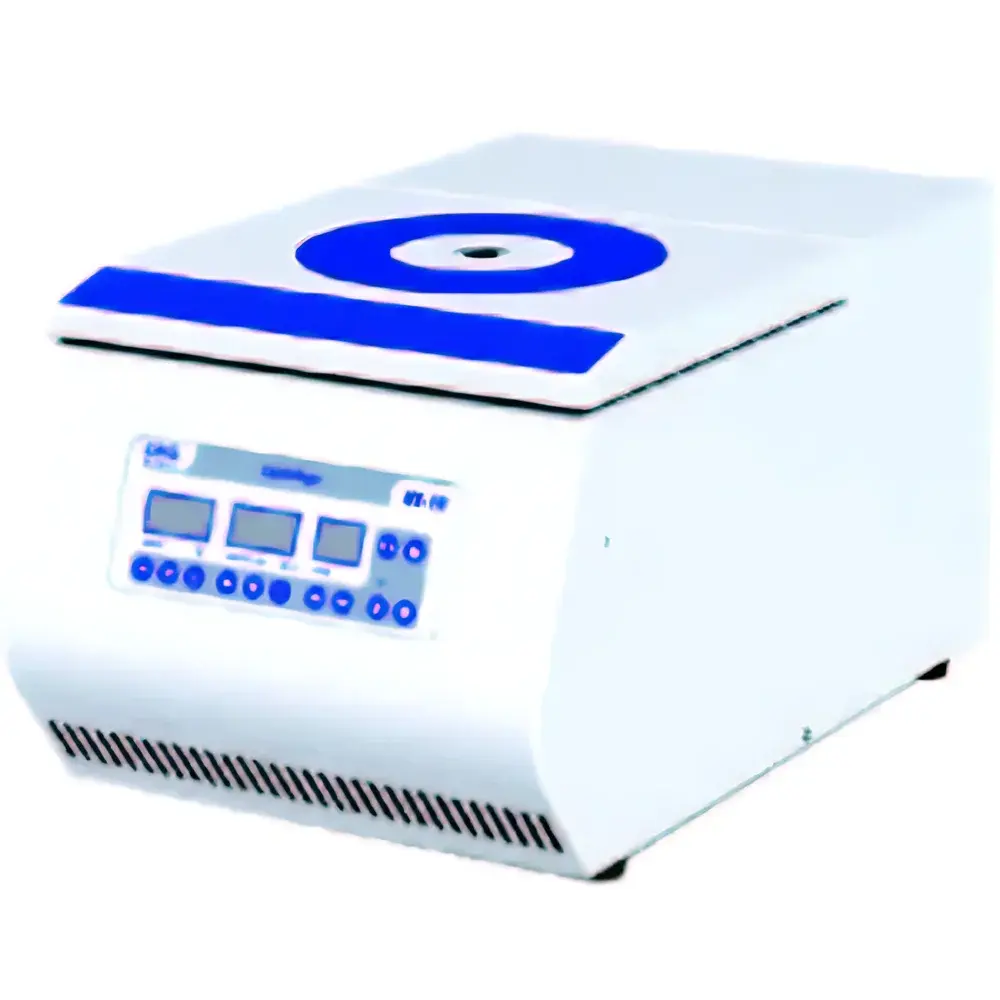
DHS NX-1/1R High-Speed Microcentrifuge with Refrigeration
| Brand | DHS |
|---|---|
| Origin | Tianjin, China |
| Model | NX-1/1R |
| Instrument Type | Benchtop Centrifuge |
| Speed Range | 200–17,500 rpm |
| Max RCF | 23,300 × g |
| Max Capacity | 12 × 5 mL tubes |
| Temperature Range | –20 °C to +40 °C |
| Refrigeration System | Eco-friendly non-CFC compressor |
| Dimensions (W×D×H) | 325 × 295 × 540 mm |
| Noise Level | ≤58 dB(A) |
| Rotor Type | Fixed-angle rotor |
| Compliance | CE, ISO 13485 (manufacturing), IEC 61010-1 |
| Certifications | Factory-tested per EN 61010-2-020 for centrifuges |
Overview
The DHS NX-1/1R is a compact, refrigerated benchtop high-speed microcentrifuge engineered for precision separation of biological macromolecules—including nucleic acids, proteins, and subcellular organelles—in resource-constrained or high-throughput laboratory environments. Operating on the principle of sedimentation under controlled rotational acceleration, the NX-1/1R delivers consistent RCF (relative centrifugal force) up to 23,300 × g at its maximum speed of 17,500 rpm. Its integrated non-CFC refrigeration system maintains sample integrity by stabilizing the rotor chamber at ≤4 °C during prolonged high-speed runs—a critical requirement for temperature-sensitive applications such as plasmid purification, viral pellet recovery, and enzyme activity preservation. The unit’s rigid all-metal chassis, combined with dual-chamber acoustic insulation and helical airflow ducting, ensures mechanical stability and operational quietness (<58 dB[A])—a design priority for shared lab spaces, cleanrooms, and clinical diagnostics suites.
Key Features
- Refrigerated operation with rapid cooling: Achieves –20 °C setpoint in <15 minutes; maintains ≤4 °C at full speed (17,500 rpm) via intelligent thermal load compensation
- Fixed-angle rotor optimized for 0.2–5 mL tube formats: Compatible with conical-bottom, round-bottom microtubes, spin filters, and 8-strip PCR plates—no adapter required for standard 1.5/2.0 mL tubes
- Advanced safety architecture: Electromagnetic door interlock, overspeed detection, real-time rotor imbalance monitoring, and overtemperature cutoff (both chamber and motor windings)
- UV-resistant, corrosion-resistant finish: Electrostatically applied epoxy-polyester coating withstands repeated ethanol wiping and UV-C surface decontamination cycles
- Condensation management system: Heated chamber walls and vapor-trap geometry prevent ice accumulation on rotor shaft and motor housing—even during extended low-temperature operation
- Dedicated “Quick Spin” button: Enables transient centrifugation (5–30 sec) without parameter programming—ideal for brief pelleting before pipetting or column-based workflows
Sample Compatibility & Compliance
The NX-1/1R supports routine handling of biospecimens classified under Biosafety Level 2 (BSL-2) containment protocols. Its sealed rotor chamber and non-porous interior surfaces meet ISO 15190:2020 requirements for diagnostic laboratory equipment hygiene. The instrument complies with IEC 61010-2-020 (safety for centrifuges), carries CE marking under the EU Machinery Directive 2006/42/EC, and adheres to electromagnetic compatibility standards per EN 61326-1. While not validated for GMP production environments, its design facilitates GLP-aligned documentation: event logs (start/stop time, speed, temperature, error codes) are retained in non-volatile memory and exportable via USB for audit trails. All materials contacting samples conform to USP Class VI biocompatibility testing.
Software & Data Management
The NX-1/1R operates via an embedded 3.5-inch TFT LCD interface with tactile membrane keys—designed for glove-compatible use and resistance to condensation ingress. No external PC or proprietary software is required for routine operation. However, optional firmware updates (distributed via encrypted USB drive) introduce enhanced data logging: timestamped run records include actual RCF, cumulative rotor hours, thermal deviation history, and door-cycle count—supporting preventive maintenance scheduling per ISO/IEC 17025 Clause 6.4.2. Audit-ready reports can be exported in CSV format for integration into LIMS platforms compliant with 21 CFR Part 11 (when paired with validated third-party electronic signature modules).
Applications
- Nucleic acid isolation: Rapid pelleting of silica-membrane columns and magnetic beads in automated extraction workflows
- Proteomics sample prep: Clarification of lysates prior to SDS-PAGE or LC-MS analysis
- Clinical microbiology: Concentration of low-titer pathogens (e.g., Mycobacterium tuberculosis sputum supernatants) for downstream PCR amplification
- Virology: Recovery of lentiviral or AAV particles from transfection supernatants at 4 °C
- Cell biology: Mitochondrial or nuclear fractionation using differential centrifugation protocols (e.g., 1,000 × g → 12,000 × g → 23,300 × g)
- Quality control in molecular diagnostics labs: Routine verification of reagent lot consistency via standardized spin-down assays
FAQ
What is the minimum operating temperature during continuous 17,500 rpm runs?
The chamber maintains ≤4.0 °C at rated speed when ambient temperature is ≤25 °C and humidity <60% RH.
Is rotor balancing required for 12 × 5 mL loads?
Yes—symmetrical loading is mandatory. The NX-1/1R does not support automatic imbalance compensation beyond ±0.5 g per position.
Can the unit be operated inside a cold room (4 °C)?
Yes, but ambient dew point must remain >–10 °C to prevent external condensation on electronics; recommended operating range is 10–32 °C.
Does the NX-1R rotor support autoclaving?
No—rotors are aluminum alloy with anodized finish; cleaning is limited to 70% ethanol or neutral pH detergents per manufacturer guidelines.
How often should the refrigeration system be serviced?
Compressor oil and filter-drier replacement is recommended every 36 months or after 10,000 operational hours—whichever occurs first—by certified DHS service personnel.



