
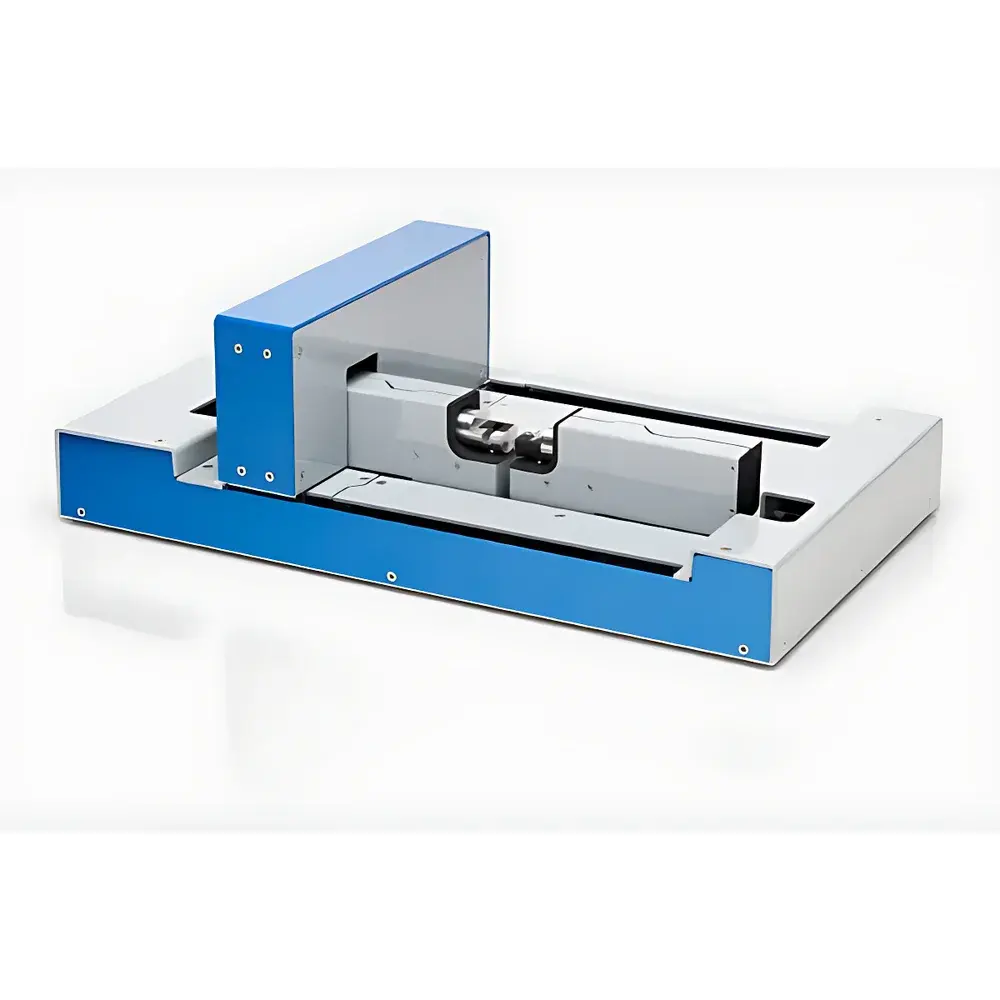
Dia-stron fibra.stress Automated Fiber Tensile Tester
| Brand | Dia-stron |
|---|---|
| Origin | United Kingdom |
| Model | fibra.stress |
| Type | Automated tensile testing system with integrated cross-sectional area measurement |
| Compliance | Designed for ISO 5079, ASTM D3822, and ISO 13934-1 compliant fiber mechanical characterization |
Overview
The Dia-stron fibra.stress is a fully automated, high-precision tensile testing system engineered specifically for the mechanical characterization of single fibers and fine filaments. Unlike conventional universal testing machines, the fibra.stress integrates real-time optical cross-sectional area measurement directly into the tensile workflow—enabling true stress–strain analysis rather than nominal force–extension reporting. Its core measurement principle relies on synchronized high-resolution imaging (via calibrated monochrome CMOS camera and telecentric optics) and closed-loop servo-controlled actuation to deliver repeatable, traceable mechanical data under controlled environmental conditions. The system operates on the fundamental premise that accurate tensile strength, modulus, and elongation at break require normalization to the actual geometric cross-section—not estimated or assumed values—particularly critical for natural fibers, regenerated cellulose, synthetic microfilaments, and bio-based yarn precursors where diameter heterogeneity exceeds ±5%.
Key Features
- Integrated dual-function measurement: Simultaneous acquisition of tensile load/displacement and fiber cross-sectional area (CSA) per specimen using calibrated image analysis
- Automated specimen handling: Motorized stage with programmable grip separation, auto-alignment, and zero-tension pre-loading detection
- High-fidelity force resolution: Load cell with ≤0.01 mN resolution and <±0.2% full-scale accuracy across 0.1–100 cN range
- Sub-micron displacement tracking: Non-contact optical encoder with 0.1 µm positional resolution and sampling rate up to 1 kHz
- Environmental control readiness: Compatible with optional temperature- and humidity-regulated test chambers (e.g., 20–30°C, 40–65% RH) meeting ISO 139 conditioning requirements
- Modular software architecture: Supports method-driven test sequencing, pass/fail criteria definition, and automatic report generation in PDF/CSV formats
Sample Compatibility & Compliance
The fibra.stress accommodates fibers ranging from 5 mm to 100 mm gauge length, with diameters between 5 µm and 500 µm—including staple fibers, continuous filaments, electrospun nanofibers (with auxiliary mounting aids), and twisted or core-sheath structures. Specimen mounting uses low-compliance pneumatic grips with interchangeable jaw faces (flat, serrated, or rubber-coated) to minimize slippage and crushing artifacts. All test protocols are structured to align with internationally recognized standards: ISO 5079 (determination of tensile properties of single textile fibers), ASTM D3822 (tensile properties of single textile fibers by constant-rate-of-extension), and ISO 13934-1 (tensile properties of fabrics—part 1: determination of maximum force and elongation). Data audit trails comply with GLP documentation requirements, and optional 21 CFR Part 11–compliant user access controls and electronic signatures are available via licensed software modules.
Software & Data Management
Dia-stron’s proprietary fibra.stress Control Suite provides a deterministic, scriptable interface for defining multi-step test methods—including preconditioning cycles, creep-recovery sequences, and cyclic loading protocols. Each test session captures raw load, displacement, and pixel-based CSA time-series data, with real-time calculation of engineering stress (MPa), strain (%), Young’s modulus (GPa), toughness (MJ/m³), and failure mode classification (brittle, ductile, fibrillar rupture). Data files are stored in vendor-neutral HDF5 format with embedded metadata (operator ID, calibration timestamp, environmental log, instrument firmware version). Export options include ANSI-standard CSV for third-party statistical analysis (e.g., JMP, Minitab) and XML-based reports compatible with LIMS integration. Version-controlled method libraries support laboratory-wide protocol harmonization and regulatory audit readiness.
Applications
This system serves laboratories engaged in fiber development, quality assurance, and academic research where mechanical fidelity directly correlates with end-product performance. Typical use cases include comparative evaluation of polymer molecular weight effects on polyamide filament strength; assessment of enzymatic or oxidative degradation in cotton or lyocell fibers; validation of spinning process parameters for PVA hydrogel fibers; and benchmarking of spider silk mimetics against natural references. In industrial settings, it supports supplier qualification per AATCC TM207 or customer-specific technical data packages requiring certified mechanical baselines. Its capacity to resolve sub-1% differences in modulus between nominally identical lots makes it indispensable for R&D teams optimizing fiber morphology–property relationships.
FAQ
Does the fibra.stress require manual diameter input before testing?
No. The integrated optical module acquires and analyzes the fiber’s projected area immediately prior to tensile loading, eliminating operator-dependent assumptions.
Can the system test non-circular or flattened fibers?
Yes. The image analysis algorithm computes equivalent circular diameter (ECD) and elliptical aspect ratio, enabling stress normalization for irregular cross-sections.
Is calibration traceable to national standards?
Yes. Force calibration is performed using NIST-traceable deadweight standards; dimensional calibration employs ISO 10360–compliant step gauges.
What sample preparation tools are recommended?
Dia-stron supplies fiber mounting frames, microtweezers, and epoxy embedding kits optimized for fragile or slippery specimens.
How is data integrity maintained during long-term deployment?
The software enforces immutable audit logs, automatic backup to network drives, and checksum-verified data archiving per ISO/IEC 17025 clause 7.5.2.






