
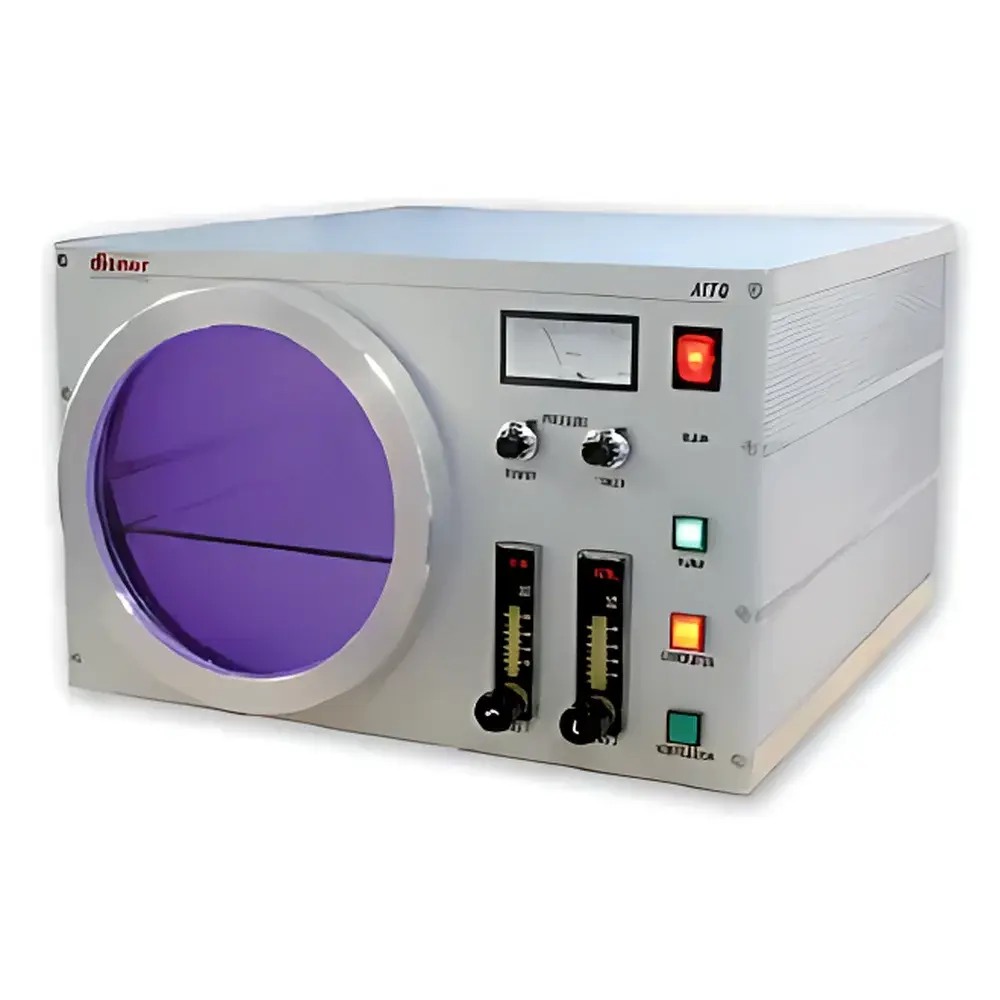
Diener ATTO Plasma Cleaning System
| Brand | Diener |
|---|---|
| Origin | Germany |
| Model | ATTO |
| RF Frequencies | 13.56 MHz & 40 kHz |
| Power Output | 50 W (low-mode) / 200 W (high-mode) |
| Chamber Dimensions | Ø211 mm × L300 mm |
| Chamber Volume | 10.5 L |
| Chamber Material | High-borosilicate glass |
| Gas Inlets | Dual-channel, configurable with manual needle valves or mass flow controllers (MFCs) |
| Control Architecture | Manual timer-based operation, external PC control (Windows XP/CE), or integrated embedded PC control |
| Vacuum Pump Capacity | 5 m³/h |
| External Dimensions | 525 mm (W) × 275 mm (H) × 450 mm (D) |
| Input Voltage | AC 220 V |
Overview
The Diener ATTO Plasma Cleaning System is a compact, benchtop-capable low-pressure plasma processing platform engineered for precision surface modification in research, development, and small-batch production environments. Operating on the principle of capacitively coupled radio-frequency (RF) plasma generation, the ATTO supports dual-frequency excitation—13.56 MHz for high-density, uniform plasma suitable for gentle cleaning and activation, and 40 kHz for higher ion energy delivery optimized for controlled etching and ashing. Its 10.5 L high-borosilicate glass chamber provides optical transparency for real-time process observation and ensures chemical inertness against reactive species generated from O₂, Ar, N₂, CF₄, or air-based plasmas. Designed for reproducible, operator-independent results, the ATTO serves as a foundational tool for sample preparation prior to electron microscopy (SEM/TEM), adhesion enhancement in microfabrication, biofunctionalization of polymers, and residue-free decontamination in medical device R&D.
Key Features
- Dual-frequency RF generator (13.56 MHz and 40 kHz) with automatic impedance matching to maintain stable plasma ignition and minimize reflected power across varying gas compositions and pressures.
- Modular gas delivery system supporting either manual needle-valve regulation or precision mass flow control (MFC) for two independent process gases—enabling repeatable gas mixing ratios critical for process transferability.
- Optically transparent borosilicate glass chamber (Ø211 mm × 300 mm L) rated for vacuum operation down to ≤10⁻² mbar, compatible with standard KF-25 and ISO-KF flanges for integration with turbomolecular or diaphragm pumps.
- Three control configurations: manual analog timer mode for rapid prototyping; external PC-based control via RS232/USB interface running Windows XP or CE; or fully integrated embedded PC control with touchscreen GUI and onboard data logging.
- Robust mechanical architecture with vibration-damped baseplate, EMI-shielded RF enclosure, and safety interlocks compliant with EN 61000-6-3 (EMC) and EN 61010-1 (electrical safety).
Sample Compatibility & Compliance
The ATTO accommodates substrates up to Ø200 mm and 50 mm in height—including silicon wafers, polymer films, metal foils, ceramic tiles, biological scaffolds, and archaeological artifacts—without requiring custom fixtures. Its low-thermal-load plasma regime (<40 °C substrate temperature rise under typical 5–10 min treatments) preserves heat-sensitive materials such as PET, PDMS, and protein-coated surfaces. The system meets essential requirements for GLP-compliant laboratories: full audit trail capability (when equipped with PC control), user-access-level permissions, and timestamped parameter logging. While not certified as a medical device sterilizer per ISO 14937 or ISO 11137, it is widely employed in pre-sterilization surface conditioning and bioburden reduction studies aligned with USP and AAMI ST79 guidelines.
Software & Data Management
PC-controlled variants run Diener’s proprietary Plasmawin software, offering programmable multi-step recipes with real-time monitoring of forward/reflected RF power, chamber pressure, gas flow rates, and treatment duration. All operational parameters are stored in .csv format with ISO 8601 timestamps, enabling traceability for internal quality audits and regulatory submissions. The software supports export to third-party analysis platforms (e.g., MATLAB, Python pandas) and integrates with laboratory information management systems (LIMS) via OPC UA or TCP/IP protocols. Embedded PC versions include local storage redundancy and optional remote access via secure SSH or VNC—facilitating unattended overnight runs and cross-site method validation.
Applications
- Electron Microscopy Sample Prep: Removal of hydrocarbon contamination and native oxides from TEM grids and SEM stubs to improve signal-to-noise ratio and reduce charging artifacts.
- Microfluidic Device Fabrication: Oxygen plasma activation of PDMS/glass bonding interfaces to achieve irreversible, leak-tight seals without adhesive layers.
- Biomaterial Surface Engineering: Amine-functionalization of polystyrene culture plates or PCL electrospun meshes to enhance cell adhesion and proliferation kinetics.
- Archaeological Conservation: Non-abrasive removal of sulfate crusts and organic residues from fragile ceramic or metal artifacts prior to XRF or Raman mapping.
- Printed Electronics: Pre-deposition cleaning of ITO/PET substrates to eliminate surface contaminants that compromise conductive ink wetting and film continuity.
FAQ
What vacuum level is required for stable plasma ignition in the ATTO chamber?
Stable plasma ignition is achieved at pressures between 0.1–10 Pa (1×10⁻³–1×10⁻¹ mbar), typically maintained using the标配 5 m³/h rotary vane pump. For oxygen-rich chemistries or high-precision ashing, optional turbomolecular pumping extends the low-pressure range to 1×10⁻⁴ mbar.
Can the ATTO be used for plasma polymerization?
Yes—when equipped with MFC-controlled monomer vapor delivery (e.g., HMDSO, allylamine) and appropriate pressure stabilization, the ATTO supports conformal plasma polymer film deposition with thickness control down to sub-10 nm per minute.
Is the glass chamber resistant to fluorinated plasmas (e.g., CF₄/O₂)?
High-borosilicate glass exhibits acceptable resistance to short-duration (<5 min), low-power CF₄/O₂ plasmas. For extended fluorocarbon processing, Diener recommends optional quartz chamber upgrade (part no. QZ-ATTO-10L) to prevent etch-induced clouding.
Does the system support FDA 21 CFR Part 11 compliance?
The embedded PC configuration with Plasmawin v4.2+ provides electronic signatures, role-based access control, and immutable audit logs—meeting core technical requirements for Part 11 adherence when deployed within validated IT infrastructure.
What maintenance intervals are recommended for the RF generator and vacuum system?
RF generator requires no routine calibration; annual verification of output power accuracy (±5%) using a calibrated RF power meter is advised. The vacuum pump oil should be changed every 500 operating hours or semiannually, whichever occurs first.



