
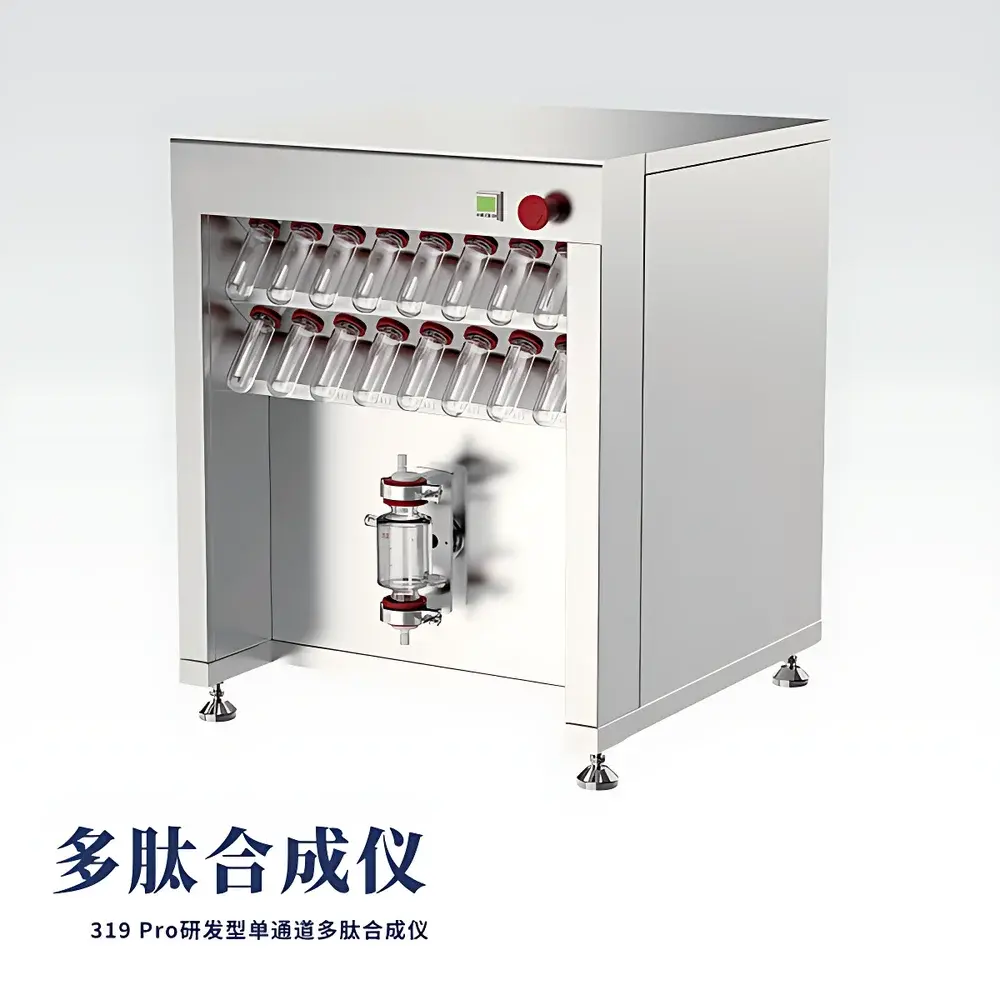
Dilun Bio 319 Pro Research-Grade Single-Channel Peptide Synthesizer
| Brand | Dilun Bio |
|---|---|
| Origin | Beijing, China |
| Model | 319 Pro |
| Channel Count | 1 |
| Reactor Quantity | 2 |
| Reactor Volume Range | 25/50 mL and 50/100/250 mL |
| Synthesis Scale | 0.1–3 mmol |
| Amino Acid Positions | 8 or 16 |
| Solvent Ports | 7 |
| Solvent Reservoir Options | 0.5 L, 1 L, 2 L, 5 L, 10 L |
| Mixing Mode | 180° vertical inversion agitation with continuously variable speed control |
| Reagent Dispensing Precision | ±0.1 mL |
| Temperature Control | 360° electromagnetic induction annular heating (optional water bath) |
| Dimensions (W×D×H) | 60 × 60 × 72 cm |
| Weight | 68 kg |
| Power Supply | 110/220 V, 50/60 Hz |
| Max Peptide Length | 100 residues |
Overview
The Dilun Bio 319 Pro Research-Grade Single-Channel Peptide Synthesizer is an engineered platform for solid-phase peptide synthesis (SPPS) optimized for method development, process validation, and small-batch production in academic laboratories and early-stage biopharmaceutical R&D environments. It implements Fmoc- and Boc-based SPPS chemistries through fully automated, programmable cycles of deprotection, coupling, washing, and capping—executed with high reproducibility across synthesis scales from 0.1 to 3 mmol. The system’s core architecture centers on dual-reactor capability (25/50 mL and 50/100/250 mL configurations), enabling parallel optimization of resin swelling kinetics, reagent stoichiometry, and coupling efficiency under identical thermal and mechanical conditions. Its 180° vertical inversion mixing mechanism eliminates dead zones in resin beds and ensures uniform suspension without shear-induced cleavage—a critical advantage for long or sterically hindered sequences.
Key Features
- Single-channel, dual-reactor configuration supports comparative synthesis studies (e.g., resin screening, solvent optimization, or coupling reagent evaluation) within a single run.
- Continuously variable mechanical agitation via 180° vertical inversion—adjustable from 0 to 60 rpm—ensures consistent resin suspension while minimizing mechanical degradation of sensitive resins or growing chains.
- Automated amino acid and activator delivery with volumetric precision of ±0.1 mL per dispense, calibrated against gravimetric standards traceable to NIST-certified reference materials.
- Modular solvent station with seven independently addressable ports and configurable reservoirs (0.5 L to 10 L) enables seamless integration of multi-solvent protocols—including DMF, DCM, piperidine, and cleavage cocktails—without manual intervention.
- Dual temperature control options: standard 360° electromagnetic induction ring heater (ambient to 90°C, ±0.5°C stability) or optional external recirculating water bath interface compliant with ISO 17025 environmental chamber requirements.
- Robust stainless-steel and chemical-resistant polymer chassis (IP54-rated enclosure) meets CE and RoHS directives for laboratory instrumentation safety and electromagnetic compatibility.
Sample Compatibility & Compliance
The 319 Pro accommodates standard SPPS resins—including Wang, Rink amide, 2-Cl-Trt, and Sieber amide supports—in particle sizes ranging from 100–300 µm. It supports both pre-loaded and custom-packed reactors, compatible with standard 25–250 mL reaction vessels conforming to ASTM D5231-20 (resin bed volume calibration). All fluidic pathways are constructed from PFA, PTFE, and 316L stainless steel to ensure inertness toward TFA, HOBt, DIC, and other aggressive reagents. The system operates in alignment with GLP-compliant documentation workflows: all synthesis parameters (temperature setpoints, agitation profiles, dispense volumes, cycle timestamps) are logged with UTC-stamped audit trails exportable in CSV and XML formats. Optional 21 CFR Part 11-compliant software modules support electronic signatures, user access tiers, and data integrity controls required for preclinical peptide manufacturing.
Software & Data Management
The embedded control interface runs Dilun SynthOS v4.2—a deterministic real-time operating system with deterministic task scheduling and non-volatile parameter storage. Method templates are stored locally with version-controlled revision history; each synthesis run generates a machine-readable metadata file containing full execution logs, error flags, and sensor telemetry (temperature, pressure, valve actuation status). Data export supports direct integration into LIMS platforms via RESTful API or OPC UA protocol. Batch reports include calculated coupling yields (via ninhydrin or chloranil assay integration), resin loading verification, and deviation alerts triggered by out-of-spec dispense volumes or thermal excursions exceeding ±1.0°C for >30 s. Backup and restore functions comply with ISO/IEC 27001 Annex A.8.2.3 for secure firmware and method archive management.
Applications
- Optimization of SPPS protocols for novel peptide therapeutics, including stapled peptides, cyclic analogs, and D-amino acid-containing sequences.
- Resin and linker evaluation under controlled hydration and swelling conditions to improve C-terminal fidelity and reduce aspartimide formation.
- Scale-down modeling for GMP manufacturing transfer—correlating 0.25 mmol lab-scale results with 5–50 mmol pilot-scale outcomes using identical kinetic profiles.
- Synthesis of isotopically labeled peptides for NMR structural studies, where batch-to-batch consistency in truncation and deletion profiles is essential.
- Method qualification per ICH Q5B and USP <1058> for analytical reference standards used in HPLC and LC-MS quantification.
FAQ
What synthesis chemistries does the 319 Pro support?
The system natively supports both Fmoc- and Boc-strategy SPPS, including orthogonal side-chain protection schemes and specialty coupling reagents (e.g., PyAOP, HATU, COMU). Customizable deprotection times and wash cycles accommodate acid-labile linkers.
Can the 319 Pro be integrated into a cleanroom environment?
Yes—the instrument meets ISO Class 7 (Class 10,000) particulate emission limits when operated with HEPA-filtered exhaust ducting. Optional pass-through ports and static-dissipative surface finishes are available for ISO 14644-1 compliance.
Is remote monitoring supported?
Standard Ethernet and optional Wi-Fi connectivity enable secure remote viewing of real-time synthesis status, alarm logs, and historical run archives via TLS 1.2–encrypted web interface.
What regulatory documentation is provided with the system?
Each unit ships with a Factory Acceptance Test (FAT) report, IQ/OQ protocol templates aligned with ASTM E2500-13, and a Certificate of Conformance detailing material traceability, electrical safety testing (IEC 61010-1), and electromagnetic immunity (IEC 61326-1).
Does the system support automated cleavage and precipitation?
While cleavage is performed off-instrument per standard SPPS practice, the 319 Pro includes dedicated solvent ports and timing logic to coordinate post-synthesis quenching and neutralization steps prior to resin filtration—enabling seamless handoff to downstream lyophilization or HPLC purification workflows.





