
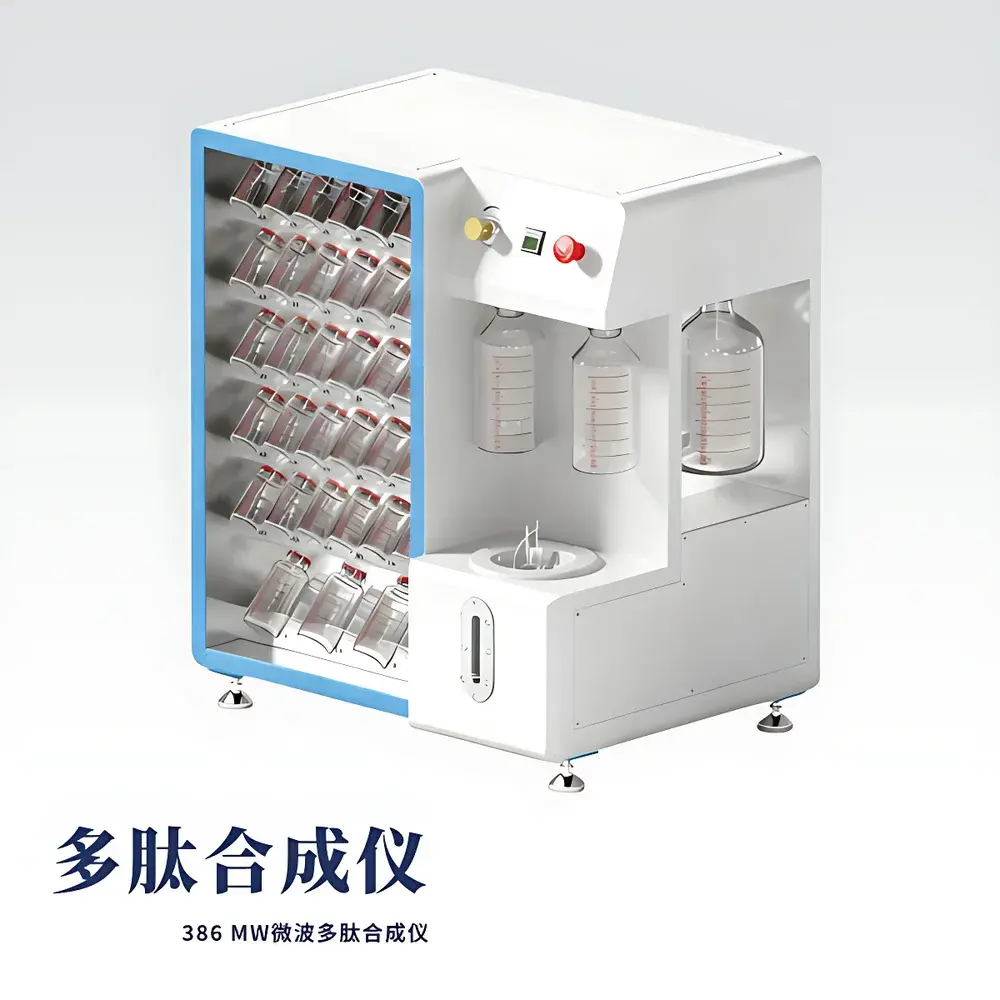
Dilun Bio 386MW Microwave-Assisted Solid-Phase Peptide Synthesizer
| Brand | Dilun Bio |
|---|---|
| Origin | Beijing, China |
| Model | 386MW |
| Amino Acid Addition | Automated |
| Reagent Addition | Automated |
| Synthesis Scale | 0.1–1.5 mmol |
| Reactor Count | 1 |
| Reactor Volume Options | 30 mL / 120 mL |
| Synthesis Purity | ≥99.5% |
| Amino Acid Positions | 28 |
| Activator Positions | 4 |
| Solvent Positions | 4–6 |
| Dimensions (W×D×H) | 77.5 × 55 × 84 cm |
| Weight | 75 kg |
| Power Supply | 110/220 V, 50/60 Hz |
Overview
The Dilun Bio 386MW Microwave-Assisted Solid-Phase Peptide Synthesizer is an engineered platform for high-efficiency, sequence-specific peptide synthesis using controlled microwave irradiation. Unlike conventional conductive heating methods—such as oil baths or hot-air ovens—the 386MW applies non-ionizing electromagnetic energy (typically at 2.45 GHz) to directly couple with polar molecules and ionic intermediates in the reaction milieu. This enables rapid, volumetric, and selective heating of the resin-bound peptide chain during critical steps: Fmoc deprotection and amino acid coupling. As a result, reaction kinetics are significantly accelerated—typical coupling and deprotection cycles are reduced to 1/30–1/10 of conventional times—while maintaining high fidelity in amide bond formation. The system operates under programmable, closed-vessel conditions with real-time temperature monitoring and pressure regulation, minimizing racemization risk in most standard residues. Notably, while cysteine, histidine, and aspartic acid require careful protocol optimization due to heightened epimerization susceptibility under microwave conditions, the 386MW integrates configurable power ramping, pulse modulation, and inert gas purging to mitigate these effects.
Key Features
- Single-reactor architecture supporting dual-volume configurations (30 mL and 120 mL reaction vessels), enabling flexible scale-up from analytical to preparative synthesis (0.1–1.5 mmol).
- Automated reagent delivery system with 28 dedicated amino acid positions, four activator ports (with 0.1 mL volumetric precision), and 4–6 solvent reservoirs (compatible with 0.5 L–10 L tanks).
- Integrated microwave cavity with dynamic power control (0–300 W adjustable), temperature feedback loop (±0.5 °C accuracy), and pressure-sensing safety interlock.
- Modular fluidic design compliant with USP Chapter <1058> guidelines for analytical instrument qualification—supports IQ/OQ documentation packages upon request.
- Rugged stainless-steel chassis (75 kg mass) with vibration-damped base and EMI-shielded electronics, suitable for shared core facilities and GMP-adjacent laboratories.
Sample Compatibility & Compliance
The 386MW accommodates standard Wang, Rink, and 2-chlorotrityl resins, as well as specialty supports for C-terminal modifications (e.g., hydrazide, aldehyde, or thioester linkers). It is compatible with common coupling reagents (HBTU, HATU, DIC/Oxyma), Fmoc-protected amino acids (including pseudoproline dipeptides and sterically hindered residues), and orthogonal protecting groups (e.g., Trt for Cys, Boc for His, tBu for Asp). All wetted materials meet ISO 10993-1 biocompatibility requirements for contact with synthetic peptides intended for preclinical research. The system supports audit-ready operation under GLP environments through optional electronic logbook integration and user-access-level controls aligned with FDA 21 CFR Part 11 principles (when paired with validated third-party LIMS or ELN platforms).
Software & Data Management
Controlled via Dilun Bio’s proprietary SynthOS™ v4.2 software, the 386MW provides intuitive method scripting—including stepwise temperature/power profiles, dwell time sequencing, and conditional branching for iterative coupling validation. All synthesis logs (time-stamped temperature, pressure, reagent dispense volume, and cycle count) are exported in CSV and XML formats compliant with ASTM E2500-18 for raw data archival. Optional API access enables bidirectional communication with laboratory information management systems (LIMS) for automated sample ID propagation and batch record generation. Software validation documentation (IQ/OQ/PQ protocols) is available for regulated users upon formal request and site-specific installation verification.
Applications
- Rapid synthesis of difficult sequences (>30 residues) containing aggregation-prone motifs (e.g., poly-Leu, β-sheet domains) where microwave-enhanced solvation improves coupling efficiency.
- Parallel synthesis of peptide libraries for epitope mapping, structure–activity relationship (SAR) studies, and vaccine candidate screening.
- Preparation of isotopically labeled peptides for NMR structural analysis, requiring high chemical fidelity and minimal side-product formation.
- Production of peptide–drug conjugates (PDCs) and cyclic peptides with head-to-tail or side-chain-to-side-chain cyclization under microwave-accelerated conditions.
- Method development for continuous-flow solid-phase synthesis workflows, leveraging the 386MW’s precise reagent metering and thermal responsiveness as a reference platform.
FAQ
Does the 386MW support multi-channel parallel synthesis?
No—the 386MW is a single-reactor system optimized for high-fidelity, parameter-controlled synthesis. For parallel synthesis, Dilun Bio offers the 386MW-12 variant (12 independent reactors), sold separately.
What safety certifications does the instrument carry?
The 386MW complies with IEC 61010-1 (Safety Requirements for Electrical Equipment for Measurement, Control, and Laboratory Use) and bears CE marking for EMC and low-voltage directives. It includes redundant thermal cutoffs, pressure-relief valves, and door-interlocked microwave emission shielding.
Can the system be integrated into an automated lab infrastructure?
Yes—via RS-232, Ethernet, and Modbus TCP interfaces, the 386MW supports external trigger signals and status reporting for integration into robotic workcells or centralized process orchestration platforms.
Is on-site installation and qualification support available internationally?
Yes—Dilun Bio coordinates with certified local partners in North America, EU, APAC, and EMEA regions to deliver IQ/OQ services, including calibration traceability to NIST standards and GxP-aligned documentation templates.
What maintenance intervals are recommended for routine operation?
Daily: Visual inspection of fluid lines and O-rings; weekly: cleaning of microwave waveguide window and solvent filters; annually: full calibration of temperature/pressure sensors and pump volumetric accuracy verification per ISO/IEC 17025 procedures.



