
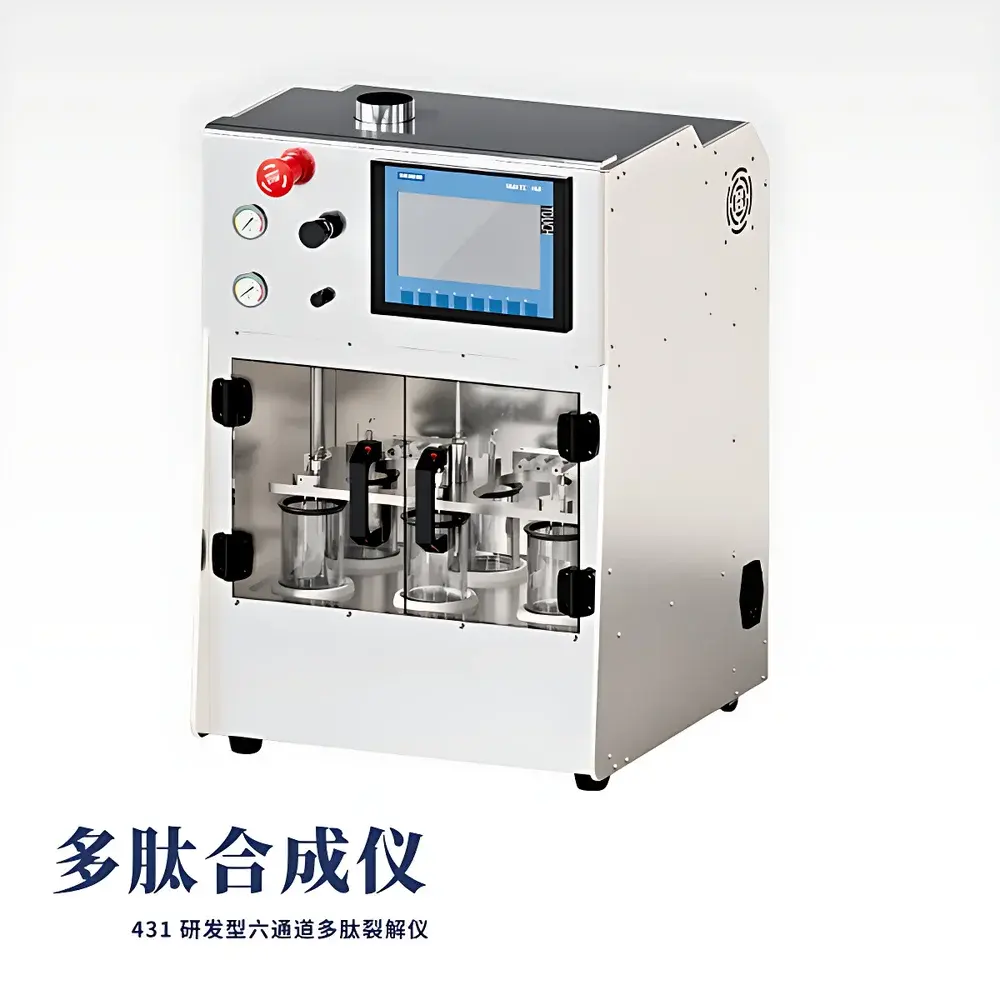
Dilun Bio 431 Research-Grade Six-Channel Peptide Cleavage System
| Brand | Dilun Bio |
|---|---|
| Origin | Beijing, China |
| Model | 431 |
| Amino Acid Addition | Automated |
| Reagent Addition | Automated |
| Reactor Count | 1 |
| Reactor Volume Range | 10–500 mL |
| Cleavage Volume Precision | ±0.1 mL |
| Precipitation Volume Precision | ±0.1 mL |
| Cleavage Reservoir | 5 L (PP) |
| Precipitation Reservoir | 5 L (Glass) |
| Stirring Method | Magnetic Stirring |
| Power Supply | 110/220 V, 50/60 Hz |
| Dimensions (W×D×H) | 45×45×66 cm |
| Weight | 30 kg |
Overview
The Dilun Bio 431 Research-Grade Six-Channel Peptide Cleavage System is an engineered platform designed for high-fidelity, parallel cleavage of resin-bound peptides in solid-phase peptide synthesis (SPPS) workflows. Unlike conventional single-batch cleavage stations, the 431 system executes six independent cleavage, concentration, and precipitation cycles simultaneously—each with full volumetric control and process traceability. It operates on a sequential solvent delivery principle: cleavage cocktails (e.g., TFA-based mixtures) are precisely metered into individual reaction vessels containing peptide-resin, followed by controlled agitation, timed incubation, vacuum-assisted solvent removal, and quantitative transfer of cleaved crude peptide solution into designated precipitation chambers. The system integrates gravimetric and volumetric feedback loops to ensure repeatability across scales from 0.1 mmol to 10 mmol synthesis batches. Its architecture supports both Fmoc- and Boc-based cleavage chemistries and is compatible with standard 10–500 mL glass or PTFE-lined reactors, enabling direct scalability from discovery-scale screening to pilot-stage purification readiness.
Key Features
- Six-channel parallel processing with independent timing, temperature (ambient), and volume control per channel
- Automated dual-fluid handling: cleavage reagent (TFA, phenol, water, TIPS, etc.) and precipitation solvent (cold diethyl ether, MTBE) delivered via calibrated peristaltic pumps with ±0.1 mL accuracy
- Integrated magnetic stirring for uniform resin suspension during cleavage, minimizing channeling and incomplete deprotection
- Dual reservoir system: 5 L polypropylene cleavage solvent tank and 5 L borosilicate glass precipitation solvent tank, both equipped with level sensors and inert gas purge ports
- Modular reactor interface accommodating standard threaded-neck glass vessels (10–500 mL), with vacuum-sealed lid assemblies and integrated filter frits
- Embedded microprocessor controller with password-protected method storage, real-time status logging, and USB export of process logs (timestamp, volumes dispensed, stir duration, vacuum cycle count)
Sample Compatibility & Compliance
The 431 system accommodates a broad range of resin types—including Wang, Rink amide, 2-chlorotrityl, and Sieber resins—as well as diverse amino acid side-chain protecting groups (e.g., tBu, Trt, Pbf, OtBu). All wetted materials comply with USP Class VI biocompatibility standards: PP reservoirs, PTFE tubing, borosilicate glass vessels, and EPDM gaskets resist aggressive cleavage solvents (TFA, HF, TFMSA) and low-temperature precipitants. The system supports GLP-compliant operation through audit-trail-enabled method execution and electronic logbook generation. While not certified to ISO 13485 or FDA 21 CFR Part 11 out-of-the-box, its data export architecture (CSV/Excel-compatible logs) enables integration into validated laboratory information management systems (LIMS) and satisfies documentation requirements under ICH Q5, Q7, and USP analytical instrument qualification frameworks.
Software & Data Management
The 431 runs on embedded firmware with a tactile 7-inch LCD HMI interface supporting multilingual operation (English, Chinese, German, Japanese). Users define cleavage protocols via intuitive step sequencing: “Add cleavage cocktail → Stir × X min → Vacuum evacuate → Transfer supernatant → Add cold ether → Centrifuge-ready output.” Each protocol stores up to 99 steps with configurable dwell times, pump speeds, and vacuum thresholds. All executed runs generate timestamped .csv files containing volume dispensed, stir RPM (if external motor used), vacuum pressure profile, and error flags (e.g., low-level alarm, overpressure timeout). Logs are exportable via USB flash drive or optional Ethernet module (TCP/IP) for centralized archive in institutional data repositories. No cloud connectivity or remote telemetry is enabled by default—data sovereignty remains fully under user control.
Applications
- High-throughput cleavage optimization studies (solvent composition, scavenger ratios, cleavage time gradients)
- Parallel synthesis of peptide libraries for structure–activity relationship (SAR) analysis
- Preparative-scale cleavage prior to HPLC purification of therapeutic peptides (e.g., GLP-1 analogs, antimicrobial peptides)
- Resin recovery and reuse validation under controlled cleavage conditions
- Process development for GMP-aligned peptide manufacturing, including tech transfer documentation support
- Academic and CRO labs requiring reproducible, auditable cleavage for publication-grade data generation
FAQ
Can the 431 accommodate custom reactor geometries beyond standard round-bottom vessels?
Yes—the base plate features adjustable clamping brackets and standardized 1/4″ NPT vacuum and fluid ports, permitting integration of non-standard reactors (e.g., jacketed vessels, inline filters) with appropriate adapters.
Is the system compatible with hydrogen fluoride (HF) or trimethylsilyl trifluoromethanesulfonate (TFMSA) cleavage protocols?
HF requires specialized containment; the 431’s standard configuration is rated for TFA and milder acids only. Optional HF-resistant PFA fluid paths and quartz reactor kits are available upon engineering review.
Does the 431 support automated lyophilization integration?
No—lyophilization is a downstream step. However, the system outputs cleaved peptide solutions in pre-chilled, sealed vials compatible with standard freeze-dryer loading trays.
What maintenance intervals are recommended for pump tubing and seals?
Peristaltic pump tubing should be replaced every 6 months under continuous use; O-rings and gaskets are inspected during quarterly preventive maintenance and replaced if compression set exceeds 15%.
Can method parameters be locked to prevent unauthorized modification?
Yes—administrator-level password protection restricts editing of stored protocols, calibration constants, and system configuration settings. Audit trails record all login attempts and parameter changes.




