
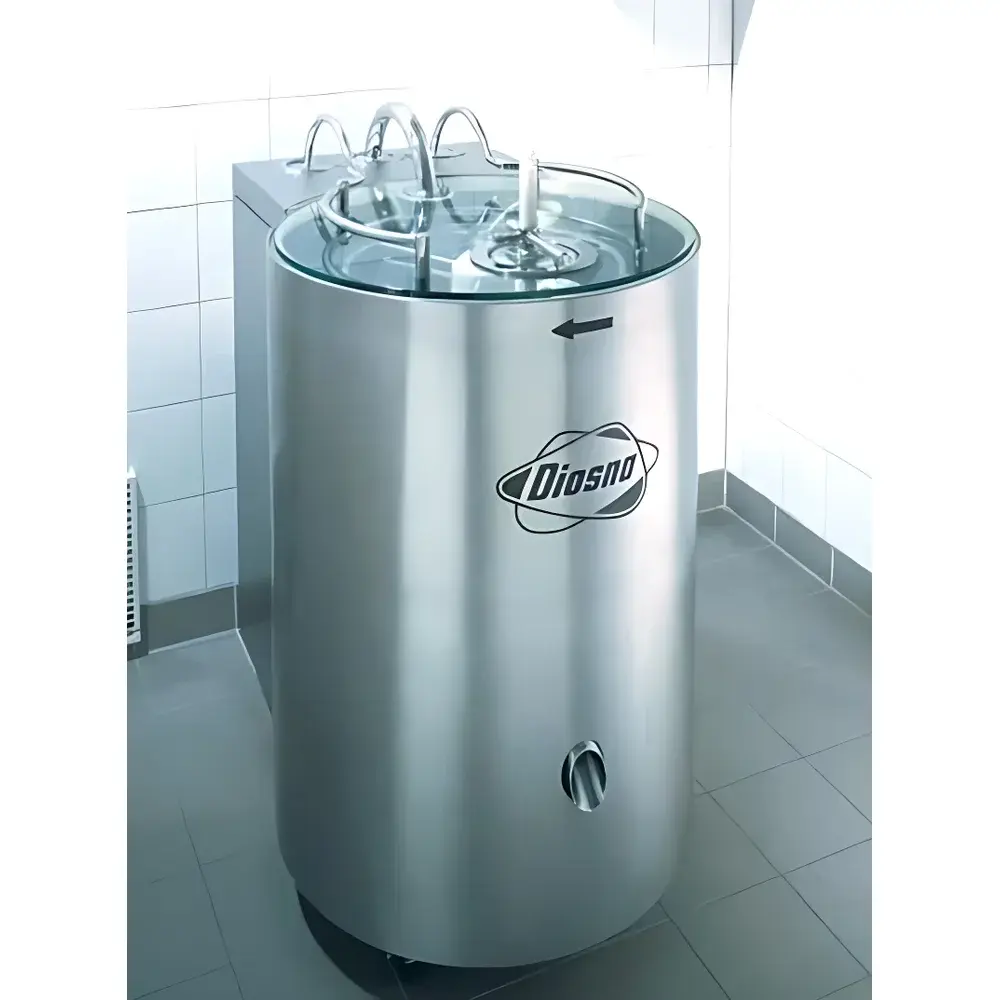
Diosna VCC3 Laboratory-Scale Film Coating Machine
| Brand | Diosna |
|---|---|
| Origin | Germany |
| Model | VCC3 |
| Type | Vertical Centrifugal Coater |
| Batch Capacity | 5.0 kg |
| Drive System | Precision Variable-Speed Motor |
| Spray System | Central 6-Nozzle Atomizer Assembly |
| Drying Mechanism | Integrated Hot Air Circulation with Adjustable Temperature & Flow Control |
| Construction Material | AISI 316L Stainless Steel (Contact Parts) |
| Compliance | Designed to Support GLP/GMP Development Workflows |
| Dimensions (W×D×H) | Approx. 850 × 750 × 1,450 mm |
| Weight | ~220 kg |
| Electrical Supply | 230 V / 50–60 Hz / 3.5 kW |
Overview
The Diosna VCC3 is a laboratory-scale vertical centrifugal film coating machine engineered for precision process development in pharmaceutical, nutraceutical, food, and advanced materials R&D laboratories. Unlike conventional pan or fluidized-bed coaters, the VCC3 employs a patented vertical centrifugal principle—where product movement is governed by controlled rotational force rather than gravity-driven tumbling or air suspension. This architecture enables uniform, reproducible film deposition on irregular, fragile, or low-density substrates—including immediate-release tablets, granules, pellets, mini-tablets, and even botanical particles—that are prone to attrition or segregation in traditional systems. The unit integrates simultaneous atomization and convective drying within a single compact chamber, significantly reducing coating cycle time by up to 50% compared to batch pan coaters—without compromising coating homogeneity or thickness control. Its design reflects over a century of Diosna’s engineering heritage in mixing, granulation, and particle modification technologies, with direct lineage to the company’s first commercial fluidized-bed system (1996) and patented vertical centrifugal coating platform (2000).
Key Features
- Vertical centrifugal drum with precisely regulated rotational speed (0–60 rpm), ensuring consistent particle trajectory and residence time distribution.
- Central-mounted 6-nozzle spray assembly delivering full 360° circumferential atomization—minimizing overspray and maximizing coating solution utilization efficiency.
- Integrated hot-air drying system with independent temperature (30–80 °C) and volumetric flow rate control, enabling both aqueous and organic solvent-based coating processes.
- AISI 316L stainless steel contact surfaces compliant with FDA-recommended material standards for pharmaceutical equipment; fully traceable surface finish (Ra ≤ 0.8 µm).
- Modular construction supporting rapid cleaning validation (CIP-ready interfaces) and compatibility with standard lab-scale environmental monitoring protocols.
- Intuitive manual operation interface with calibrated analog dials for spray rate, airflow, temperature, and rotation—designed for method transfer to pilot- and production-scale Diosna VCC systems (VCC5 to VCC300).
Sample Compatibility & Compliance
The VCC3 accommodates a broad spectrum of solid dosage forms and particulate materials: coated tablets (3–15 mm), extruded pellets (0.5–3 mm), spheronized beads, freeze-dried powders, ceramic microspheres, polymer resins, and plant-derived granules. Its low-shear, high-uniformity motion profile prevents fragmentation of friable cores and maintains integrity of enteric or pH-sensitive layers. While not certified as GMP-compliant per se, the VCC3 is engineered to support GLP-aligned development workflows—including documentation of critical process parameters (CPPs) such as spray flux (g/min), inlet air dew point, drum rotation profile, and exhaust humidity. Its mechanical design facilitates integration into ISO 14644-1 Class 7/8 cleanroom environments and aligns with core principles of ICH Q5A, Q5C, and USP on pharmaceutical equipment qualification.
Software & Data Management
The VCC3 operates via a dedicated manual control panel without embedded digital software—intentionally optimized for transparency, repeatability, and audit readiness in early-stage formulation work. All operational parameters are directly adjustable and mechanically indexed, eliminating software-related validation overhead. Users record CPPs and CQAs (coating weight gain, dissolution profile shifts, visual uniformity scores) using standardized lab notebooks or LIMS-integrated spreadsheets. This analog-first architecture ensures full traceability during regulatory submissions and supports seamless scale-up to Diosna’s digitally enabled VCC platforms (e.g., VCC10+ with optional Modbus TCP interface and 21 CFR Part 11–compliant data logging modules).
Applications
- Formulation screening of polymeric film coatings (HPMC, Eudragit®, cellulose acetate phthalate) under variable solvent systems.
- Process parameter optimization for sustained-release, taste-masking, or moisture-barrier functionalities.
- Stability-indicating studies requiring precise, repeatable coating thicknesses (±0.5 µm typical deviation across 5 kg batch).
- Development of functional coatings for nutraceuticals (vitamin encapsulation), agrochemicals (controlled-release pesticides), and specialty ceramics (thermal barrier pre-coating).
- Teaching and training in pharmaceutical manufacturing science—demonstrating mass transfer dynamics, solvent evaporation kinetics, and particle–fluid interaction physics.
FAQ
Is the VCC3 suitable for aqueous-based coating processes?
Yes—the integrated drying system supports stable operation with water-based polymer dispersions, including HPMC and acrylic latex formulations, at controlled inlet temperatures between 40–65 °C.
Can it handle very small particles (<500 µm)?
It is optimized for particles ≥0.5 mm; sub-500 µm materials require pre-agglomeration or use of a carrier matrix to ensure stable centrifugal transport.
What is the typical coating uniformity achieved?
Measured weight gain CV is typically ≤2.5% across a 5 kg batch when operated within validated parameter ranges.
Does Diosna provide IQ/OQ documentation templates?
Yes—standard qualification packages (including test protocols and acceptance criteria aligned with ASTM E2500 and ISPE GAMP5) are available upon request for laboratory validation support.
How does the VCC3 compare to fluidized-bed coaters for heat-sensitive APIs?
Its lower effective thermal load (shorter dwell time + localized spray/dry zone) reduces cumulative thermal exposure—making it preferable for thermolabile actives where fluidized beds may induce prolonged heating.






