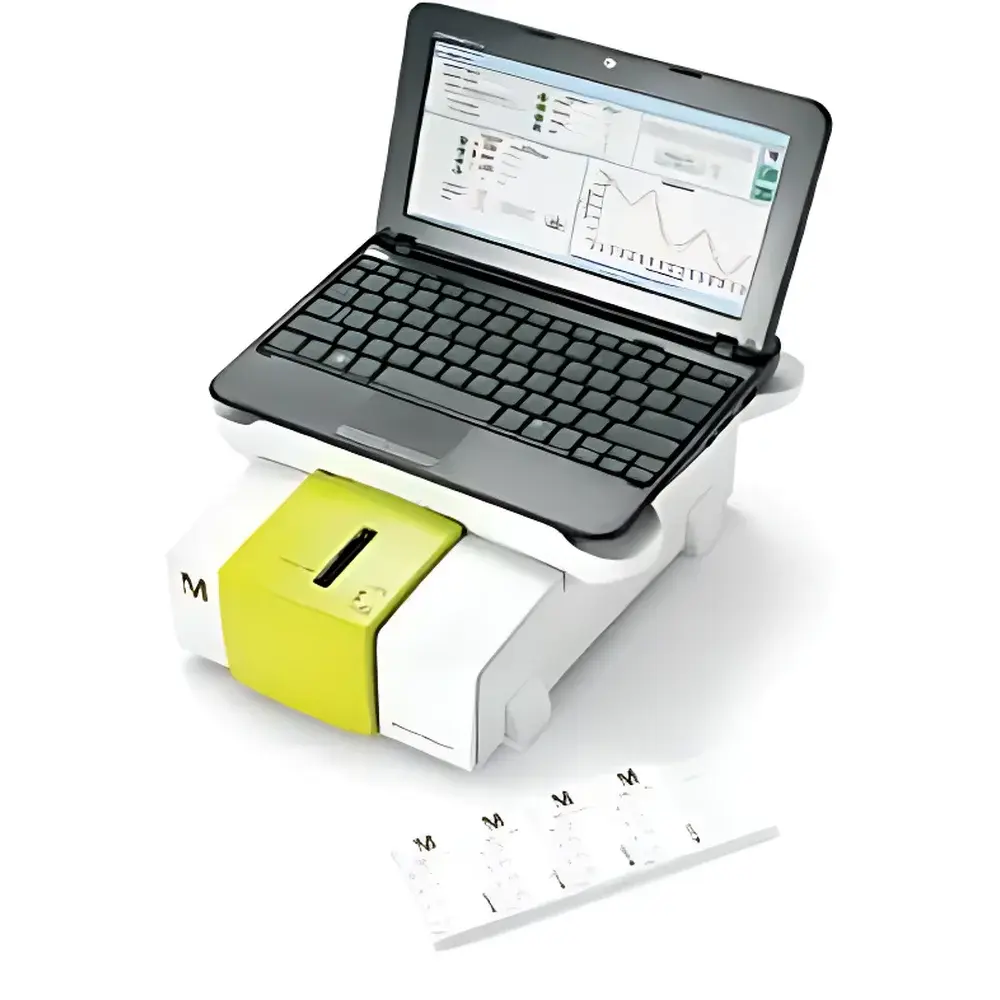
Direct Detect Infrared Micro-Quantitation Analyzer
| Origin | USA |
|---|---|
| Manufacturer Type | Authorized Distributor |
| Origin Category | Imported |
| Model | Direct Detect |
| Pricing | Available Upon Request |
Overview
The Direct Detect Infrared Micro-Quantitation Analyzer is the world’s first commercially available instrument engineered for label-free, infrared-based quantification of biomolecules directly in solution. Unlike conventional colorimetric or UV-absorbance methods—such as Bradford, BCA, or A280 assays—the Direct Detect system operates on the fundamental principle of Fourier-transform infrared (FTIR) spectroscopy, specifically targeting the amide I and amide II vibrational bands (1600–1700 cm−1) characteristic of peptide bonds. This physical measurement approach eliminates dependence on amino acid composition, dye-binding kinetics, redox state, or nucleic acid interference—factors that routinely compromise accuracy and reproducibility in traditional protein assays. The system requires only 2 µL of undiluted sample and a matched blank (e.g., buffer), delivering quantitative results in under 60 seconds without derivatization, reagent addition, or calibration curve generation per run.
Key Features
- Label-free, reagent-free operation: No dyes, no UV-transparent cuvettes, no standard curves—reducing assay variability and consumable costs.
- Micro-volume capability: Optimized for 2 µL sample volume, enabling analysis of precious or low-yield biological preparations (e.g., immunoprecipitates, microscale chromatography fractions, single-cell lysates).
- Multi-analyte discrimination: Simultaneous quantification of proteins, nucleic acids, lipids, and carbohydrates based on their distinct, non-overlapping IR absorption signatures across the mid-infrared region (e.g., phosphate backbone at ~1080 cm−1, C=O stretch of fatty acids at ~1740 cm−1, glycosidic bonds at ~1150 cm−1).
- Robust optical architecture: Integrated diamond ATR (Attenuated Total Reflectance) crystal with temperature-stabilized detector ensures high signal-to-noise ratio and long-term spectral fidelity.
- Automated background subtraction & baseline correction: Real-time algorithmic compensation for solvent absorption (e.g., D2O, H2O, glycerol), minimizing operator-dependent error.
Sample Compatibility & Compliance
The Direct Detect analyzer accepts aqueous and semi-aqueous solutions—including Tris, PBS, HEPES, RIPA, and mild detergent buffers—without interference from common contaminants such as reducing agents (DTT, β-mercaptoethanol), chelators (EDTA), or moderate concentrations of imidazole or glycerol. It is incompatible with strongly absorbing solvents (e.g., DMSO >5%, ethanol >20%) or particulate-laden samples requiring centrifugation or filtration prior to loading. The system complies with ISO/IEC 17025:2017 requirements for analytical instrument validation and supports GLP/GMP workflows through audit-trail-enabled software (see Software & Data Management). While not FDA-cleared as an IVD device, its performance characteristics align with ASTM E2912–21 (Standard Practice for Quantitative FTIR Analysis of Biomacromolecules) and USP Spectrophotometry and Light-Scattering guidelines for method suitability assessment.
Software & Data Management
Bundled Direct Detect Control Software (v3.x) provides intuitive acquisition, spectral processing, and quantitative reporting. Each measurement records full interferogram and processed absorbance spectra (128 co-added scans, 4 cm−1 resolution), stored in vendor-neutral .spc and .csv formats. The software implements 21 CFR Part 11-compliant features including electronic signatures, role-based user access control, immutable audit trails for all parameter changes and result exports, and automatic timestamping of every analysis event. Data integrity is further ensured via integrated checksum verification and optional networked backup to secure, IT-managed NAS or LIMS endpoints. Batch processing, custom report templates (PDF/Excel), and API-driven integration with ELN platforms (e.g., Benchling, LabArchives) are supported.
Applications
- High-throughput QC of recombinant protein purification fractions (e.g., SEC, IEX eluates)
- Concentration determination of membrane proteins solubilized in detergents or nanodiscs
- Quantification of nucleic acid contaminants in protein preps (e.g., residual plasmid DNA in mRNA vaccine intermediates)
- Simultaneous protein:lipid ratio analysis in liposome or exosome formulations
- Stability-indicating assay for thermal or chemical denaturation studies (via amide I band shift analysis)
- Method transfer support for orthogonal verification of UV or colorimetric assays during regulatory submissions
FAQ
Does the Direct Detect system require daily calibration with protein standards?
No. Calibration is factory-performed using NIST-traceable reference materials; routine user calibration is not required. System performance verification is conducted via built-in reference checks before each session.
Can it quantify proteins in complex lysates without cleanup?
Yes—provided the lysate is clarified by centrifugation (≥13,000 × g, 10 min) and free of visible particulates or high-concentration detergents (>1% Triton X-100 may attenuate signal).
Is spectral interpretation expertise needed to operate the instrument?
No. Quantitative results are generated automatically using chemometric models embedded in the software; advanced spectral analysis tools are available but optional.
What is the typical coefficient of variation (CV) for replicate measurements?
Instrumental precision is ≤2.1% CV (n = 10, 1 mg/mL BSA in PBS); total method CV (including pipetting) is ≤3.8% under optimized lab conditions.
How is data security maintained during remote instrument monitoring?
All remote connections use TLS 1.2+ encrypted channels; no raw spectral data is transmitted outside the local network unless explicitly exported via authenticated, audit-logged export functions.