
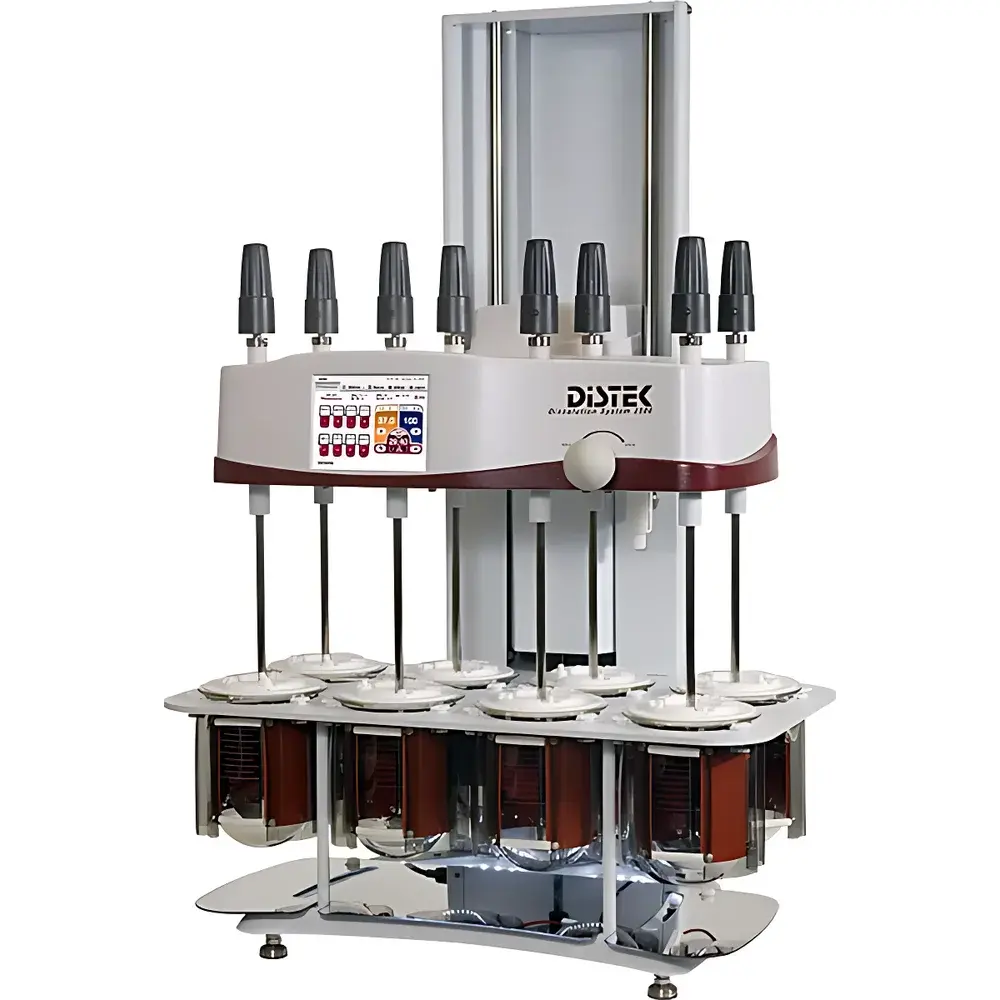
DISTEK 2500 Select Dry-Block Dissolution Tester
| Brand | Distek |
|---|---|
| Origin | USA |
| Model | 2500 Select |
| Instrument Type | Offline Dissolution Tester |
| Vessel Positions | 6, 7, or 8 |
| Temperature Range | 20–99 °C |
| Temperature Accuracy | ±0.25 °C |
| Temperature Resolution | 0.01 °C |
| Rotational Speed Range | 30–300 rpm |
| Speed Resolution | 0.1 rpm |
| Speed Accuracy | ±0.5 rpm |
| Paddle Wobble Tolerance | 0.5 mm |
| Basket Wobble Tolerance | 1.0 mm |
| Heating Rate | 2 °C/min |
| Vessel Capacity | 500–1000 mL |
| Block Volume Equivalent | 17.5 L (dry-block thermal mass) |
Overview
The DISTEK 2500 Select Dry-Block Dissolution Tester is an FDA-compliant, offline dissolution system engineered for precision, regulatory traceability, and operational flexibility in pharmaceutical quality control and formulation development laboratories. Unlike conventional water-bath-based systems, the 2500 Select employs a patented dry-block heating architecture—eliminating fluid media while delivering rapid, uniform thermal stabilization across all vessel positions. This design mitigates evaporation artifacts, reduces maintenance overhead, and enhances long-term temperature stability critical for USP , , and compliance. Each dissolution vessel operates within a thermally isolated, aluminum alloy heating block with embedded platinum resistance thermometers (Pt100), enabling real-time, position-specific temperature feedback and closed-loop PID control. The system supports standard USP Apparatus 1 (basket) and Apparatus 2 (paddle) configurations, with mechanical tolerances verified per USP mechanical calibration requirements.
Key Features
- Patented dry-block thermal system: Eliminates water bath dependency, reducing contamination risk, evaporation loss, and daily maintenance while maintaining ±0.25 °C temperature accuracy across all vessels.
- Independent modular vessel stations: Each of the 6-, 7-, or 8-position configurations features individually addressable heating and rotational control—enabling mixed-method testing (e.g., different speeds or temperatures per vessel) without hardware reconfiguration.
- High-fidelity motion control: Brushless DC motors deliver precise rotational speed from 30 to 300 rpm at 0.1 rpm resolution; paddle wobble limited to ≤0.5 mm and basket wobble to ≤1.0 mm (measured per USP mechanical verification protocol).
- Intuitive 7-inch color touchscreen interface: Graphical HMI provides real-time monitoring of temperature, speed, elapsed time, and method status; supports multi-language UI and on-device method storage with user-accessible audit trail logs.
- Rapid thermal response: Achieves setpoint stabilization in under 15 minutes (from ambient to 37 °C), with heating rate of 2 °C/min—critical for high-throughput QC workflows and accelerated stability studies.
Sample Compatibility & Compliance
The 2500 Select accommodates standard USP-compliant dissolution vessels (500–1000 mL capacity) and accepts all common tablet, capsule, and extended-release dosage forms. Its mechanical performance meets or exceeds USP requirements for rotational speed accuracy, centering, verticality, and wobble. Temperature uniformity across all positions is validated per ASTM E2503 and ISO/IEC 17025-accredited protocols. The system supports 21 CFR Part 11–compliant data integrity when integrated with DISTEK’s Dissolution Data Manager (DDM) software, including electronic signatures, audit trails, and role-based access control—making it suitable for GLP and GMP environments subject to FDA, EMA, and PMDA inspections.
Software & Data Management
When paired with DISTEK Dissolution Data Manager (DDM) software, the 2500 Select enables full lifecycle data governance: automated method execution, real-time curve visualization, customizable reporting (PDF/CSV), and secure database archiving. DDM enforces ALCOA+ principles (Attributable, Legible, Contemporaneous, Original, Accurate, Complete, Consistent, Enduring, Available) and includes electronic signature capability compliant with 21 CFR Part 11 Annex 11. All instrument events—including parameter changes, calibration entries, and user logins—are timestamped and immutable within the audit trail. Raw sensor data (temperature, RPM, time) is stored at 1 Hz resolution and exportable for statistical process control (SPC) analysis or submission to regulatory dossiers.
Applications
- Quality control release testing of immediate- and modified-release solid oral dosage forms per USP monographs.
- Dissolution profile comparison (f1/f2 analysis) during generic product development and post-approval change evaluations.
- Forced degradation and stability-indicating dissolution method development under ICH Q5C conditions.
- Excipient interaction screening and formulation robustness assessment using multi-condition vessel programming.
- Regulatory submission support—including complete IQ/OQ/PQ documentation packages and validation templates aligned with ASTM E2503 and USP .
FAQ
Does the 2500 Select require external water circulation or reservoir refills?
No. The dry-block system uses solid-state conduction heating and requires no water, glycol, or fluid top-up—reducing operational downtime and eliminating bath-related variability.
Can individual vessels operate at different temperatures or speeds simultaneously?
Yes. Each vessel station is independently controlled, allowing heterogeneous test conditions within a single run—ideal for bracketing studies or comparative dissolution profiling.
Is mechanical calibration supported directly on the instrument?
Yes. Built-in calibration routines guide users through USP mechanical verification steps (centering, verticality, wobble), with results logged and exportable as part of the system’s electronic record.
What validation documentation is provided with the system?
DISTEK supplies comprehensive IQ/OQ documentation, including factory-verified performance reports, traceable calibration certificates (NIST-traceable Pt100 and tachometer standards), and a URS-mapped validation protocol template.
How is data integrity ensured during networked operation?
When connected to DDM via Ethernet, all data transfers are encrypted (TLS 1.2), and system-generated audit trails meet 21 CFR Part 11 requirements—including user authentication, action logging, and tamper-evident records.




