
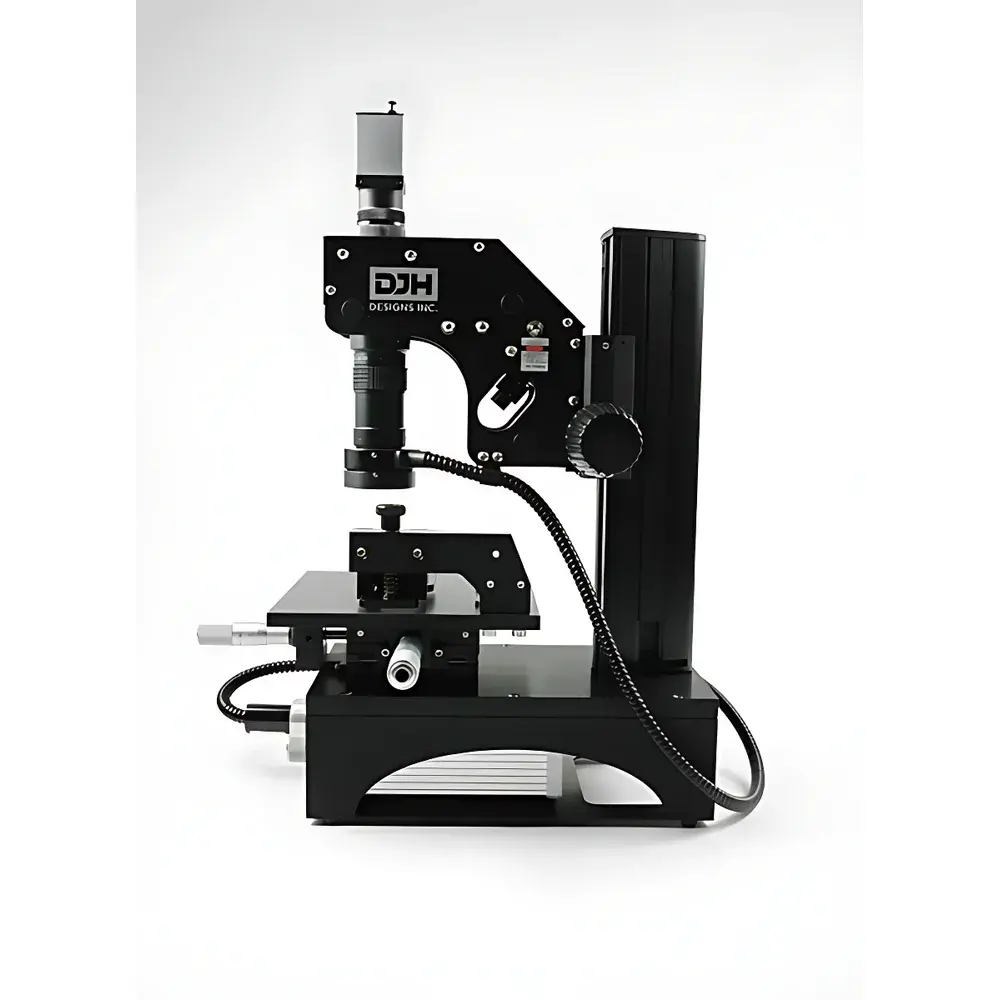
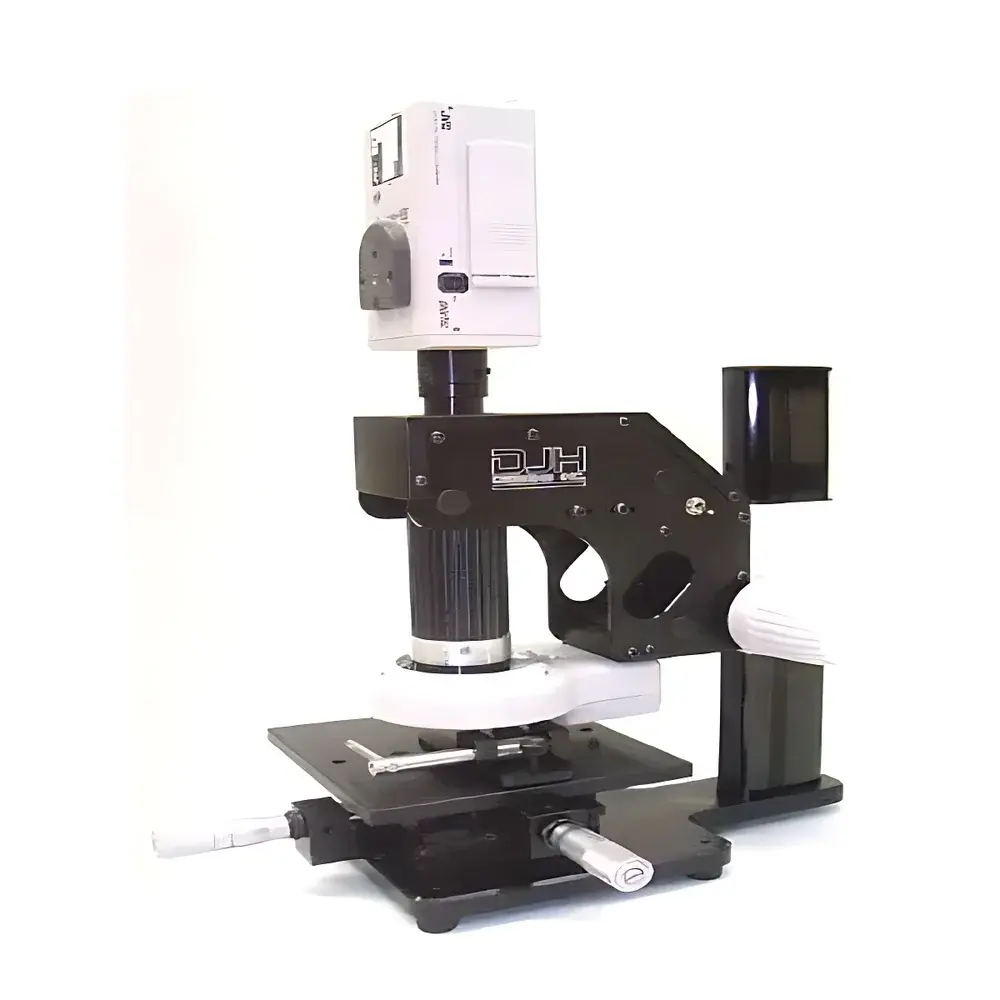
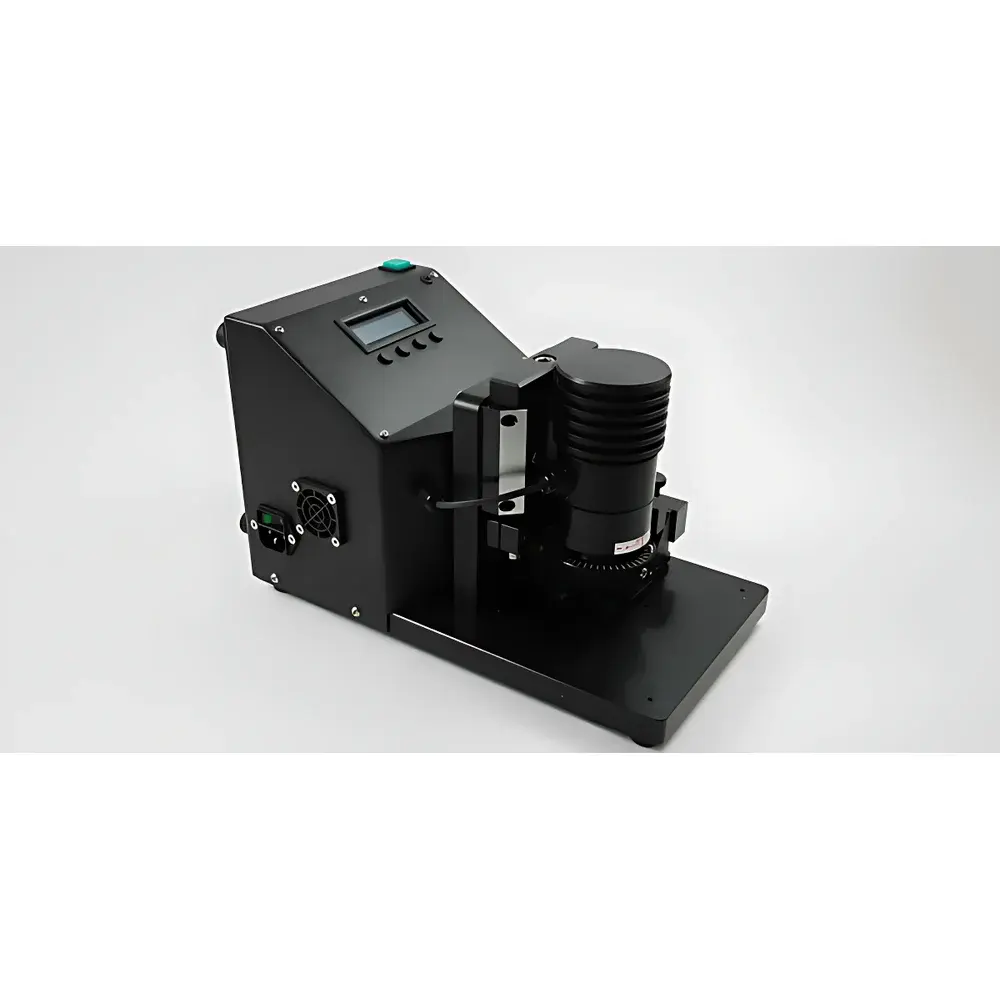
DJH Crater Film Thickness Measurement System
| Brand | DJH Designs |
|---|---|
| Origin | Canada |
| Manufacturer Type | Authorized Distributor |
| Origin Category | Imported |
| Model | DJH Crater Film Thickness System |
| Price | Upon Request |
| Drilling Accuracy | ±0.17 µm |
| Sample Thickness Range | 0–2 mil (0–50.8 µm) and 0–8 mil (0–203.2 µm) with interchangeable carbide drill bits |
| Drill Unit Minimum Substrate Thickness | >50 µm |
| Net Weight | 65 lbs (29.5 kg) |
| Gross Weight | 80 lbs (36.3 kg) |
| Packaging Dimensions | 610 mm × 610 mm × 610 mm |
| Power Supply | 220 V / 50 Hz |
Overview
The DJH Crater Film Thickness Measurement System is a precision-engineered, non-destructive (drill-based) optical profilometry instrument designed for quantitative measurement of multi-layer dry film coatings on metallic substrates—particularly in continuous coil coating (coil涂) production environments. It operates on the principle of controlled micro-drilling followed by high-resolution optical video imaging and digital cross-sectional profile analysis. A precisely calibrated carbide drill bit removes material down to the substrate, creating a crater whose depth and layer interfaces are captured in real time via integrated coaxial optical video microscopy. The system computes individual layer thicknesses—including primer, color coat, and clear topcoat—based on pixel-accurate edge detection and calibrated depth scaling. As specified in ASTM D5796 “Standard Test Method for Measurement of Dry Film Thickness of Organic Coatings Using the Crater Grinding Technique,” this methodology delivers traceable, reproducible results essential for QC/QA compliance in high-volume industrial coating lines.
Key Features
- ASTM D5796-compliant crater grinding methodology with certified measurement uncertainty and documented calibration traceability
- NCCA (National Coil Coating Association) recommended instrumentation for coil coating process validation and supplier qualification
- Interchangeable carbide drill bits enabling dual-range measurement capability: 0–2 mil (0–50.8 µm) for thin architectural or automotive coatings, and 0–8 mil (0–203.2 µm) for heavy-duty industrial or corrosion-resistant systems
- Optical video imaging subsystem with 10×–50× magnification, adjustable LED illumination, and real-time digital overlay of measurement cursors and layer boundaries
- Drill unit accuracy of ±0.17 µm (root-mean-square), verified per ISO/IEC 17025-accredited calibration procedures
- Robust mechanical architecture optimized for both laboratory benchtop use and shop-floor deployment—vibration-damped base, sealed drill housing, and ESD-safe operation
- No solvents, no consumables beyond drill bits, and zero hazardous waste generation—fully aligned with ISO 14001 environmental management requirements
Sample Compatibility & Compliance
The DJH Crater System accommodates rigid, flat, or slightly curved metallic substrates typical of pre-painted steel and aluminum coil stock (e.g., GI, GA, Al-Mg alloys). Minimum substrate thickness is 50 µm to ensure structural integrity during crater formation. It supports coated samples with surface roughness (Ra) up to 3.2 µm and hardness up to 300 HV. All measurements comply with ASTM D5796, ISO 2808 Annex F (crater method), and relevant sections of ISO 12944-5 for protective paint systems. The system meets electromagnetic compatibility (EMC) requirements per IEC 61326-1 and electrical safety standards per IEC 61010-1. Its design facilitates audit readiness for GLP, GMP, and FDA 21 CFR Part 11 environments when paired with validated software configurations.
Software & Data Management
The embedded measurement software provides intuitive workflow navigation, automatic layer segmentation, and export of raw image stacks, calibrated profiles, and summary reports in CSV, PDF, and XML formats. Audit trail functionality logs operator ID, timestamp, calibration status, drill bit serial number, and image metadata—supporting data integrity requirements under 21 CFR Part 11 when deployed with electronic signature modules. Data can be integrated into LIMS or MES platforms via OPC UA or RESTful API endpoints. Firmware updates are delivered through secure HTTPS channels with SHA-256 signature verification. Calibration certificates include uncertainty budgets per GUM (Guide to the Expression of Uncertainty in Measurement).
Applications
- Real-time QC verification of coil-coated steel and aluminum strip prior to slitting, packaging, or shipment
- Process validation of curing parameters (time/temperature) across continuous ovens
- Root cause analysis of interlayer delamination, orange peel, or edge thinning defects
- Supplier qualification testing per OEM specifications (e.g., Ford WSS-M2P177-A2, GM GMW14872)
- Coating formulation development requiring precise thickness-to-performance correlation (e.g., corrosion resistance, gloss retention, UV stability)
- Third-party certification testing for ISO 9001:2015 and EN 10169 compliance documentation
FAQ
Is the DJH Crater System suitable for measuring coatings on non-metallic substrates such as plastic or wood?
No—this system is specifically engineered for conductive, rigid metallic substrates where controlled crater formation and stable drill engagement are assured. Non-metallic or flexible substrates require alternative methods (e.g., eddy current or ultrasonic).
What maintenance is required beyond drill bit replacement?
Annual recalibration by an ISO/IEC 17025-accredited service provider is recommended; routine cleaning of optical lenses and drill chuck with lint-free isopropyl alcohol is sufficient for daily operation.
Can measurement data be exported directly to SAP QM or Oracle Quality modules?
Yes—via configurable CSV templates or middleware integration using standard ODBC drivers or custom REST API adapters developed per client ERP schema.
Does the system support automated batch reporting for statistical process control (SPC)?
Yes—the software includes built-in X̄-R and Cpk calculation engines with real-time SPC charting, alarm thresholds, and export to Minitab or JMP-compatible formats.
Related Products



