
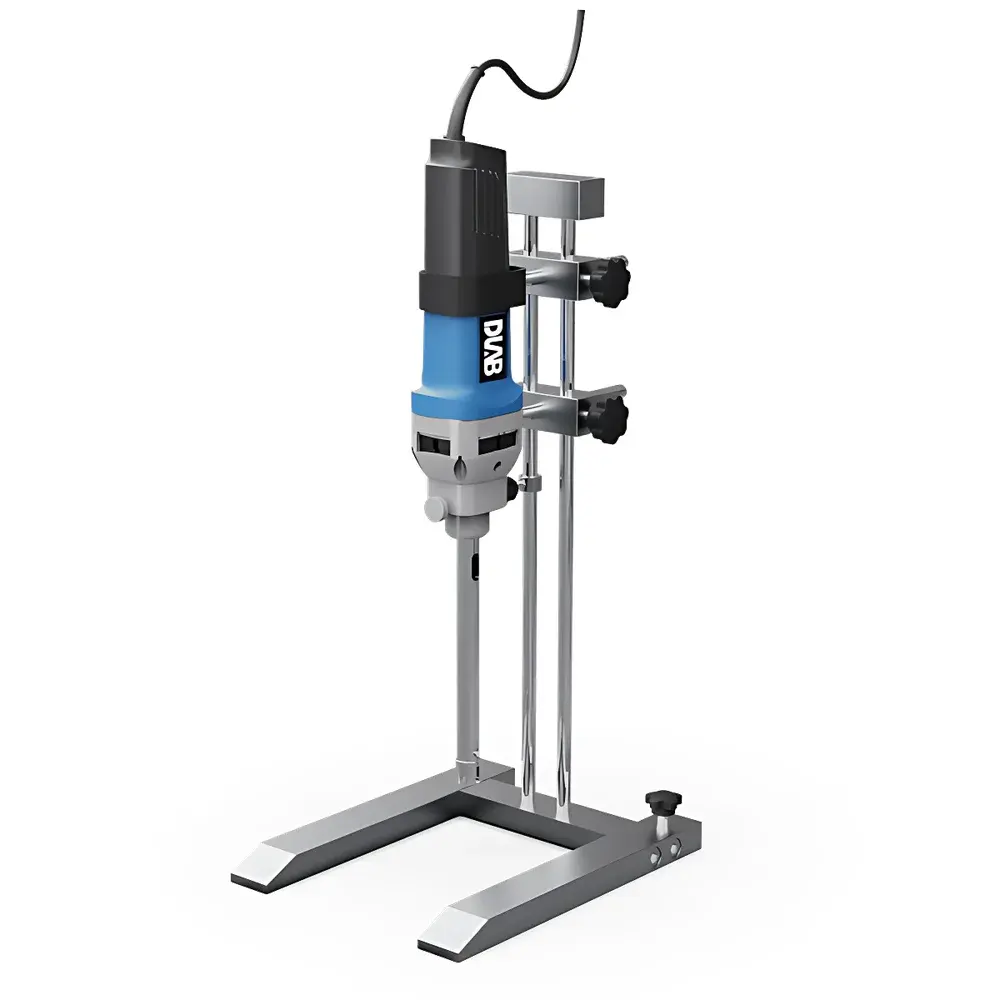
DLAB D-500 High-Shear Rotor-Stator Homogenizer
| Brand | DLAB |
|---|---|
| Origin | Beijing, China |
| Manufacturer Type | Direct Manufacturer |
| Product Category | Domestic |
| Model | D-500 |
| Instrument Type | Probe-Type Rotor-Stator Homogenizer |
| Dimensions (W×D×H) | 75 × 75 × 280 mm |
| Processing Volume Range | 10–40,000 mL |
| Speed Range | 10,000–30,000 rpm |
| Speed Control | 6-step Continuous Adjustment |
| Maximum Viscosity Handling | 10,000 mPa·s |
| Construction Material | 316L Stainless Steel |
| Safety Features | Automatic Overload Protection, Soft-Start Motor |
| Rotor/Stator Interchangeability | Yes (Shared Shaft Design) |
| Cleaning & Maintenance | Tool-Free Disassembly of Dispersion Heads |
Overview
The DLAB D-500 is a high-performance, probe-type rotor-stator homogenizer engineered for reproducible high-shear processing in research and quality control laboratories. Operating on the principle of intense mechanical shear generated between a rapidly rotating rotor and a fixed stator, the D-500 delivers controlled energy input to disrupt cellular structures, reduce particle size, emulsify immiscible phases, and stabilize heterogeneous dispersions. Its compact benchtop footprint (75 × 75 × 280 mm) integrates a robust 316L stainless steel drive motor with precision-machined dispersion heads, enabling consistent operation across viscous media up to 10,000 mPa·s. Designed for routine use in regulated environments, the system supports GLP-compliant sample preparation workflows through repeatable speed control, thermal stability during extended runs, and full traceability of operational parameters via analog interface logic.
Key Features
- Probe-based rotor-stator architecture delivering uniform shear gradients across the active zone—critical for scalable process development from lab to pilot scale.
- 6-step continuously adjustable speed control (10,000–30,000 rpm) with digital tachometer feedback ensuring precise rotational velocity management without external calibration.
- Interchangeable dispersion heads (DS-500/1 for solid-liquid homogenization; DS-500/2 for emulsification) mounted on a shared shaft assembly—reducing inventory overhead and cross-contamination risk while maintaining geometric consistency.
- 316L stainless steel construction certified for autoclaving (121 °C, 20 min), chemical resistance to common solvents (e.g., ethanol, acetone, dilute acids/bases), and compliance with ISO 8573-1 Class 4 air purity standards when used with inert gas purging.
- Integrated soft-start motor control mitigates torque surge at startup, minimizing sample splashing and preserving vessel integrity—particularly essential for low-volume (<50 mL) or volatile formulations.
- Automatic thermal overload protection circuitry monitors coil temperature in real time and initiates safe shutdown before irreversible motor degradation occurs, extending service life under continuous duty cycles.
Sample Compatibility & Compliance
The D-500 accommodates a broad spectrum of sample matrices including biological tissues (animal/human), microbial suspensions, polymer emulsions, pigment dispersions, pharmaceutical suspensions, and food-grade colloids. It meets functional requirements outlined in ASTM D3925-22 (Standard Practice for Sampling Liquid Paints), USP (Light Scattering Measurements of Liposomal Products), and ISO 13320:2020 (Laser Diffraction Particle Size Analysis—sample dispersion prerequisites). All wetted parts comply with FDA 21 CFR Part 11 Annex 11 principles for electronic records and signatures when paired with validated third-party data loggers. The unit is CE-marked per Directive 2014/30/EU (EMC) and 2014/35/EU (LVD), and conforms to IEC 61000-6-3 emission limits for laboratory electromagnetic environments.
Software & Data Management
While the D-500 operates via analog front-panel controls, its rotational output is compatible with external data acquisition systems via 0–10 V analog signal output (RPM proportional voltage). When integrated with LabVIEW™, MATLAB® Data Acquisition Toolbox, or custom SCADA platforms, users can record time-stamped speed profiles, correlate shear rate with viscosity changes (via inline viscometers), and generate audit-ready CSV logs compliant with 21 CFR Part 11 §11.10(b) for electronic record retention. Optional USB-to-analog adapters enable direct connection to Windows-based PCs for automated protocol execution using Python-driven PySerial scripts—supporting batch-mode homogenization sequences with programmable ramp-hold-cool-down cycles.
Applications
- Cell lysis and subcellular fractionation in molecular biology labs—validated for HEK293, CHO-K1, and primary hepatocyte disruption with >95% membrane rupture efficiency at 25,000 rpm (5×30 s pulses).
- Pre-formulation development of nanoemulsions and lipid nanoparticles (LNPs) for mRNA delivery, where controlled droplet size distribution (PDI <0.25) is achieved within 2 min using DS-500/2 at 28,000 rpm.
- QC sample preparation for HPLC analysis of active pharmaceutical ingredients (APIs), including dissolution enhancement of poorly water-soluble compounds (e.g., fenofibrate, itraconazole) via nanosuspension generation.
- Stabilization of pigment dispersions in waterborne coatings—reducing agglomerate count by >99.2% (measured by Malvern Mastersizer 3000) after single-pass treatment at 22,000 rpm.
- Environmental matrix standardization—homogenizing sediment cores, sludge samples, and biofilm scrapings prior to metal speciation analysis (ICP-MS) per EPA Method 6020B.
FAQ
What is the maximum recommended operating time per cycle to maintain thermal stability?
Continuous operation is rated for ≤90 seconds per cycle at full speed (30,000 rpm); allow ≥60 seconds cooling interval between cycles to prevent heat accumulation in the dispersion head.
Can the D-500 be used with corrosive solvents such as chloroform or concentrated HCl?
Only with optional PTFE-coated dispersion heads (not included standard); standard 316L components are incompatible with halogenated organics and strong oxidizers.
Is rotor-stator geometry standardized across DLAB homogenizer models?
Yes—the DS-500 series heads share identical stator inner diameter (8.5 mm) and rotor tip speed profiles with DLAB’s D-150 and D-250 platforms, enabling direct method transfer.
Does the D-500 support validation documentation for GMP environments?
DLAB provides IQ/OQ templates aligned with ASTM E2500-13 and EU Annex 15; PQ must be performed in situ using user-defined acceptance criteria.
How is maintenance tracked for regulatory audits?
Maintenance logs—including dispersion head sterilization cycles, bearing replacement dates, and calibration verification records—should be retained per ISO/IEC 17025:2017 clause 7.7.2.



