
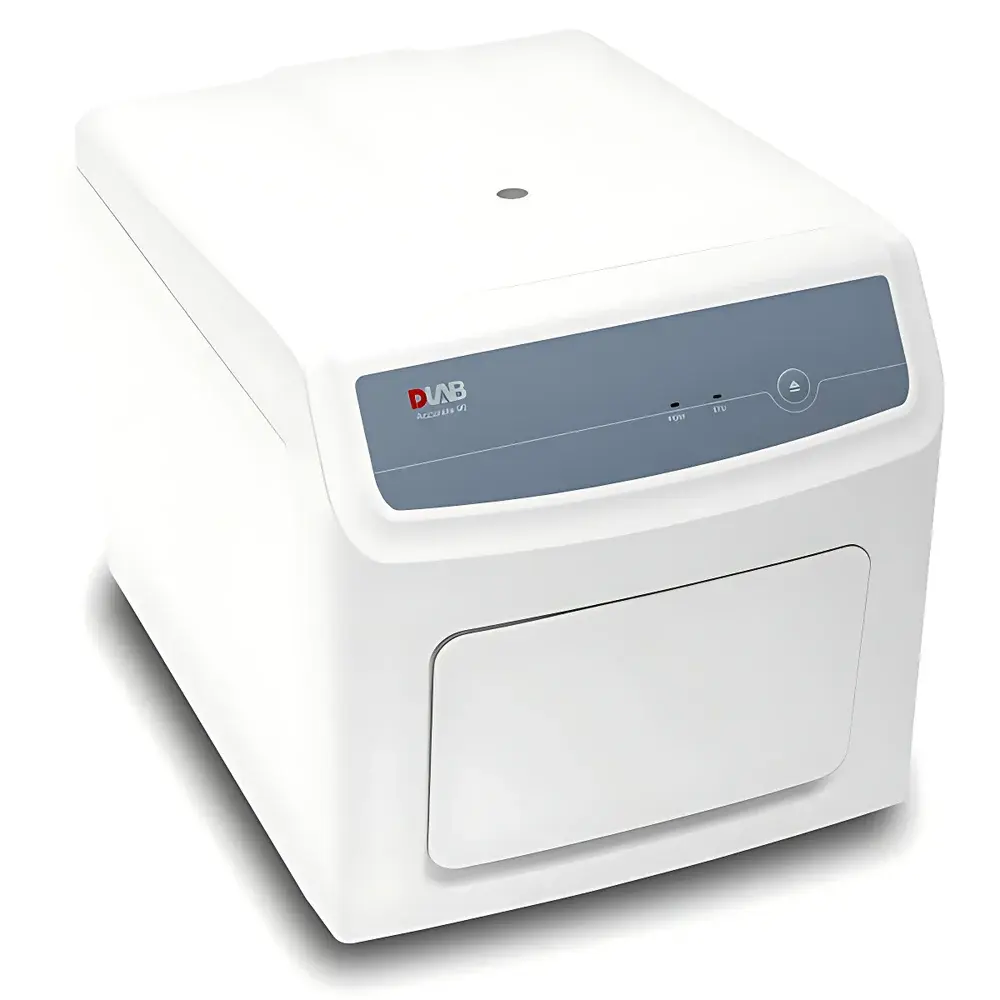
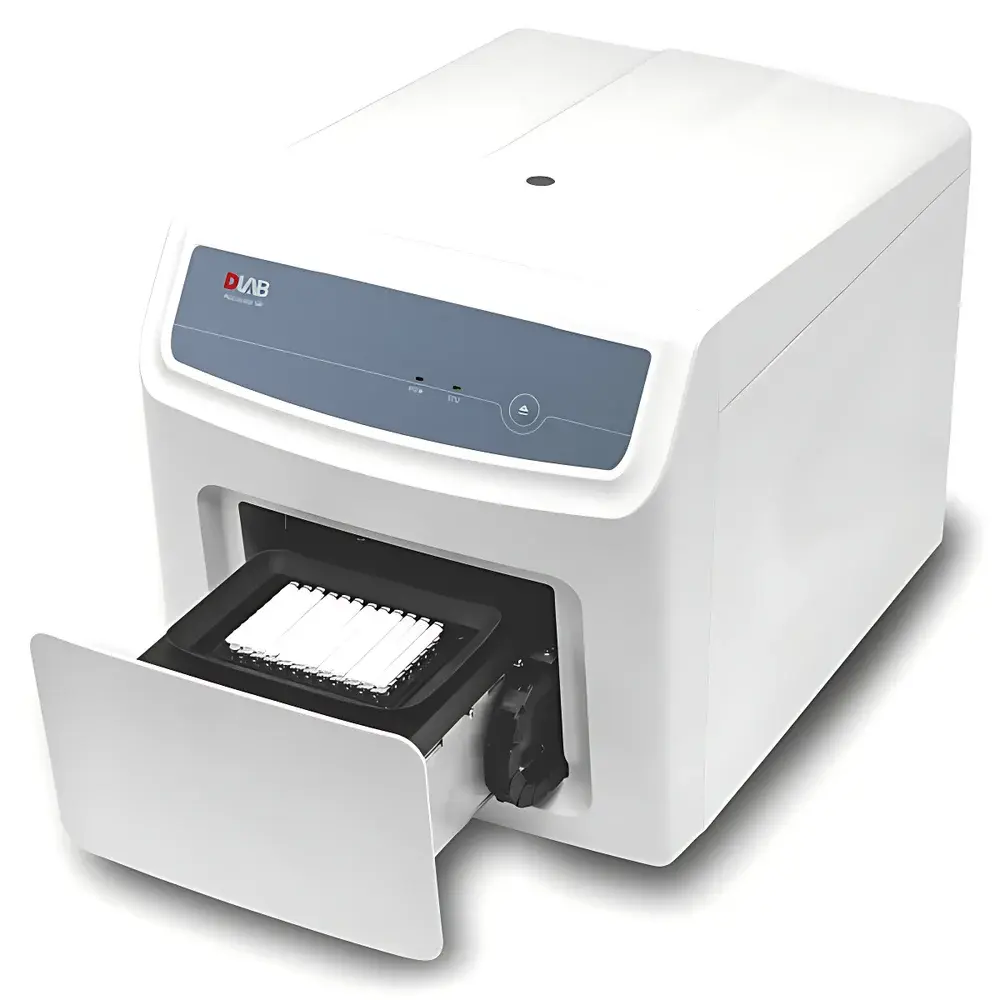
DLAB Accurate 96-X4/X6 Real-Time Fluorescent Quantitative PCR System
| Brand | DLAB |
|---|---|
| Origin | Beijing, China |
| Manufacturer Type | Direct Manufacturer |
| Instrument Category | Real-Time Fluorescent Quantitative PCR System |
| Model | Accurate 96-X4 / Accurate 96-X6 |
| Sample Throughput | Dual-Channel / Quad-Channel (X4) or Hexa-Channel (X6) |
| Excitation Source | 4 (X4) or 6 (X6) High-Efficiency Monochromatic LEDs (>100,000 h lifetime) |
| Fluorescence Detection Channels | 4 or 6 independent optical channels |
| Supported Dyes | FAM/SYBR Green I, VIC/HEX/JOE/TET, ROX/Texas Red, Cy5, NED/TAMRA/Cy3 |
| Detector | High-Sensitivity Silicon Photomultiplier (MPPC) |
| Read Position | Top-Reading Configuration |
| Sensitivity | Single-Copy Gene Detection |
| Excitation Range | 455–680 nm |
| Emission Detection Range | 510–730 nm |
| Dynamic Range | 10 decades (1–10¹⁰ copies) |
| Resolution | Discrimination of 1.33-fold copy number difference in singleplex assays |
| Sample Capacity | 96-well standard plate |
| Reaction Volume | 10–50 µL |
| Temperature Range | 4–100 °C |
| Thermal Lid | Electronically Controlled Adjustable Lid (RT to 115 °C) |
| Temperature Gradient | 12-column gradient with adjustable ΔT from 1–40 °C |
| Heating/Cooling Rate | Up to 6 °C/s |
| Temperature Accuracy | ≤ ±0.2 °C |
| Temperature Uniformity | ≤ ±0.2 °C across block |
| Thermal Control Architecture | Six Independent Peltier Modules |
| Analysis Modes | Absolute Quantification, Relative Quantification, Qualitative Detection, End-Point Fluorescence Analysis, Melting Curve Analysis, High-Resolution Melting (HRM), Genotyping |
| Data Export Formats | CSV, Excel (.xlsx), TXT |
| Report Output | PDF, Printable Graphs & Tables, Customizable Templates, Preloaded Report Modules |
| Software Compliance | Audit Trail, User Access Levels, Electronic Signature Support (aligned with FDA 21 CFR Part 11 principles for GLP/GMP environments) |
Overview
The DLAB Accurate 96-X4/X6 Real-Time Fluorescent Quantitative PCR System is an engineered platform for nucleic acid amplification and quantification based on sequence-specific fluorescent probe hybridization and intercalating dye detection during thermal cycling. Utilizing time-resolved real-time scanning and spectral deconvolution algorithms, the system captures fluorescence emission kinetics at each cycle with high temporal and spatial fidelity. Its dual- or multi-channel optical architecture eliminates the need for post-acquisition spectral correction by minimizing cross-talk through physically isolated excitation/detection pathways and optimized optical filtering. Designed for reproducible performance in regulated and research-intensive settings, the instrument integrates six independently controlled Peltier modules, enabling precise thermal gradient programming and exceptional well-to-well temperature uniformity—critical for HRM, multiplex assay development, and low-abundance target detection.
Key Features
- Six independent Peltier-controlled thermal modules ensure ≤ ±0.2 °C temperature accuracy and uniformity across all 96 wells—validated per ISO 13485-aligned thermal mapping protocols.
- Top-reading optical configuration with high-sensitivity silicon photomultiplier (MPPC) detectors delivers single-copy sensitivity and enables reliable detection in low-input clinical samples and environmental extracts.
- Monochromatic LED excitation sources (4 for X4; 6 for X6) operate over 455–680 nm with >100,000-hour lifetime—eliminating lamp replacement and intensity drift associated with traditional halogen or xenon sources.
- Time-resolved scanning technology acquires full fluorescence spectra at sub-second intervals, decoupling signal acquisition from thermal ramp transitions to minimize kinetic artifacts.
- Intelligent edge compensation algorithm dynamically adjusts local heating profiles to counteract peripheral heat loss—essential for consistent amplification efficiency across plate edges.
- Electronically adjustable thermal lid (RT to 115 °C) maintains optimal evaporation control without manual calibration or pressure adjustment.
Sample Compatibility & Compliance
The Accurate 96-X4/X6 accommodates standard 0.2 mL skirted and semi-skirted 96-well PCR plates, as well as compatible tube strips and individual tubes (with appropriate adapters). It supports all major qPCR chemistries—including hydrolysis probes (TaqMan), hybridization probes (FRET), molecular beacons, scorpions, and double-stranded DNA-binding dyes (SYBR Green I). The system complies with international standards relevant to molecular diagnostics and quality-controlled laboratories: ISO/IEC 17025 for testing laboratory competence, CLSI EP17-A2 for limit-of-detection validation, and ASTM E2587 for statistical process control in quantitative nucleic acid assays. Software audit trail functionality—including user login logs, parameter change history, and result modification timestamps—supports alignment with FDA 21 CFR Part 11 requirements for electronic records and signatures in GxP environments.
Software & Data Management
DLAB’s proprietary qPCR analysis software provides a modular interface supporting experimental design, run monitoring, and post-run interpretation. It includes built-in templates for absolute quantification (standard curve), comparative ΔΔCt, presence/absence calling, melting curve derivation, and high-resolution melt profiling (HRM) with cluster analysis. All data files are stored in a structured binary format with embedded metadata (instrument ID, operator, timestamp, thermal profile, optical settings). Export options include CSV, Excel (.xlsx), and plain-text formats; graphical outputs (amplification plots, melt curves, scatter plots) can be exported as PNG, SVG, or directly printed. Users may define custom report layouts using drag-and-drop fields and save them as reusable templates—supporting institutional SOPs and regulatory submission workflows. Role-based access control allows administrators to assign permissions for method editing, result deletion, and software configuration.
Applications
The Accurate 96-X4/X6 serves diverse applications requiring precision nucleic acid quantification and genotypic discrimination. In clinical microbiology, it enables rapid detection and load monitoring of viral pathogens (e.g., SARS-CoV-2, HIV, HBV) and antimicrobial resistance markers. In food safety testing, it supports quantitative screening for Salmonella, Listeria monocytogenes, and GMO content per ISO 21569 and AOAC guidelines. Environmental labs use its HRM capability for microbial community profiling and strain differentiation without sequencing. In academic and pharmaceutical research, the system facilitates gene expression profiling, CRISPR editing efficiency assessment, miRNA quantification, and SNP genotyping via allele-specific amplification. Its dynamic range (1–10¹⁰ copies) and resolution (1.33-fold difference) make it suitable for both high-titer pathogen detection and rare-variant identification in heterogeneous samples.
FAQ
What is the maximum number of fluorescence channels supported on the Accurate 96-X6 model?
The Accurate 96-X6 supports six independent optical detection channels, each with dedicated excitation and emission filters.
Does the system support high-resolution melting (HRM) analysis?
Yes—both X4 and X6 models include hardware-level temperature ramp control (0.01 °C increments) and continuous fluorescence acquisition during melt transitions, enabling robust HRM cluster classification.
Is the software compliant with FDA 21 CFR Part 11 requirements?
While not certified as a standalone Part 11 system, the software implements core technical controls—including electronic signatures, audit trails, and role-based access—that align with Part 11 implementation guidance for laboratory instruments used in regulated environments.
Can the instrument perform gradient PCR with customizable column-wise temperature profiles?
Yes—the 12-column thermal gradient function allows independent temperature assignment per column, with programmable ΔT from 1 to 40 °C, facilitating assay optimization and primer validation.
What file formats are supported for data export and reporting?
Raw and analyzed data can be exported as CSV, Excel (.xlsx), or TXT; reports can be generated in PDF, printed directly, or saved as vector-based SVG for publication-quality figures.




