
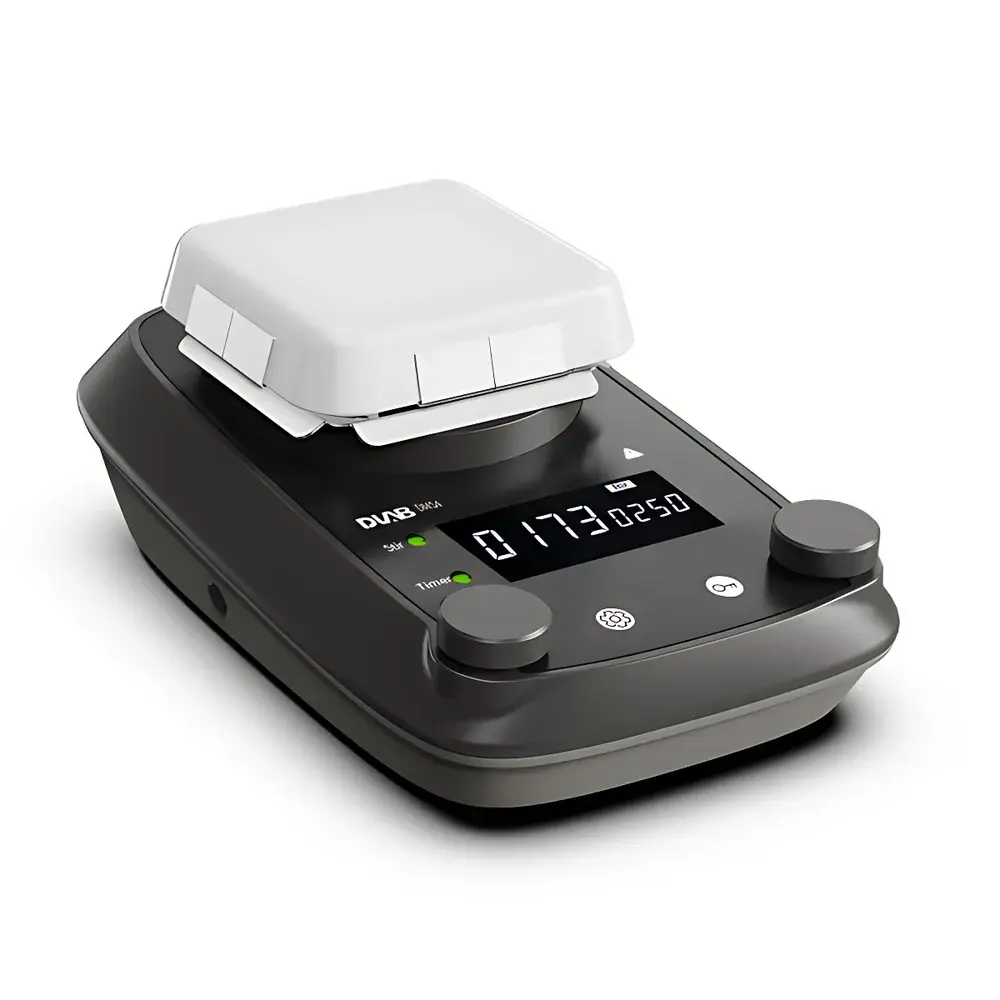
DLAB DMS4 LCD Digital Magnetic Stirrer with 4-inch Glass-Ceramic Plate
| Brand | DLAB |
|---|---|
| Origin | Beijing, China |
| Manufacturer Type | Direct Manufacturer |
| Product Category | Domestic |
| Model | DMS4 |
| Instrument Type | Magnetic Stirrer |
| Max Stirring Volume | 10 L (water) |
| Speed Range | 50–1500 rpm (1-rpm increment) |
| Plate Dimensions | 100 × 100 mm |
| Plate Material | Glass-Ceramic |
| Motor Type | Brushless DC Motor |
| Display | LCD (speed setpoint & real-time speed, timer) |
| Timer Range | 1 min – 99 h 59 min |
| IP Rating | IP21 |
| Output Power | 10 W |
| Total Power Consumption | 30 W |
| Input Voltage | 100–240 V, 50/60 Hz |
| Dimensions (L×W×H) | 270 × 175 × 108 mm |
| Net Weight | 1.8 kg |
| Operating Temperature | 5–40 °C |
| Max Relative Humidity | ≤80% RH |
| Max Stir Bar Length | 40 mm |
| Safety Features | Keypad Lock, Audible Alert (buzzer), Overheat Protection, Spill-Resistant Edge Design |
| Connectivity | PC Remote Control Interface |
Overview
The DLAB DMS4 LCD Digital Magnetic Stirrer is an engineered solution for precise, reliable, and contamination-free mixing in analytical, quality control, and research laboratories. Designed around the fundamental principle of magnetic coupling—where a rotating permanent magnet beneath the plate induces synchronous rotation of a stir bar immersed in the sample—the DMS4 delivers consistent torque transfer across a wide viscosity range. Its 4-inch (100 × 100 mm) glass-ceramic top plate provides exceptional chemical inertness, resisting aggressive solvents, concentrated acids (e.g., HNO₃, H₂SO₄), alkalis (e.g., NaOH up to 50%), and thermal shock up to 350 °C. This material choice eliminates surface porosity, preventing reagent absorption and enabling rapid decontamination via wipe-down or ethanol rinse—critical for GLP-compliant workflows where cross-sample carryover must be eliminated.
Key Features
- Glass-ceramic plate with certified resistance to ASTM D1308 (chemical etching) and ISO 10545-13 (thermal shock), ensuring long-term integrity under repeated exposure to corrosive reagents and hot solutions.
- Brushless DC motor delivering stable rotational output from 50 to 1500 rpm in 1-rpm increments—enabling fine-tuned optimization for low-shear emulsification or high-viscosity polymer dissolution.
- LCD interface displaying real-time speed, set speed, elapsed time, and remaining timer duration—supporting traceable parameter recording per USP and ISO/IEC 17025 documentation requirements.
- Integrated safety architecture: keypad lock prevents unintended parameter changes during unattended operation; audible buzzer alerts at timer completion or thermal fault detection; spill-resistant perimeter lip and sealed internal electronics conforming to IP21 ingress protection.
- Thermally optimized aluminum-alloy housing with passive convection cooling—maintaining stable motor performance even during extended 24-hour runs at 1200+ rpm.
Sample Compatibility & Compliance
The DMS4 accommodates standard laboratory vessels—including borosilicate glass beakers (50 mL to 2 L), stainless-steel reaction flasks, and PTFE-lined containers—when paired with chemically resistant stir bars (up to 40 mm length). Its non-porous ceramic surface meets FDA-recommended cleanability criteria for multi-product labs handling pharmaceutical intermediates or agrochemical formulations. The unit complies with IEC 61010-1:2010 for electrical safety in laboratory equipment and incorporates electromagnetic compatibility (EMC) shielding per EN 61326-1:2013. For regulated environments, audit trails can be generated via optional PC logging software supporting 21 CFR Part 11–compliant electronic signatures when used with validated host systems.
Software & Data Management
The DMS4 supports bidirectional RS-232 or USB-to-serial communication for remote parameter configuration and real-time data streaming. Compatible with DLAB’s proprietary LabStir Control Suite (Windows/macOS), users can schedule multi-step protocols (e.g., ramp-and-hold profiles), export timestamped speed/time logs in CSV format, and synchronize stirring events with external instruments such as pH meters or temperature controllers. All firmware updates are delivered via signed binary packages, preserving device integrity throughout its operational lifecycle—essential for laboratories maintaining ISO 13485 or GMP-aligned validation records.
Applications
- Preparation of homogeneous buffer solutions and calibration standards in clinical chemistry labs.
- Dissolution testing of solid dosage forms per USP , where reproducible agitation minimizes inter-run variability.
- Controlled mixing during synthesis of metal-organic frameworks (MOFs) and nanoparticle suspensions requiring oxygen-sensitive or anhydrous conditions.
- Long-duration enzymatic assays (e.g., protease kinetics) where silent, spark-free operation prevents interference with sensitive optical detection systems.
- Environmental sample homogenization prior to ICP-MS analysis—leveraging corrosion resistance to withstand HF-containing digestates.
FAQ
What is the maximum recommended operating temperature for the glass-ceramic plate?
The plate is rated for continuous use up to 350 °C; however, sustained operation above 200 °C requires compatible high-temp stir bars (e.g., PTFE-coated samarium-cobalt) and ventilation per local lab safety protocols.
Does the DMS4 support analog signal output for integration into SCADA systems?
No analog outputs are provided; integration relies on digital serial commands via RS-232/USB, with programmable response codes for status interrogation and error reporting.
Can the timer function be disabled for continuous operation?
Yes—the timer defaults to “infinite” mode unless explicitly activated; pressing the timer button toggles between timed and untimed modes without resetting speed parameters.
Is calibration required before first use?
No factory calibration is needed; speed accuracy is maintained within ±2 rpm across the full range, verified against NIST-traceable tachometric standards during final QA testing.
How is firmware updated, and is version history documented?
Firmware updates are performed via DLAB’s authenticated desktop utility; each release includes a changelog detailing resolved issues, compliance enhancements, and backward-compatible feature additions—all archived on the DLAB Technical Support Portal.



