
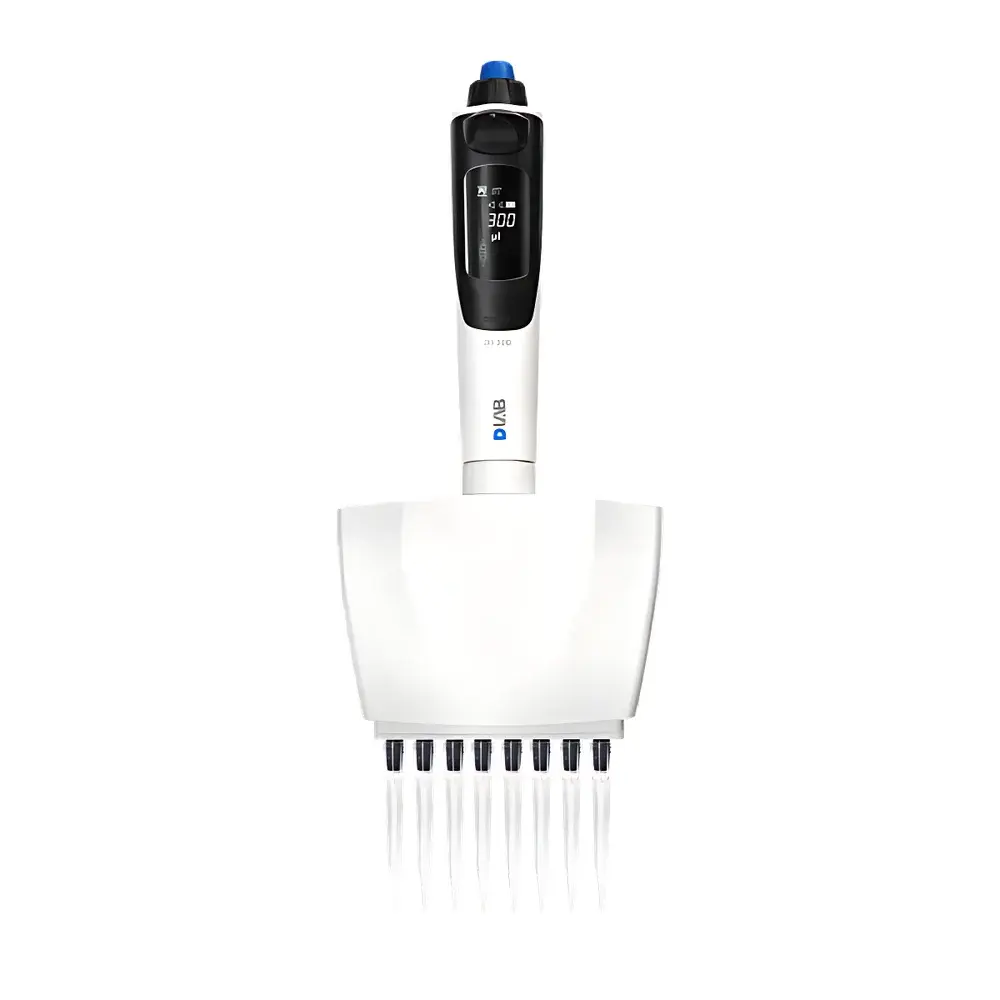
DLAB dPette+ Multi-Channel Electronic Pipette (8-Channel)
| Brand | DLAB |
|---|---|
| Origin | Beijing, China |
| Manufacturer Type | Direct Manufacturer |
| Product Category | Domestic |
| Model | dPette+ Multi-Channel Electronic Pipette (8-Channel) |
| Instrument Type | Multi-Channel Pipette |
| Automation Level | Electronic Pipette |
| Channel Count | 8 |
| Volume Range | 0.5–10 µL, 10–100 µL, 15–300 µL, 30–300 µL, 20–200 µL |
| Maximum Capacity | 300 µL |
| Accuracy | ±0.10 µL ±1.00%, ±0.10 µL ±2.00%, ±0.05 µL ±5.00%, ±0.3 µL ±0.30%, ±0.40 µL ±0.80%, ±0.20 µL ±2.00%, ±0.90 µL ±0.30%, ±0.75 µL ±0.50%, ±0.15 µL ±1.00%, ±0.90 µL ±0.30%, ±0.75 µL ±0.50%, ±0.30 µL, ±0.60 µL ±0.30%, ±0.50 µL ±0.50%, ±0.20 µL ±1.00% |
Overview
The DLAB dPette+ Multi-Channel Electronic Pipette (8-Channel) is an engineered solution for high-throughput, precision liquid handling in molecular biology, clinical diagnostics, pharmaceutical QC, and academic research laboratories. Designed around a brushless DC motor-driven piston system, it delivers repeatable aspiration and dispensing across all eight channels with minimal mechanical hysteresis and thermal drift. Unlike air-displacement pipettes relying solely on spring-loaded plungers, the dPette+ integrates closed-loop position feedback and adaptive torque control to compensate for tip resistance, viscosity variation, and operator-induced force fluctuations—ensuring consistent volume delivery across heterogeneous sample matrices. Its modular architecture supports rapid tip ejection, ergonomic thumb-wheel volume adjustment, and programmable multi-step protocols including reverse pipetting, serial dilution, and repetitive dispensing. The device complies with ISO 8655-2:2022 (volumetric performance of piston-operated volumetric apparatus) and is calibrated traceable to NIST-certified reference standards.
Key Features
- Eight independent, synchronized channels with adjustable inter-channel spacing (standard 9 mm pitch) compatible with 96-well and 384-well microplates.
- Five preconfigured volume ranges: 0.5–10 µL, 10–100 µL, 15–300 µL, 30–300 µL, and 20–200 µL—each optimized for minimal dead volume and maximal linearity within its span.
- High-resolution digital display with backlight and intuitive menu navigation supporting volume setting, mode selection (forward/reverse/multi-dispense), and battery status monitoring.
- Rechargeable lithium-ion battery providing >1,200 pipetting cycles per full charge (based on 100 µL at 1 Hz); USB-C charging interface with status LED indicator.
- Ergonomic, low-center-of-gravity housing with textured grip surface and balanced weight distribution (<180 g) to reduce wrist fatigue during extended use.
- Auto-calibration function accessible via service mode; supports user-performed routine verification using gravimetric methods per ISO 8655-6.
Sample Compatibility & Compliance
The dPette+ accommodates standard conical polypropylene tips (DNase/RNase-free, low-retention, filtered, or sterile options) from major third-party suppliers and DLAB’s own tip portfolio. It maintains accuracy and precision when handling aqueous buffers, glycerol-containing solutions (up to 40% v/v), serum, cell lysates, and ethanol-based reagents—validated under controlled environmental conditions (20–25 °C, 40–60% RH). All calibration certificates include uncertainty budgets compliant with ISO/IEC 17025:2017 requirements. The instrument meets CE marking directives (2014/30/EU EMC, 2014/35/EU LVD), RoHS 2011/65/EU, and fulfills essential requirements for GLP-compliant environments where documented traceability and audit-ready calibration records are mandatory.
Software & Data Management
While the dPette+ operates as a standalone instrument, its firmware supports optional PC connectivity via USB for firmware updates and configuration backup. Logged operational data—including total actuation count, last calibration date, battery health metrics, and error codes—is retained in non-volatile memory and exportable as CSV for internal QA review. When integrated into laboratory information management systems (LIMS) or electronic lab notebooks (ELN), the device satisfies FDA 21 CFR Part 11 requirements for audit trails through timestamped event logging and password-protected administrative access levels (Operator / Technician / Administrator). DLAB provides a secure, web-based calibration management portal for certificate archiving and expiry alerts.
Applications
- High-volume nucleic acid extraction workflows requiring parallel loading of lysis buffer into 96-well plates.
- Enzyme-linked immunosorbent assay (ELISA) plate setup with precise, simultaneous addition of capture antibodies, detection reagents, and substrate solutions.
- Cell culture maintenance involving uniform seeding across multiwell plates and serial passaging with defined dilution factors.
- qPCR master mix preparation with sub-microliter accuracy for low-abundance target amplification.
- Quality control testing of raw materials and intermediates in GMP-regulated biomanufacturing facilities.
FAQ
Is the dPette+ compatible with third-party pipette tips?
Yes—it accepts industry-standard conical tips with nominal inner diameters matching ISO 8655-3 specifications, including universal-fit and low-binding variants.
What is the recommended recalibration interval?
DLAB recommends verification every 3 months for routine use and full recalibration annually—or after any impact event, significant environmental shift, or performance deviation exceeding ISO 8655-2 tolerance limits.
Does the device support reverse pipetting for viscous or volatile liquids?
Yes—reverse pipetting mode is selectable via the main menu and automatically adjusts piston displacement to retain a preset over-delivery volume, minimizing surface tension effects and evaporation losses.
Can multiple users share one dPette+ unit while maintaining individual calibration records?
Each unit stores a single calibration history tied to its unique serial number; however, user-specific settings (e.g., default volume, dispense speed) can be saved independently via profile slots.
How is traceability ensured during regulatory audits?
All calibration events generate time-stamped digital logs with operator ID, ambient conditions, reference standard IDs, and measurement results—exportable for inclusion in audit packages or LIMS integration.
Related Products



