
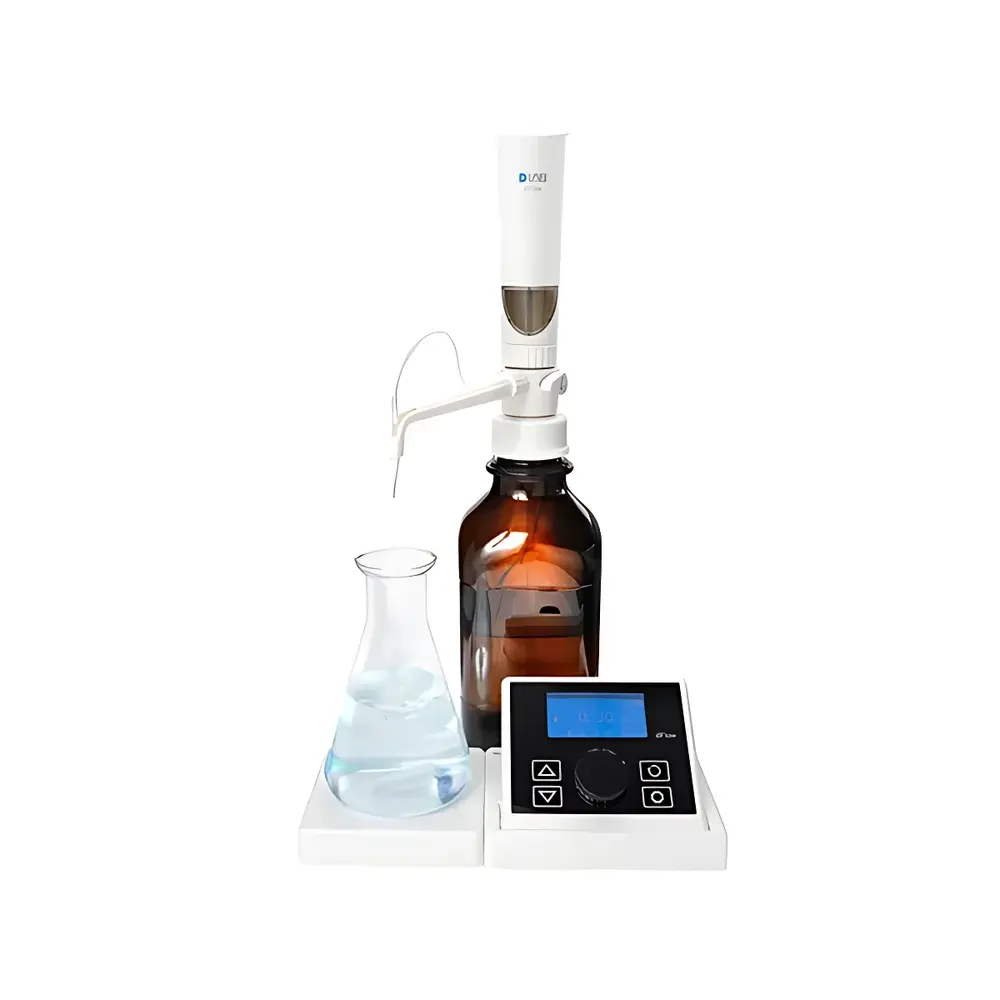
DLAB dTrite Electronic Titrator
| Brand | DLAB |
|---|---|
| Origin | Beijing, China |
| Manufacturer Type | Manufacturer |
| Product Category | Domestic |
| Model | dTrite |
| Price | USD 850 (approx.) |
| Dispensing Range | 0.01–99.99 mL |
| Single-Dispense Volume | 10 µL–10 mL |
| Precision | ±0.2% RSD |
| Coefficient of Variation (CV) | ≤0.07% |
| Flow Rate Control | 16-step adjustable |
| Operating Temperature | 10–30 °C |
| Compliance | DIN EN ISO 8655 |
| Interface | USB for PC connectivity and data export |
| Display | Large backlit LCD with intuitive parameter navigation |
| Data Management | On-device storage + USB export |
| Includes | Main titrator unit, external controller, integrated magnetic stirrer module |
Overview
The DLAB dTrite Electronic Titrator is a precision-engineered liquid dispensing instrument designed for volumetric titration in regulated and research-grade laboratory environments. Based on motor-driven piston displacement technology compliant with DIN EN ISO 8655–6 (volumetric instruments — piston-operated burettes), the dTrite delivers traceable, repeatable delivery across its full operational range of 0.01 mL to 99.99 mL. Unlike manual or semi-automated burettes, the dTrite employs a closed-loop stepper motor system coupled with high-tolerance glass syringe barrels and PTFE-coated plungers to minimize hysteresis and ensure consistent fluidic response. Its architecture integrates real-time position feedback and pressure-compensated aspiration/dispense algorithms—critical for handling low-viscosity aqueous solutions as well as moderately viscous reagents (e.g., EDTA, silver nitrate, or sodium hydroxide solutions) without bubble formation or wall adhesion artifacts. The system operates within a controlled thermal envelope (10–30 °C), ensuring metrological stability per ISO/IEC 17025 environmental requirements for quantitative chemical analysis.
Key Features
- High-accuracy piston-driven dispensing mechanism certified to DIN EN ISO 8655–6 for volumetric accuracy and repeatability
- Adjustable flow rate across 16 discrete steps—enabling optimized delivery kinetics for endpoint-sensitive titrations (e.g., potentiometric or photometric detection)
- Single-dispense capability from 10 µL to 10 mL with ≤0.07% coefficient of variation (CV) under standard operating conditions
- Large-format backlit LCD interface supporting multilingual menu navigation (English default), real-time volume tracking, and parameter lockout for GLP-compliant workflows
- Dual-mode operation: standalone mode with onboard memory (up to 100 method protocols) and PC-connected mode via USB 2.0 for remote control, audit trail logging, and CSV-formatted data export
- Integrated synchronization with external magnetic stirrer module—ensuring homogeneous mixing during titrant addition and eliminating localized concentration gradients that compromise equivalence point detection
Sample Compatibility & Compliance
The dTrite is validated for use with common titration media including aqueous acids/bases, redox reagents (e.g., KMnO₄, K₂Cr₂O₇), complexometric chelators (EDTA), and precipitation titrants (AgNO₃). It supports Class A glass syringes (1, 5, 10, and 25 mL volumes) and compatible disposable tips for cross-contamination mitigation. All wetted materials meet USP Class VI biocompatibility standards. Device firmware incorporates electronic calibration logging per ISO/IEC 17025 clause 6.4.10 and supports user-defined calibration intervals with timestamped verification records. While not FDA 21 CFR Part 11–certified out-of-the-box, the dTrite’s USB data export architecture enables integration into validated LIMS or ELN systems where electronic signatures and audit trails are managed at the enterprise software layer.
Software & Data Management
The dTrite does not require proprietary software for basic operation but includes a Windows-compatible configuration utility for method programming, firmware updates, and raw data retrieval. Each titration event logs volume dispensed, time stamp, flow rate setting, and stirrer RPM (if active)—stored internally with a 2,000-entry circular buffer. Exported datasets include metadata headers compliant with ASTM E1992–21 (Standard Guide for Data Exchange in Analytical Chemistry) and support direct import into Excel, MATLAB, or laboratory informatics platforms. Audit trail functionality records operator ID (via optional USB keyboard input), method revision history, and calibration status—facilitating internal QA reviews and regulatory inspections under GLP or ISO 9001 frameworks.
Applications
- Quantitative acid-base titrations in food safety testing (e.g., titratable acidity in dairy, juice, and vinegar per AOAC 947.05)
- Redox titrations for chlorine residual analysis in wastewater per EPA Method 334.0
- Complexometric determination of Ca²⁺/Mg²⁺ hardness in drinking water (ISO 6059)
- Pharmaceutical assay validation requiring volumetric precision per USP and
- Educational laboratories performing standardized titration experiments with reproducible inter-user results
FAQ
Is the dTrite compatible with non-aqueous titrants such as perchloric acid in glacial acetic acid?
Yes—provided appropriate chemically resistant syringe barrels (e.g., borosilicate glass with PTFE seals) and inert tip materials are used. Users must validate compatibility per solvent exposure guidelines in ISO 8655–7.
Can calibration certificates be issued traceable to NIST or CNAS standards?
DLAB provides factory calibration reports; end-users may obtain third-party accredited calibration through ISO/IEC 17025–accredited labs using the device’s built-in calibration mode and reference weights.
Does the system support programmable multi-step titration sequences?
Yes—up to 99 sequential dispensing steps per method, each with independent volume, rate, pause duration, and stirrer activation settings.
What maintenance is required to sustain ISO 8655 compliance?
Monthly visual inspection of seals and plunger movement, quarterly performance verification using certified volumetric flasks, and annual full recalibration recommended.
Is the magnetic stirrer speed independently controllable from the titrator interface?
Yes—the external stirrer module features dedicated RPM adjustment (100–1,200 rpm) accessible both via front-panel buttons and synchronized commands from the titrator’s LCD or PC software.



