
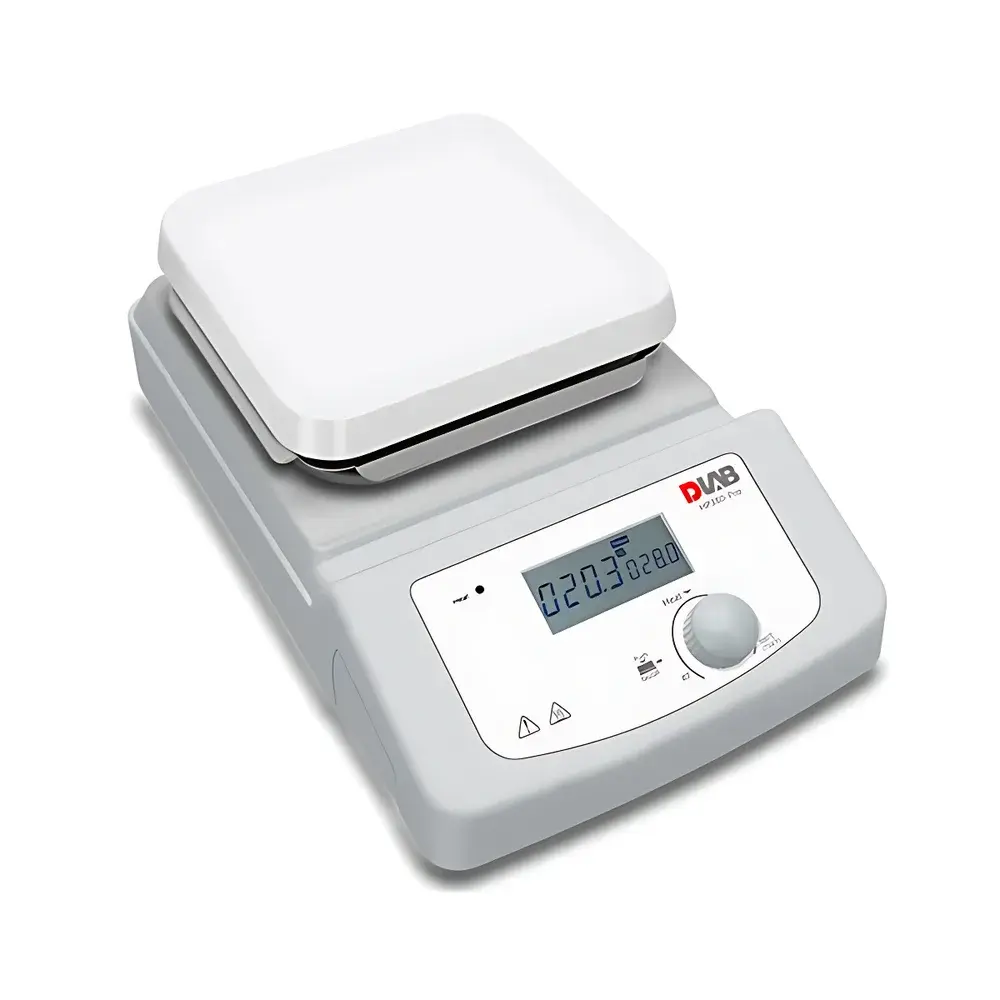
DLAB HP380-Pro LCD Digital Ceramic-Coated Electric Heating Plate
| Brand | DLAB |
|---|---|
| Origin | Beijing, China |
| Manufacturer Type | Direct Manufacturer |
| Country of Origin | China |
| Model | HP380-Pro |
| Heating Power | 500 W |
| Max. Heating Temperature | 380 °C |
| Temperature Uniformity | ±0.5 °C |
| Plate Dimensions | 140 mm × 140 mm |
| Heating Area | 140 mm × 140 mm |
| Display | LCD |
| Voltage | 100–120 V / 200–240 V, 50/60 Hz |
| Temperature Range | Ambient +5 °C to 380 °C |
| Overheat Protection Threshold | 420 °C |
| Temperature Display Accuracy | ±0.1 °C |
| External Sensor Compatibility | PT1000 (±0.5 °C accuracy) |
| IP Rating | IP21 |
| Dimensions (W × D × H) | 320 × 180 × 108 mm |
| Weight | 2.2 kg |
| Operating Environment | 5–40 °C, ≤80% RH |
Overview
The DLAB HP380-Pro is a precision-engineered electric heating plate designed for demanding laboratory applications requiring stable, uniform, and controllable thermal input. Built upon a robust aluminum heating block with a high-performance ceramic coating, it delivers rapid thermal response and exceptional resistance to chemical corrosion and thermal degradation—critical attributes for routine sample preparation, open-vessel digestion, solvent evaporation, and reaction monitoring in chemistry, environmental, pharmaceutical, and life science laboratories. Unlike basic resistive hotplates, the HP380-Pro integrates a closed-loop temperature control architecture, where real-time feedback from either the internal sensor or an optional external PT1000 probe enables dynamic power modulation. Its operational principle relies on Joule heating across a low-thermal-mass ceramic-coated aluminum plate, minimizing thermal lag and ensuring high reproducibility across repeated heating cycles. The device complies with IEC 61010-1 safety standards for laboratory electrical equipment and is engineered for continuous duty under GLP-aligned workflows.
Key Features
- Ceramic-coated aluminum heating surface (140 mm × 140 mm) offering superior thermal conductivity, chemical inertness, and mechanical durability against spills of acids, bases, and organic solvents.
- LCD display with 0.1 °C resolution provides immediate visual feedback of setpoint, actual temperature, and system status—including overheat protection activation.
- Dual-sensor capability: factory-calibrated internal sensor for general use; plug-and-play external PT1000 port supports direct sample-contact temperature monitoring per ASTM E220 or ISO 17025 traceability requirements.
- Precision temperature control with ±0.5 °C uniformity across the entire heating zone and ±0.1 °C display accuracy—validated at multiple points using NIST-traceable reference thermometers.
- Intelligent overtemperature safeguard: independent hardware-based cutoff triggers at 420 °C, preventing thermal runaway even during controller failure.
- Universal voltage compatibility (100–120 V / 200–240 V, 50/60 Hz) ensures seamless deployment in global laboratory environments without external transformers.
- IP21-rated enclosure protects internal electronics from vertically falling drips and solid objects ≥12.5 mm—suitable for standard benchtop use in controlled indoor settings.
Sample Compatibility & Compliance
The HP380-Pro accommodates a wide range of sample containers including borosilicate glass beakers (up to 1 L), stainless steel crucibles, PTFE digestion vessels, and ceramic evaporating dishes. Its flat, non-porous ceramic surface prevents cross-contamination and facilitates rapid cleaning between runs. The unit meets essential regulatory prerequisites for method validation in regulated environments: its temperature stability and repeatability support compliance with USP Analytical Instrument Qualification, FDA 21 CFR Part 11 data integrity expectations (when paired with validated logging software), and ISO/IEC 17025 clause 6.4.3 on equipment suitability. While not intrinsically explosion-proof, its design excludes ignition sources and aligns with OSHA Lab Standard 29 CFR 1910.1450 for safe handling of volatile reagents under supervised conditions.
Software & Data Management
The HP380-Pro operates as a standalone analog-digital hybrid instrument with no embedded firmware update capability or USB/Ethernet connectivity. However, its external PT1000 interface is compatible with third-party data acquisition systems (e.g., LabVIEW, MATLAB, or dedicated thermorecorders) via standard 2-wire or 4-wire RTD inputs. Users performing audit-ready procedures may integrate the device into electronic lab notebooks (ELNs) by manually recording setpoints, dwell times, and observed temperatures—or by connecting an external digital thermometer with CSV export functionality. For GMP environments, documented calibration records (per ISO/IEC 17025 Section 6.6) must include verification of both internal and external sensor performance at three points across the operating range (e.g., 100 °C, 250 °C, 350 °C) using certified reference standards.
Applications
- Controlled evaporation of solvents (e.g., acetonitrile, methanol, chloroform) prior to HPLC or GC analysis.
- Open-beaker acid digestions for heavy metal determination (EPA Method 3050B, ISO 11466).
- Pre-heating and temperature conditioning of reagents, standards, and calibration solutions in QC labs.
- Supporting gravimetric moisture analysis per AOAC 950.46 and ASTM D2231.
- Accelerated aging studies of polymer samples and coatings under defined thermal stress profiles.
- Low-shear thermal activation in enzymatic assays and cell culture media preparation.
FAQ
Does the HP380-Pro support programmable ramp-hold temperature profiles?
No—the unit features only manual setpoint adjustment and does not include built-in time-based programming. For multi-step thermal protocols, integration with external controllers or programmable thermostats is required.
Can the external PT1000 sensor be used for closed-vessel digestion?
Yes, provided the probe is rated for the pressure and chemical environment (e.g., PTFE-sheathed or quartz-tipped RTDs); however, the HP380-Pro itself lacks vessel clamping or pressure containment features.
Is calibration certificate included with purchase?
A factory calibration report is supplied; full ISO/IEC 17025-accredited calibration requires third-party service and is recommended annually or per usage frequency per laboratory SOP.
What maintenance is required for long-term reliability?
No scheduled maintenance is needed—the ceramic-coated aluminum surface is non-wearing, and the solid-state heating element has no moving parts. Regular visual inspection of the power cord and periodic cleaning with mild detergent are sufficient.
How does temperature uniformity impact analytical reproducibility?
A ±0.5 °C uniformity minimizes spatial thermal gradients across the plate, reducing inter-sample variability in digestion efficiency, evaporation rate, and reaction kinetics—directly supporting RSD targets below 2% in validated methods.



