
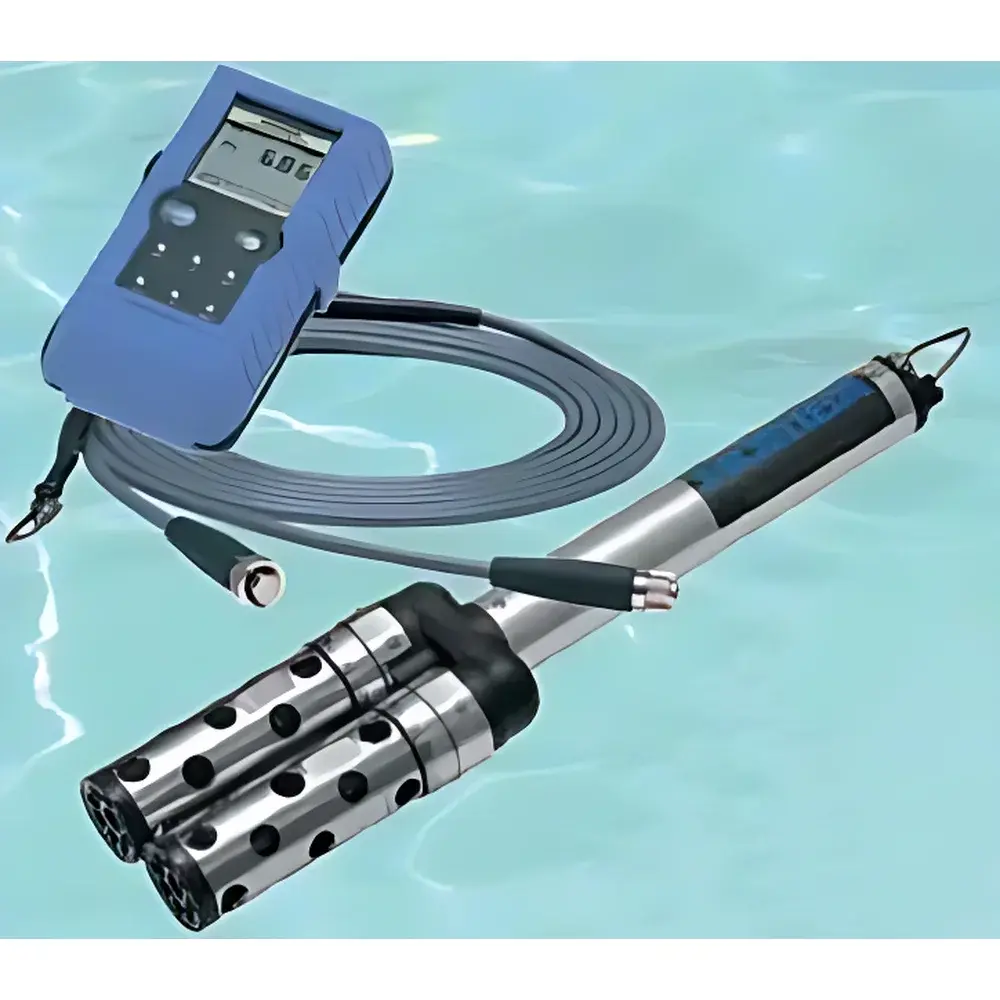
HORIBA W-20XD Series Multi-Parameter Water Quality Monitor
| Brand | HORIBA |
|---|---|
| Origin | Japan |
| Model | W-20XD (W-22XD / W-23XD) |
| Instrument Type | Portable/Handheld Water Quality Analyzer |
| Depth Rating | Up to 100 m |
| Data Logging Duration | 30 days (2880 records, 15-min interval) |
| IP Rating | IP67 (Control Unit) |
| Simultaneous Parameters | Up to 13 |
| Sensor Principle | Glass Electrode (pH), Membrane Galvanic Cell (DO), AC 4-Electrode Conductivity, Pressure-based Depth, Thermistor (Temperature), Nephelometric/Transmissive Turbidity, Platinum ORP Electrode, Ion-Selective Electrodes (NO₃⁻, Cl⁻, Ca²⁺, F⁻, K⁺, NH₃) |
| Operating Temperature | 0–55 °C |
| Storage Temperature | −5–60 °C |
| Probe Dimensions | Ø95 mm × 430 mm |
Overview
The HORIBA W-20XD Series is a rugged, submersible multi-parameter water quality monitoring system engineered for long-term, unattended field deployment in diverse aquatic environments—from coastal seawater and deep lakes to groundwater wells, municipal wastewater outfalls, agricultural irrigation channels, and aquaculture ponds. Designed and manufactured in Japan, the system operates on proven electrochemical, optical, and physical sensing principles compliant with international water quality measurement standards including ISO 5814 (dissolved oxygen), ISO 7888 (conductivity), ISO 7027 (turbidity), and ASTM D1293 (pH). Its core architecture integrates a pressure-rated probe housing (rated to 100 m water column), an IP67-rated control unit, and embedded non-volatile memory capable of storing 2,880 timestamped data points at user-configurable intervals as short as 15 minutes—enabling full 30-day autonomous operation without power or communication cables. The system requires no operator intervention during deployment: once submerged in its operational orientation, it initiates synchronized measurement cycles across all enabled parameters and logs data internally. Remote data retrieval is supported via optional Bluetooth or RS-485 interfaces compatible with HORIBA’s proprietary data management software.
Key Features
- True autonomous operation: No external power supply or tethered connection required during 30-day continuous monitoring
- 100-meter depth rating achieved through reinforced titanium-alloy sensor housing and pressure-compensated electrode design
- Simultaneous real-time measurement of up to 13 parameters—including pH, dissolved oxygen (DO), conductivity, salinity, TDS, seawater specific gravity (δt), temperature, turbidity, depth, ORP, and six ion species (NO₃⁻, Cl⁻, Ca²⁺, F⁻, K⁺, NH₃)
- Integrated auto-compensation algorithms: automatic temperature compensation for pH, DO, conductivity, and turbidity; salinity compensation for DO; and configurable ion-specific matrix correction
- Onboard two-point pH calibration and automated zero/span verification routines for conductivity and DO sensors
- High-stability glass electrode (pH), galvanic DO cell with replaceable membrane cap, and AC four-electrode conductivity cell minimizing polarization error and fouling sensitivity
- Modular probe configuration: base W-22XD supports 10 parameters; upgradeable to W-23XD for full 13-parameter capability via optional ion-selective electrode cartridges
Sample Compatibility & Compliance
The W-20XD Series is validated for use in freshwater, brackish water, and full-strength seawater (up to 40 ppt salinity). Its corrosion-resistant probe materials—including PEEK polymer housings, platinum reference electrodes, and titanium current collectors—ensure stable performance in aggressive matrices such as industrial effluents, high-sulfide groundwater, and chlorinated municipal discharge streams. All electrochemical sensors meet ISO/IEC 17025 traceability requirements when calibrated using NIST-traceable standards. The system supports GLP-compliant data integrity protocols: each logged record includes sensor ID, calibration timestamp, measurement status flags (e.g., “electrode saturated”, “membrane dry”), and environmental context (temperature, pressure, conductivity). Firmware and data export workflows are designed to align with FDA 21 CFR Part 11 requirements for electronic records and signatures when used in regulated environmental monitoring programs.
Software & Data Management
HORIBA’s AquaManager™ Desktop Software (v4.2+) provides secure, audit-ready data handling for W-20XD deployments. The application enables full configuration of logging intervals, parameter selection, alarm thresholds, and auto-calibration schedules. Raw binary logs are decrypted and converted into CSV or Excel-compatible formats with embedded metadata (GPS coordinates if paired with external GNSS module, sensor serial numbers, firmware revision, and QC flags). Time-series visualizations include overlay plots, depth-profile cross-sections, and statistical summaries (min/max/mean/std dev per parameter). Exported datasets include digital signatures and SHA-256 hash verification to ensure forensic integrity. Optional cloud synchronization via HORIBA CloudLink™ allows centralized fleet management for multi-site monitoring networks, with role-based access control and automated report generation aligned with ISO 14001 or EPA NPDES reporting templates.
Applications
- Long-term limnological and oceanographic studies requiring high-temporal-resolution vertical profiling and benthic boundary layer characterization
- Regulatory compliance monitoring for wastewater treatment plants under EPA Clean Water Act Section 402 permit conditions
- Early-warning detection of eutrophication events via correlated trends in DO depletion, nitrate accumulation, and turbidity spikes
- Groundwater vulnerability assessment in karst aquifers using multi-ion fingerprinting (Cl⁻/Ca²⁺/NO₃⁻ ratios)
- Marine aquaculture site selection and feed optimization through real-time ammonia and dissolved oxygen dynamics
- Post-disaster water safety screening following flood or chemical spill incidents, leveraging rapid-deployment portability and immediate parametric triage
FAQ
What is the maximum recommended deployment duration without maintenance?
The W-20XD is rated for continuous unattended operation up to 30 days at 15-minute logging intervals. Battery life and sensor stability beyond this period depend on ambient temperature, biofouling load, and selected measurement frequency.
Can the system be deployed in turbulent or high-flow environments?
Yes—the probe’s hydrodynamic profile and weighted base minimize drift and vortex-induced vibration. For sustained velocities exceeding 1.5 m/s, optional flow-stabilizing mounting brackets are available.
How is calibration traceability documented?
Each calibration event is stored in non-volatile memory with date/time stamp, standard solution lot number, measured value, deviation from certified value, and technician ID (if entered manually). Calibration certificates are exportable as PDF with digital signature.
Is remote firmware update supported?
Firmware updates require local USB connection to the control unit. Over-the-air updates are not supported to maintain data integrity and regulatory compliance in critical monitoring applications.
Are replacement sensors field-swappable?
All electrochemical sensors—including pH, DO, conductivity, ORP, and ion-selective electrodes—are designed for tool-free, in-field replacement using standardized O-ring seals and plug-and-play connectors. No recalibration is required after sensor swap if within the same product family.







