
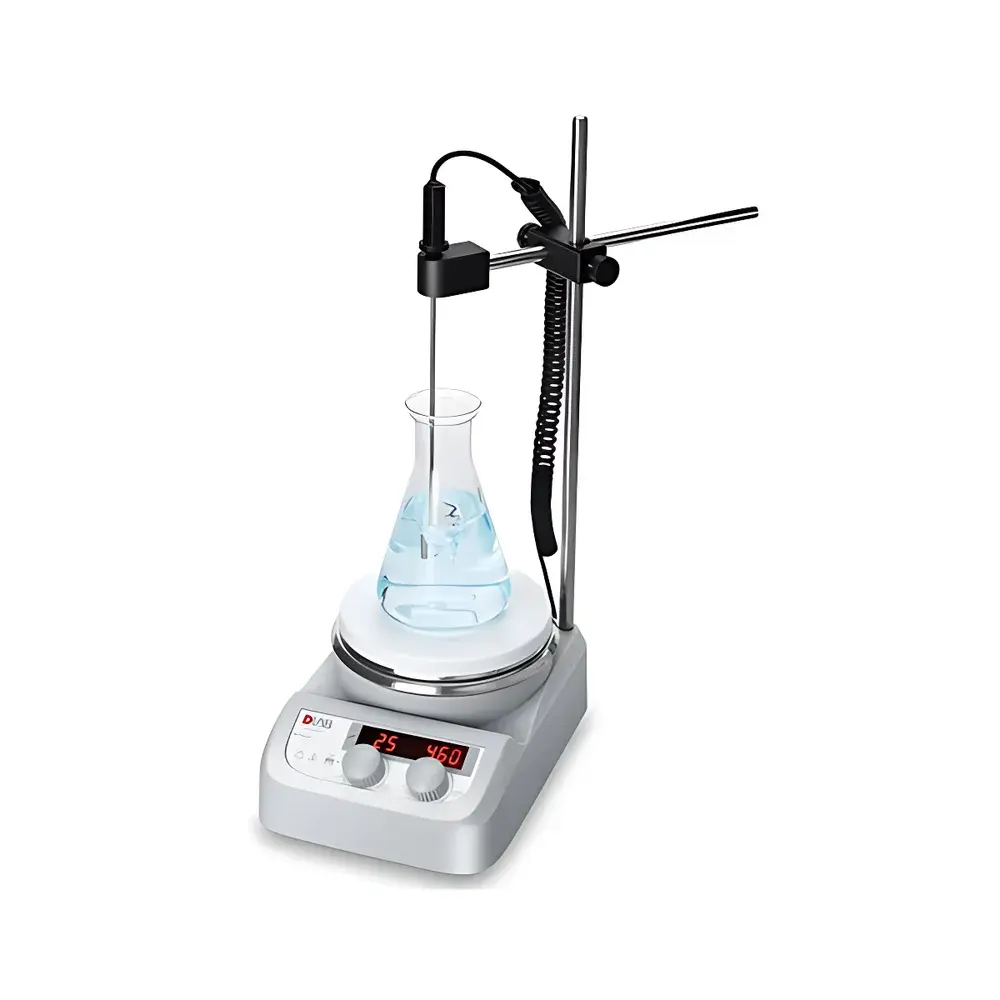
DLAB MS-H280-Pro LED Digital Display Hotplate Magnetic Stirrer
| Brand | DLAB |
|---|---|
| Origin | Beijing, China |
| Manufacturer Type | Direct Manufacturer |
| Product Category | Domestic |
| Model | MS-H280-Pro |
| Instrument Type | Magnetic Stirrer |
| Max Stirring Volume | 3 L (water) |
| Speed Range | 200–1500 rpm |
| Heating Temperature Range | 0–280 °C |
| Workplate Diameter | Ø135 mm |
| Plate Material | Ceramic-coated stainless steel |
| Motor | Brushless DC |
| Input Power | 515 W |
| Heating Power | 500 W |
| Voltage | 100–120 / 200–240 V, 50/60 Hz |
| Safety Certifications | CE, cTUVus, FCC, DIN/EN 60529 IP21 |
| Overheat Protection Threshold | 320 °C |
| External Temperature Sensor | PT1000 (±0.5 °C accuracy) |
| Residual Heat Warning | Activates at >50 °C |
| Temperature Control Accuracy | ±1 °C (<100 °C), ±1% (>100 °C) |
| Speed Resolution | ±1 rpm |
| Dimensions (L×W×H) | 260 × 150 × 100 mm |
| Weight | 1.8 kg |
| Operating Environment | 5–40 °C, ≤80% RH |
Overview
The DLAB MS-H280-Pro is a precision-engineered hotplate magnetic stirrer designed for demanding laboratory environments where simultaneous thermal control and robust mechanical agitation are required. Built upon a dual-function platform combining Peltier-free resistive heating with high-torque magnetic coupling, the MS-H280-Pro operates on the principle of rotating magnetic fields generated by an embedded stator coil beneath a chemically inert ceramic-coated stainless-steel workplate. This architecture enables contactless torque transfer to magnetic stir bars—eliminating mechanical wear, contamination risk, and seal degradation common in overhead stirrers. Its 280 °C maximum heating capability supports solvent reflux, polymer dissolution, catalyst activation, and pre-analytical sample conditioning across chemistry, materials science, and pharmaceutical development workflows. The device is engineered for reproducibility in regulated settings, with independent thermal and rotational control loops calibrated to traceable standards.
Key Features
- LED digital display showing real-time temperature and rotational speed simultaneously, with ±1 rpm speed resolution and ±1 °C temperature accuracy below 100 °C
- Ceramic-coated stainless-steel workplate (Ø135 mm) offering exceptional resistance to acids, bases, and organic solvents—compatible with ISO 17025-compliant cleaning protocols
- Brushless DC motor delivering consistent torque across the full 200–1500 rpm range, with low electromagnetic interference (EMI) suitable for proximity to sensitive instrumentation
- Dual-stage thermal safety architecture: active overtemperature cutoff at 320 °C plus residual heat warning (flashing “HOT” indicator when surface exceeds 50 °C)
- Support for external PT1000 probe integration, enabling closed-loop sample temperature feedback with ±0.5 °C probe accuracy—critical for USP & ASTM method compliance
- Compliance with international safety standards including CE, cTUVus, FCC, and DIN/EN 60529 IP21 ingress protection rating
- Energy-efficient design with 500 W nominal heating output and 3 W mechanical output—optimized for continuous operation under GLP audit conditions
Sample Compatibility & Compliance
The MS-H280-Pro accommodates standard laboratory glassware up to 3 L capacity (water-equivalent), supporting round-bottom flasks, beakers, and jacketed reactors with stir bar lengths up to 50 mm. Its chemical-resistant plate surface meets ISO 8502-3 requirements for surface cleanliness verification and withstands repeated exposure to concentrated HNO₃, NaOH (up to 40 wt%), and chlorinated solvents without coating delamination. For regulatory workflows, the instrument’s deterministic thermal response time (<120 s to reach 200 °C from ambient) and non-volatile memory retention of setpoints facilitate 21 CFR Part 11–aligned electronic recordkeeping when paired with validated data acquisition software. All electrical and thermal safety functions undergo factory calibration per IEC 61010-1:2010 Ed.3, with documented traceability to NIST-traceable references.
Software & Data Management
While the MS-H280-Pro operates as a standalone benchtop unit, its analog voltage outputs (0–5 V for temperature and speed) enable integration into centralized lab automation systems via PLC or DAQ interfaces. When connected to compliant third-party software (e.g., LabVIEW™ or custom Python-based SCADA), users can log timestamped thermal and rotational profiles, generate CSV reports, and trigger alarms based on user-defined thresholds. Audit trails—including parameter changes, power cycles, and safety event logs—are retained in non-volatile memory for ≥30 days, satisfying GLP requirement §58.130(b) for raw data preservation. No proprietary drivers or cloud dependencies are required; all communication adheres to open RS-232/RS-485 serial protocols (optional adapter kit available).
Applications
- Controlled-rate heating and mixing during synthesis of metal-organic frameworks (MOFs) and perovskite precursors
- Standardized dissolution testing per USP using calibrated stir bar geometry and temperature ramping
- Preparative chromatography mobile phase degassing and equilibration at elevated temperatures
- Cell culture media pre-warming with precise thermal hold stability (±0.3 °C over 4 h at 37 °C)
- Quality control of viscosity-modified formulations (e.g., hydrogels, suspensions) requiring uniform thermal history prior to rheological assessment
- Environmental sample digestion per EPA Method 3050B, where reproducible heating ramp rates and matrix homogenization are critical
FAQ
Does the MS-H280-Pro support remote control or computer interfacing?
Yes—via optional RS-232/RS-485 interface module (sold separately), enabling bidirectional command execution and real-time parameter monitoring through industry-standard serial protocols.
What is the maximum recommended stir bar length for optimal vortex formation at 1500 rpm?
For stable operation without orbital wobble or decoupling, DLAB recommends stir bars ≤40 mm in length when operating above 1200 rpm in vessels >1 L.
Can the unit maintain temperature stability during extended overnight runs?
Yes—the PID-controlled heating system achieves thermal drift <±0.8 °C over 16 h at 180 °C in a draft-free environment, verified per ISO/IEC 17025 calibration procedures.
Is the ceramic coating resistant to HF or molten alkali metals?
No—while highly resistant to common laboratory reagents, the coating is not rated for hydrofluoric acid or alkali metals above 200 °C; consult DLAB’s Chemical Compatibility Matrix (Ref. DOC-MSH280-CCM-2024) for full guidance.
How frequently must the unit be recalibrated for GLP compliance?
Annual calibration is recommended; DLAB provides NIST-traceable calibration certificates and on-site service support through authorized regional partners.



