
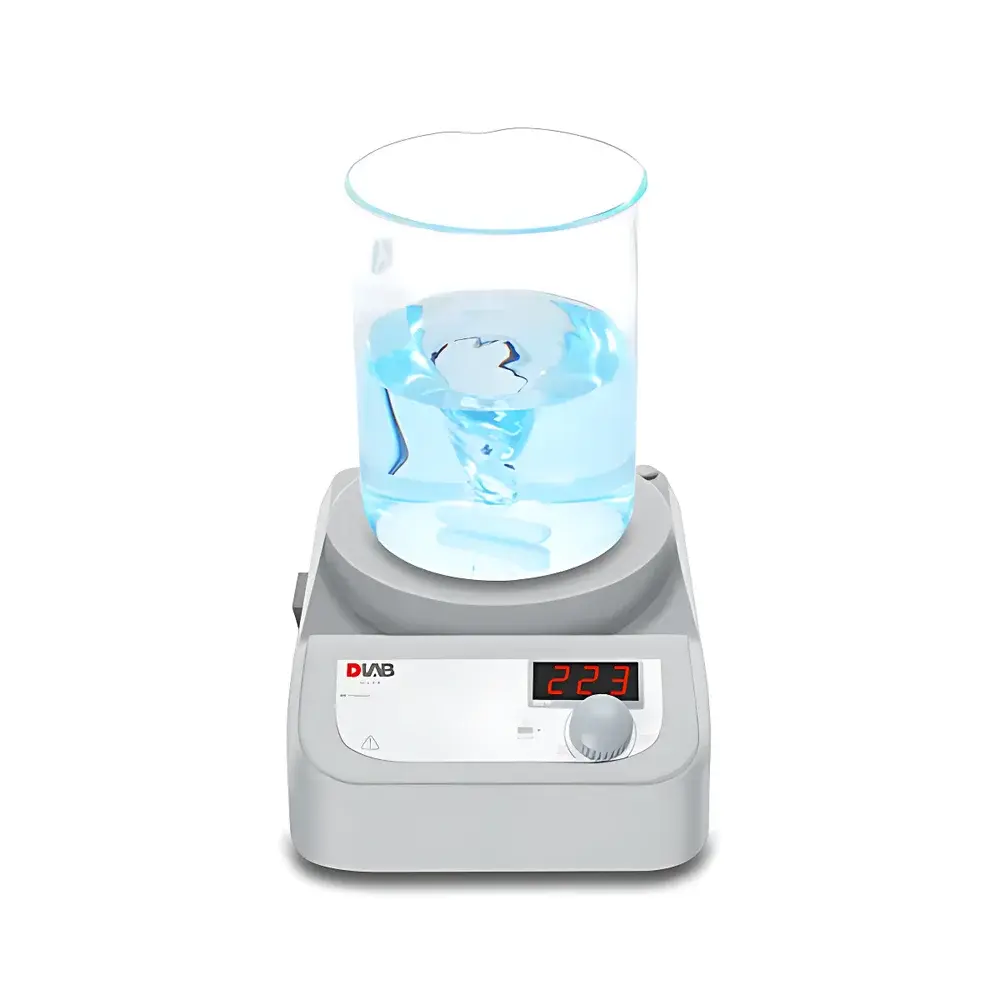
DLAB MS-PA LED Digital Magnetic Stirrer
| Brand | DLAB |
|---|---|
| Origin | Beijing, China |
| Manufacturer Type | Direct Manufacturer |
| Product Category | Domestic |
| Model | MS-PA |
| Instrument Type | Magnetic Stirrer |
| Max Stirring Volume (Water) | 3 L |
| Speed Range | 100–1500 rpm |
| Temperature Control | Ambient Only |
| Workplate Diameter | Ø135 mm (5") |
| Plate Material | Nylon + Glass Fiber (GF) |
| Motor Type | DC Motor |
| Input Power | 5 W |
| Output Power | 3 W |
| Rated Power | 15 W |
| Voltage | 100–120 V / 200–240 V, 50/60 Hz |
| Stirring Position | Single |
| Max Stir Bar Length | 50 mm |
| Speed Display | LED |
| IP Rating | IP42 |
| Dimensions (L×W×H) | 260 × 150 × 80 mm |
| Weight | 1.8 kg |
| Operating Environment | 5–40 °C, ≤80% RH |
| Safety Certifications | CE, cTUVus, FCC, DIN/EN 60529 Compliant |
Overview
The DLAB MS-PA LED Digital Magnetic Stirrer is a compact, single-position benchtop instrument engineered for precision speed control and reliable operation in routine laboratory mixing applications. Utilizing contactless magnetic coupling—where a rotating permanent magnet beneath the chemically inert workplate induces motion in a magnetic stir bar immersed in the sample—the MS-PA delivers consistent rotational agitation without mechanical shaft penetration or seal wear. Its core function centers on homogeneous mixing of low-to-medium viscosity aqueous and organic solutions, buffer preparation, dissolution testing, and pre-analytical sample homogenization. Designed for ambient-temperature operation only (no integrated heating), the unit prioritizes stability, electromagnetic compatibility, and operator safety in environments ranging from academic teaching labs to QC/QA workstations and pharmaceutical R&D support spaces.
Key Features
- Digital LED display for real-time, high-contrast readout of actual rotational speed (100–1500 rpm), enabling precise method reproducibility across users and shifts.
- Robust workplate constructed from nylon reinforced with glass fiber (Nylon+GF), offering superior chemical resistance to common solvents, acids, and bases compared to standard ceramic or aluminum surfaces.
- IP42-rated enclosure provides protection against solid objects ≥1 mm and vertically falling water droplets—suitable for general lab use where incidental splashes may occur but not for wet-process or washdown environments.
- Low-power DC motor architecture (3 W output, 15 W total rated power) ensures minimal heat generation and long-term operational stability under continuous duty cycles.
- Universal dual-voltage input (100–120 V / 200–240 V, 50/60 Hz) enables seamless deployment across North American, European, and Asian electrical infrastructures without external transformers.
- TÜV-certified safety compliance with CE, cTUVus, FCC, and DIN/EN 60529 standards confirms adherence to international requirements for electrical safety, electromagnetic interference (EMI), and mechanical ingress protection.
Sample Compatibility & Compliance
The MS-PA supports standard laboratory glassware including beakers (up to 1000 mL), Erlenmeyer flasks, and cylindrical vessels compatible with its 135 mm diameter workplate. Optimal performance is achieved with PTFE- or glass-coated stir bars up to 50 mm in length; longer bars may induce instability at higher speeds (>1200 rpm) due to torque limitations. The device complies with ISO/IEC 17025-relevant operational rigor for non-heating mixing steps in accredited testing laboratories. While not classified as a medical device or GLP/GMP-critical instrument per se, its documented safety certifications and stable speed control support traceable workflows in regulated environments where mixing consistency impacts downstream analytical validity (e.g., USP dissolution media preparation).
Software & Data Management
The MS-PA operates as a standalone analog-digital hybrid instrument with no embedded microprocessor-based data logging, remote interface, or software connectivity. All operational parameters—including set speed—are manually adjusted via front-panel controls and verified visually via the fixed-segment LED display. This design philosophy emphasizes reliability, ease of validation, and reduced failure modes in settings where digital complexity introduces unnecessary risk or maintenance overhead. For laboratories requiring audit trails, integration with LIMS, or electronic record retention, external speed verification tools (e.g., handheld tachometers) and manual entry into controlled SOPs remain the recommended practice in alignment with FDA 21 CFR Part 11 principles for non-electronic systems.
Applications
- Preparation of standardized buffer solutions and reagent dilutions in molecular biology and clinical chemistry labs.
- Homogenization of cell suspensions prior to centrifugation or filtration in microbiology workflows.
- Mixing of coating solutions and polymer dispersions during materials science sample prep.
- Stirring of titration reagents and standard solutions in analytical quality control protocols.
- Supporting ASTM D1298 (density of crude oil) and ISO 3104 (kinematic viscosity) sample conditioning steps where temperature-controlled stirring is not required.
- Teaching laboratory demonstrations of fluid dynamics, viscosity estimation, and magnetic field interactions.
FAQ
Does the MS-PA include a built-in heater or temperature control function?
No. The MS-PA is a non-heating magnetic stirrer designed exclusively for speed-controlled mixing at ambient laboratory temperature.
What is the maximum recommended viscosity for stable operation?
For optimal torque transmission and speed stability, the unit is validated for aqueous solutions and low-viscosity organic solvents (typically ≤100 mPa·s). Higher viscosities may require larger stir bars or reduced speed settings.
Is the workplate resistant to hydrochloric acid or sodium hydroxide solutions?
Yes—the Nylon+GF surface demonstrates proven resistance to short-term exposure (<30 min) to 1 M HCl and 1 M NaOH at room temperature; prolonged contact is not advised.
Can the MS-PA be used inside a fume hood?
Yes, provided the ambient temperature remains within 5–40 °C and relative humidity does not exceed 80%. Ensure adequate ventilation around the rear vents to prevent thermal buildup.
Does DLAB provide calibration documentation or traceable speed verification?
DLAB supplies factory-tested performance verification reports upon request; end-user periodic verification using NIST-traceable tachometers is recommended per ISO/IEC 17025 Clause 6.5.



