
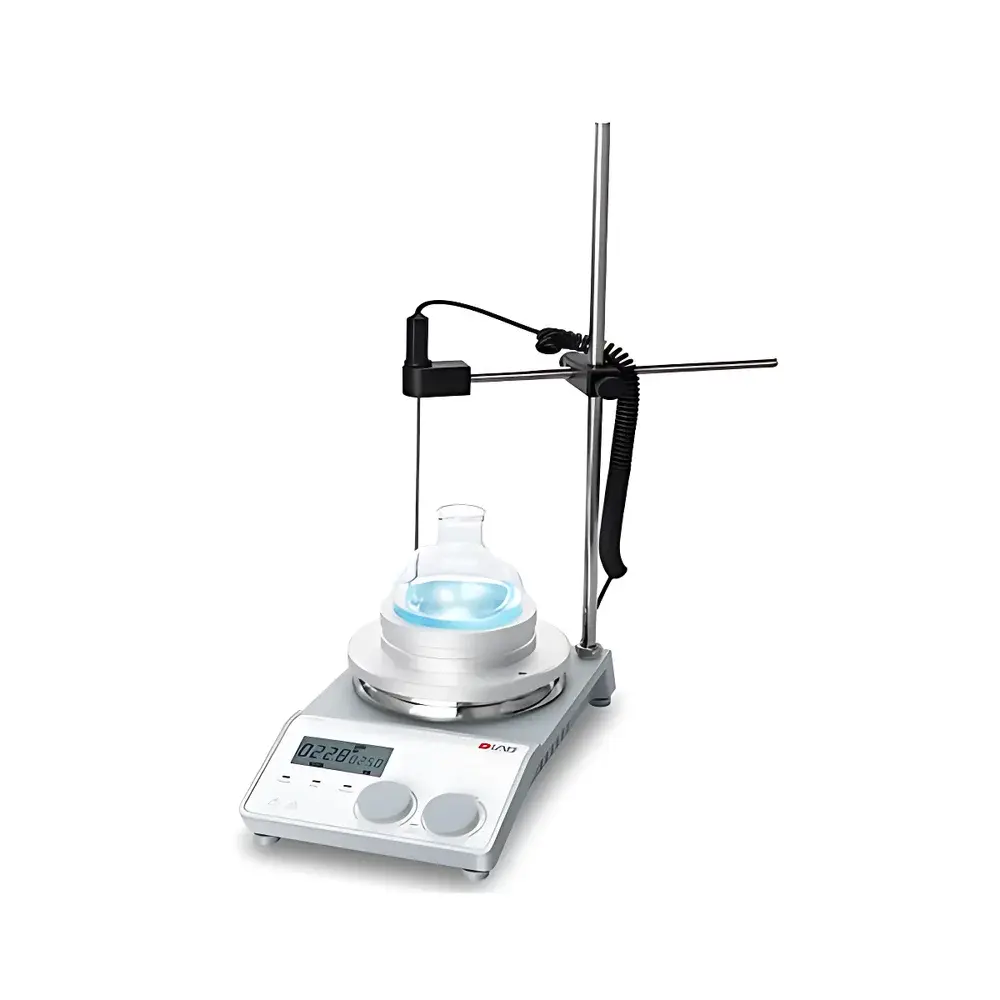
DLAB MS-H-ProT LCD Digital Programmable Heating Magnetic Stirrer
| Brand | DLAB |
|---|---|
| Origin | Beijing, China |
| Manufacturer Type | Direct Manufacturer |
| Product Category | Domestic |
| Model | MS-H-ProT |
| Instrument Type | Heating Magnetic Stirrer |
| Maximum Stirring Volume | 20 L (H₂O) |
| Speed Range | 100–1500 rpm |
| Temperature Control Range | Ambient to 340 °C |
| Heating Power | 500 W |
| Motor Type | Brushless DC Motor |
| Display | High-Resolution LCD |
| Timer Range | 1 min – 99 h 59 min |
| External Temperature Probe Support | PT1000 (±0.2 °C accuracy) |
| Overheat Protection Threshold | 420 °C |
| Residual Heat Warning | “HOT” flash at >50 °C |
| Enclosure Rating | IP42 |
| Dimensions (D×W×H) | 160 × 280 × 100 mm |
| Weight | 2.8 kg |
| Operating Environment | 5–40 °C, ≤80% RH |
Overview
The DLAB MS-H-ProT is a high-performance, microprocessor-controlled heating magnetic stirrer engineered for precision temperature management and consistent rotational mixing in research laboratories, quality control environments, and industrial R&D settings. Utilizing Couette flow principles, it induces uniform laminar motion in liquid samples via rotating magnetic fields acting on PTFE- or glass-coated stir bars. Unlike basic analog stirrers, the MS-H-ProT integrates dual independent temperature sensing—internal plate thermistor and optional external PT1000 probe—to decouple heater surface temperature from actual sample temperature, enabling true sample-centric thermal regulation. Its brushless DC motor delivers stable torque across the full 100–1500 rpm range with ±1 rpm speed reproducibility, while the ceramic-coated stainless steel plate (Ø135 mm) ensures long-term resistance to acids, alkalis, and organic solvents—critical for extended chemical synthesis or dissolution testing protocols.
Key Features
- Brushless DC motor: Eliminates carbon brush wear, enables spark-free operation in potentially hazardous environments, and requires zero routine maintenance.
- Triple heating mode selection: Mode A (rapid ramp), Mode B (linear ramp), and Mode C (PID-controlled precision hold) support method-specific thermal profiles per ASTM E2917 or ISO 11357 standards.
- Dual safety architecture: Independent hardware-based overtemperature cutoff at 420 °C prevents thermal runaway; residual heat warning (“HOT” blink) activates at >50 °C plate surface temperature to mitigate operator burn risk.
- Independent heating/stirring control: Heating can be disabled while stirring continues—preserving sample homogeneity during cooling phases or emergency shutdowns.
- LCD interface with simultaneous real-time display of setpoint/actual temperature (±0.1 °C resolution), rotational speed (±1 rpm), and elapsed/remaining timer duration (1 min – 99 h 59 min).
- RS232 serial interface compliant with standard SCPI command sets, enabling integration into LabVIEW, MATLAB, or custom Python-based data acquisition systems for GLP/GMP audit-trail logging.
- IP42-rated enclosure: Protects internal electronics against splashing water and solid particulates encountered in shared core facilities or teaching labs.
Sample Compatibility & Compliance
The MS-H-ProT accommodates aqueous, organic, and mildly corrosive media up to 20 L volume (water-equivalent), with compatibility validated for common laboratory solvents including ethanol, acetone, ethyl acetate, and dilute HCl/NaOH solutions (≤1 M). Its ceramic-coated plate meets ISO 8502-3 requirements for surface inertness under repeated thermal cycling. For regulated environments, the instrument supports 21 CFR Part 11-compliant electronic records when paired with validated third-party data logging software. Temperature accuracy (±1 °C below 100 °C; ±1% above) and external PT1000 integration (±0.2 °C) align with USP <797> and ISO/IEC 17025 calibration traceability frameworks. CE marking confirms conformity with EU Machinery Directive 2006/42/EC and EMC Directive 2014/30/EU.
Software & Data Management
Via RS232, the MS-H-ProT accepts ASCII-based SCPI commands (e.g., :TEMP:SET 85.0, :SPEED:SET 800, :TIMER:START) for remote parameter setting and status polling. Real-time streaming of temperature and speed values enables time-stamped CSV export for post-hoc analysis. When integrated with validated LIMS or ELN platforms, all user actions—including setpoint changes, timer starts/stops, and fault events—are timestamped and attributable, satisfying ALCOA+ data integrity criteria. Firmware updates are performed via terminal emulation without proprietary drivers.
Applications
- Controlled-rate dissolution testing of pharmaceutical tablets per USP <711>.
- Preparation of homogeneous catalyst slurries for heterogeneous reaction screening.
- Buffer equilibration and reagent warming prior to HPLC or ICP-MS analysis.
- Long-duration polymerization initiation where precise thermal ramping governs molecular weight distribution.
- Teaching lab demonstrations of Arrhenius kinetics, requiring simultaneous temperature stabilization and mixing.
- Environmental sample digestion (EPA Method 3050B) with closed-vessel compatibility using appropriate stir bar geometry.
FAQ
Does the MS-H-ProT support external temperature feedback control?
Yes—when connected to a calibrated PT1000 sensor (included as optional accessory), the unit performs closed-loop sample temperature regulation with ±0.2 °C accuracy, overriding plate-sensor readings.
Can the timer function operate independently of heating or stirring?
Yes—the timer is fully decoupled and may be used for process sequencing (e.g., delay start after heating ramp completion) regardless of active output states.
Is the RS232 interface optically isolated?
No—it is electrically isolated via onboard transient voltage suppression but does not include galvanic isolation; use of an external USB-to-RS232 converter with isolation is recommended for multi-instrument networks.
What is the maximum allowable stir bar length for stable operation at 1500 rpm?
Stir bars up to 80 mm in length maintain vortex stability in vessels ≥5 L at full speed; optimal performance is achieved with elliptical or cross-shaped geometries for high-viscosity media.
How frequently must the unit be recalibrated for GLP compliance?
Annual verification against NIST-traceable references is recommended; internal diagnostics log sensor drift trends to inform predictive maintenance scheduling.



