
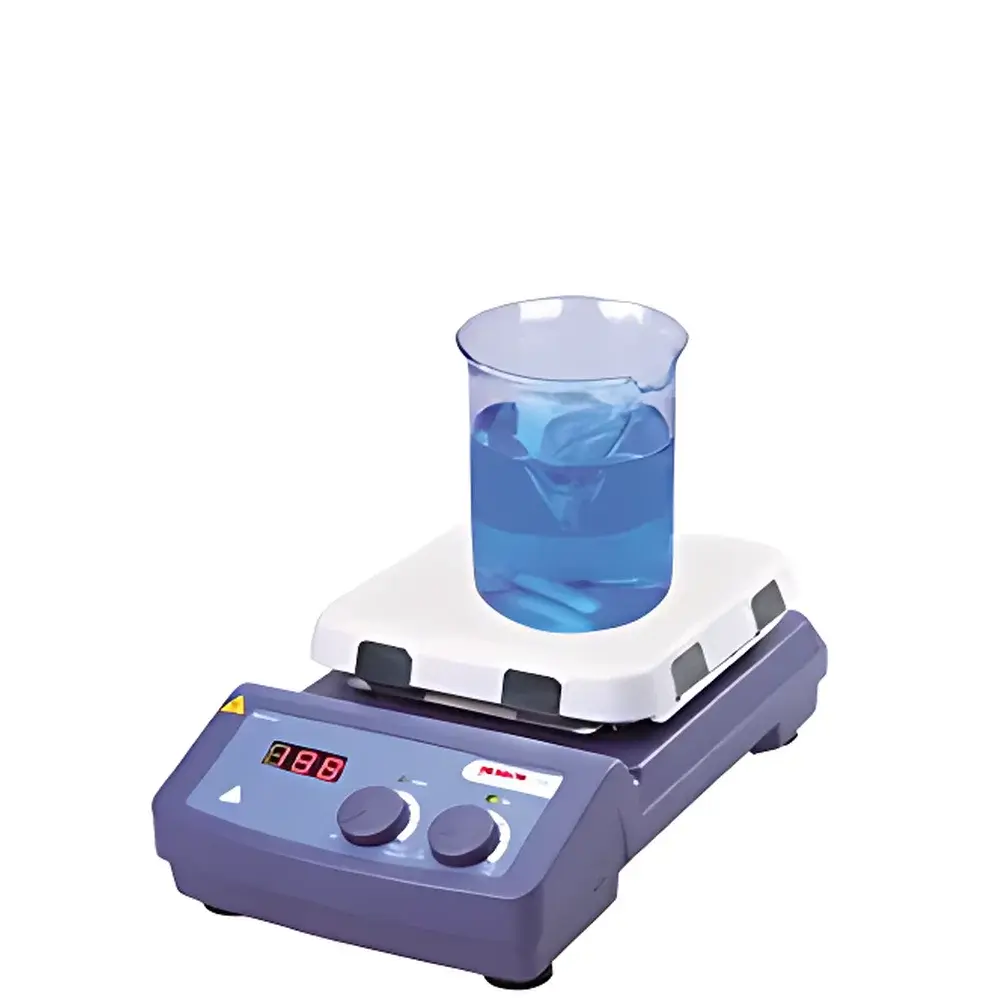
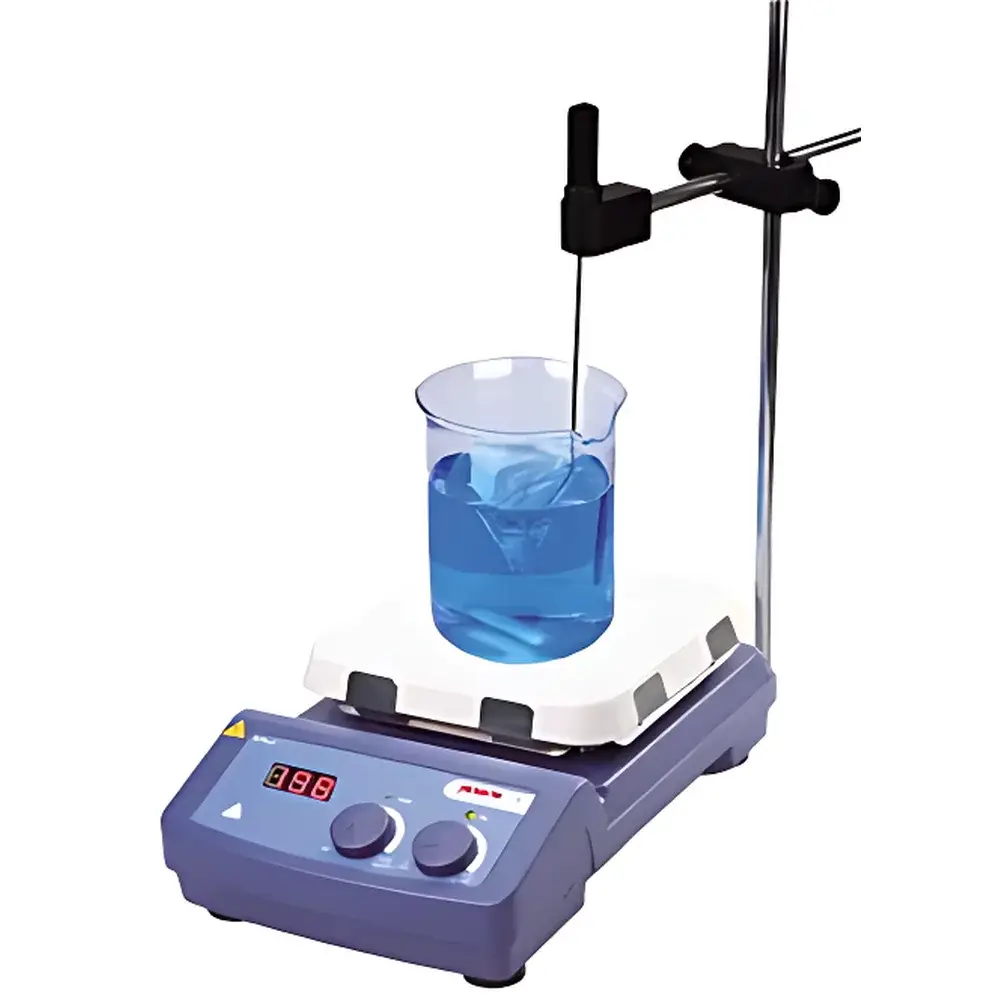
DLAB MS7-H550-S BlueSpin LCD Digital Display Heated Magnetic Stirrer with 7-inch Square Ceramic Plate
| Brand | DLAB |
|---|---|
| Origin | Beijing, China |
| Model | MS7-H550-S |
| Heating Temperature Range | Room Temp to 550°C |
| Max. Stirring Volume (H₂O) | 10 L |
| Stirring Speed Range | 0–1500 rpm |
| Plate Dimensions | 184 × 184 mm |
| Heating Area | 176 × 176 mm |
| Heating Power | 1000 W |
| Total Power Consumption | 1030 W |
| Motor Type | Shaded-pole AC motor |
| Motor Output Power | 1.5 W |
| Input Voltage | 100–120 / 200–240 VAC, 50/60 Hz |
| Temperature Control Accuracy (with PT1000) | ±0.5°C |
| Temperature Display Resolution | ±1°C |
| Safety Cut-off Temperature | 580°C |
| Residual Heat Warning Threshold | 50°C |
| Enclosure Protection Rating | IP21 (per DIN EN 60529) |
| Plate Material | High-purity glass-ceramic |
| External Temperature Sensor | PT1000 (plug-and-play) |
| Dimensions (W×D×H) | 215 × 360 × 112 mm |
| Weight | 4.5 kg |
Overview
The DLAB MS7-H550-S BlueSpin is a high-performance, digitally controlled heated magnetic stirrer engineered for precision thermal and mechanical agitation in demanding laboratory environments. Utilizing the Couette flow principle, it induces controlled rotational motion in paramagnetic stir bars immersed in low-to-medium viscosity liquids or heterogeneous suspensions—enabling uniform mixing, dissolution, and temperature equilibration across samples. Its integrated PID-controlled heating system delivers rapid thermal ramping and exceptional stability over extended operation cycles, supporting applications from catalytic synthesis and polymerization kinetics to cell culture media preparation and reagent conditioning. Designed for continuous duty under GLP-compliant workflows, the unit operates reliably at temperatures up to 550°C while maintaining full electromagnetic compatibility and electrical safety per international regulatory frameworks.
Key Features
- 7-inch square glass-ceramic top plate (184 × 184 mm) offering outstanding thermal shock resistance, chemical inertness against strong acids/bases, and easy decontamination between runs
- Dual-mode temperature control: ambient-to-550°C programmable setpoint with optional external PT1000 probe for direct sample temperature feedback and ±0.5°C accuracy
- Intelligent safety architecture including independent overtemperature cutoff at 580°C, residual heat warning activation above 50°C (even after power-off), and fully enclosed IP21-rated housing compliant with DIN EN 60529
- TÜV-certified safety compliance: CE, cTUVus, and FCC marks confirm adherence to IEC 61010-1 for laboratory electrical equipment
- Explosion-proof shaded-pole AC motor with sealed construction, eliminating spark hazards in solvent-rich or oxygen-enriched atmospheres
- LED digital display showing both setpoint and real-time measured temperature simultaneously; intuitive rotary knob interface with tactile feedback
- High-efficiency thermal design featuring aluminum alloy chassis with electrostatically applied corrosion-resistant coating and optimized passive cooling geometry
Sample Compatibility & Compliance
The MS7-H550-S accommodates a broad range of vessel formats—from standard beakers and Erlenmeyer flasks to multi-well reaction blocks and custom 1/4-circle aluminum heating modules (sold separately). Compatible stir bars include cylindrical and oval types up to 80 × 10 mm, ensuring effective torque transfer across viscosities up to ~500 mPa·s. The system meets essential requirements for ISO/IEC 17025-accredited testing laboratories, supports audit-ready documentation through traceable calibration records (PT1000 sensor included), and aligns with FDA 21 CFR Part 11 principles when paired with validated data logging software. Its non-porous ceramic surface resists leaching and complies with USP material safety standards for pharmaceutical contact surfaces.
Software & Data Management
While the MS7-H550-S operates as a standalone instrument with no built-in USB or Ethernet connectivity, its analog-compatible PT1000 output enables integration into centralized lab monitoring systems via third-party DAQ hardware (e.g., National Instruments or Keysight data acquisition modules). Users may log temperature and speed profiles using industry-standard SCADA platforms or export CSV-formatted time-series data for post-processing in MATLAB, Python (NumPy/Pandas), or Excel. For regulated environments, validation protocols—including IQ/OQ documentation templates and sensor calibration certificates—are available upon request from DLAB’s technical support team.
Applications
- Controlled-temperature synthesis of metal-organic frameworks (MOFs) and nanomaterial precursors
- Buffer and media preparation for bioprocessing, including sterile filtration compatibility verification
- Accelerated stability testing per ICH Q1A(R2) guidelines under defined thermal stress conditions
- Homogenization of nanoparticle dispersions prior to DLS or SEM analysis
- Parallel reaction screening using interchangeable 1/4-circle aluminum blocks for 4–40 mL tube formats
- Inorganic salt crystallization studies requiring precise supersaturation control
- Environmental sample digestion protocols (EPA Method 3050B, 3051A) involving hotplate-assisted acid leaching
FAQ
Does the MS7-H550-S support remote control or computer interfacing?
No—the unit features manual rotary control only and lacks digital communication ports. However, the analog voltage output from the PT1000 sensor can be routed to external DAQ systems for automated data capture.
What is the maximum recommended viscosity for stable stirring performance?
Optimal performance is maintained for Newtonian fluids up to 500 mPa·s at 1500 rpm. For higher viscosities, reduced speed settings or larger-diameter stir bars are advised.
Is the glass-ceramic plate resistant to hydrofluoric acid (HF)?
No—while highly resistant to HCl, HNO₃, H₂SO₄, and NaOH, glass-ceramic is not HF-compatible. Use PTFE-coated plates or alternative containment strategies when handling HF-based etchants.
Can the unit be operated inside a fume hood without derating?
Yes—its convection-cooled design and absence of active ventilation allow safe operation within Class II A2 hoods; ensure adequate clearance (≥10 cm) around rear and side vents.
Are calibration certificates provided with the PT1000 sensor?
Each PT1000-A and PT1000-B probe ships with a factory calibration report traceable to NIST standards. On-site recalibration services are available through authorized DLAB service centers.



