
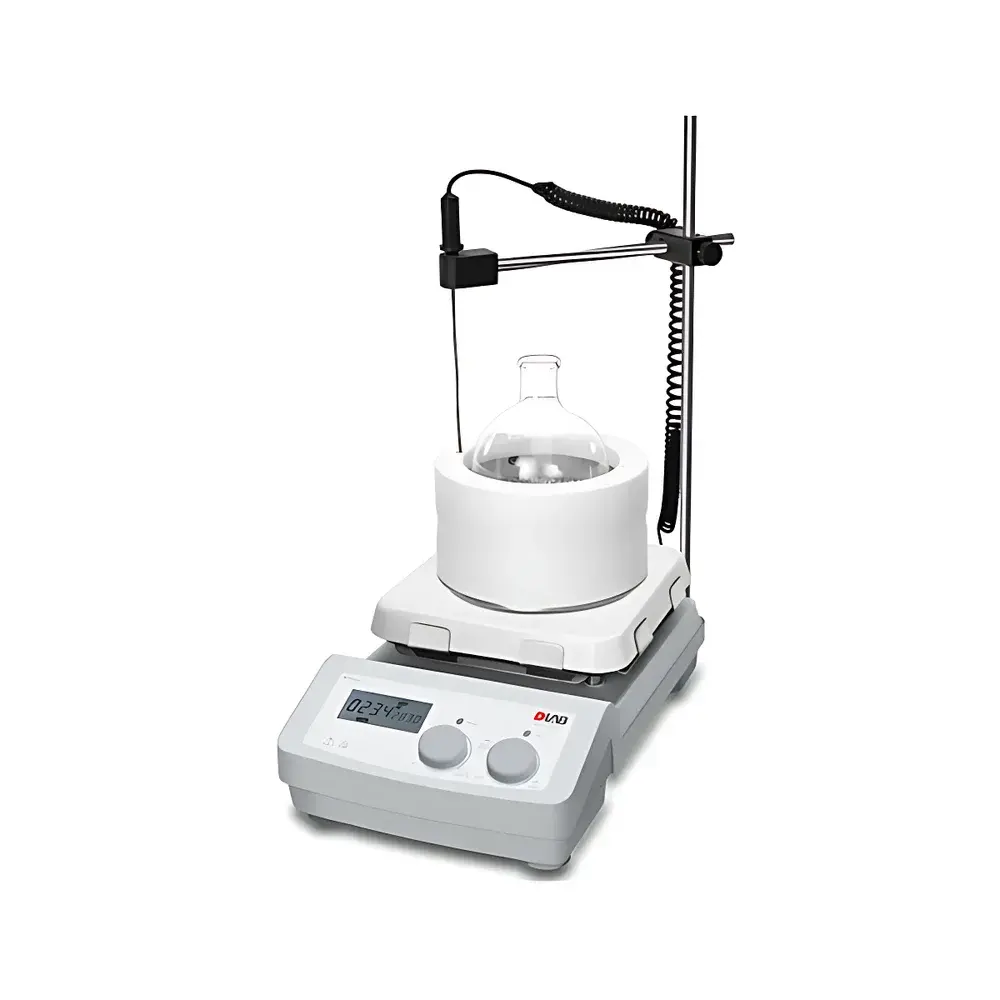
DLAB MS7-H550-Pro Advanced Magnetic Stirrer with Integrated Heating and PID Temperature Control
| Brand | DLAB |
|---|---|
| Origin | Beijing, China |
| Manufacturer | DLAB |
| Product Type | Magnetic Stirrer |
| Maximum Stirring Volume | 20 L |
| Speed Range | 100–1500 rpm |
| Heating Plate Temperature Range | Ambient to 550 °C |
| Control Accuracy (with External PT1000 Sensor) | ±0.2 °C |
| Display | Dual LCD for Real-Time Speed & Temperature |
| Safety Certification | CE, cTUVus, FCC |
| Ingress Protection | IP21 |
| Power Input | 100–120 / 200–240 VAC, 50/60 Hz |
| Rated Power | 1050 W |
| Working Plate Dimensions | 184 × 184 mm |
| Heating Area | 176 × 176 mm |
| Motor | Brushless DC |
| Output Power | 10 W |
| Heating Power | 1000 W |
| Stir Bar Max Length | 80 mm |
| Speed Resolution | 1 rpm |
| Temperature Resolution (Internal) | ±0.1 °C |
| Over-Temperature Safety Limit | 1580 °C (Sensor Cut-Off) |
| Residual Heat Warning Threshold | >50 °C |
| Interface | RS232 for PC Remote Control and Data Logging |
Overview
The DLAB MS7-H550-Pro is a high-performance benchtop magnetic stirrer engineered for precision mixing and temperature-controlled synthesis in research laboratories, quality control environments, and pilot-scale development workflows. Unlike conventional stirrers limited to ambient or low-temperature operation, the MS7-H550-Pro integrates a robust ceramic-glass heating plate capable of reaching up to 550 °C — enabling applications ranging from solvent reflux and catalyst activation to high-temperature polymerization and metal-organic framework (MOF) synthesis. Its core measurement principle relies on contactless magnetic coupling between the rotating permanent magnet drive system and PTFE- or glass-coated stir bars, ensuring contamination-free agitation without mechanical shaft penetration. The unit employs embedded PID control architecture for both speed and temperature regulation, delivering stable thermal profiles and reproducible rotational dynamics under variable load conditions. Designed for continuous-duty operation, it meets international safety and electromagnetic compatibility requirements per DIN EN 60529 (IP21), IEC 61000-6-3, and IEC 61000-6-2.
Key Features
- Brushless DC motor providing consistent torque across the full 100–1500 rpm range, with <1 rpm speed resolution and real-time digital feedback via dual-line LCD display
- Ceramic-glass heating surface (184 × 184 mm) resistant to strong acids, alkalis, and organic solvents; non-porous structure prevents residue buildup and supports rapid decontamination
- Integrated PID temperature controller with internal sensor accuracy of ±1 °C below 100 °C and ±1% above — enhanced to ±0.2 °C when paired with optional external PT1000 probe
- Intelligent residual heat warning: LED display flashes when surface temperature exceeds 50 °C post-shutdown, mitigating accidental contact injury
- RS232 serial interface compliant with standard ASCII command protocol, enabling bidirectional communication with laboratory PCs for automated parameter setting, data acquisition, and time-stamped logging of temperature/speed trajectories
- Dual independent rotary knobs for intuitive, tactile adjustment of speed and setpoint temperature — no menu navigation required during active experiments
- Over-temperature cut-off at 1580 °C (sensor-based fail-safe), combined with thermal fuse redundancy and automatic power shutdown upon open-circuit detection
Sample Compatibility & Compliance
The MS7-H550-Pro accommodates vessels from 10 mL vials to 20 L jacketed reactors, provided magnetic coupling remains effective — optimal performance is achieved using stir bars up to 80 mm in length and ≥5 mm diameter. It supports borosilicate glass, quartz, stainless steel, and PTFE-lined containers. The device complies with CE marking directives (2014/30/EU EMC, 2014/35/EU LVD), cTUVus certification for North American use (UL 61010-1, CSA C22.2 No. 61010-1), and FCC Part 15 Class B emission limits. Its IP21 enclosure rating ensures protection against vertically falling solid objects and limited ingress of moisture during standard lab handling. While not intrinsically rated for hazardous area use, its design aligns with GLP documentation requirements when used with validated RS232 data capture systems meeting FDA 21 CFR Part 11 audit trail specifications.
Software & Data Management
No proprietary software is bundled; instead, the RS232 port implements a documented ASCII command set (e.g., “SPS 1200” to set speed, “SPT 250” to set temperature) compatible with LabVIEW, Python (pySerial), MATLAB, or custom SCADA platforms. Logged datasets include timestamp (YYYY-MM-DD HH:MM:SS), actual speed (rpm), setpoint speed (rpm), measured plate temperature (°C), setpoint temperature (°C), and error codes (e.g., “E01 = overtemp”, “E02 = sensor fault”). All communications are ASCII-encoded, null-terminated, with configurable baud rates (default 9600). For regulated environments, users may implement third-party electronic lab notebook (ELN) integrations that enforce user authentication, version control, and immutable record retention — satisfying ALCOA+ principles for data integrity.
Applications
- High-temperature catalytic reactions requiring precise thermal ramping (e.g., Suzuki coupling, Fischer–Tropsch model studies)
- Preparation of nanomaterial dispersions where shear-sensitive colloids demand stable low-RPM agitation coupled with elevated bath temperatures
- Standardized dissolution testing per USP and Ph. Eur. 2.9.3, particularly when combined with calibrated PT1000 probes for vessel wall temperature validation
- Viscosity benchmarking of thermosetting resins during cure profiling (ISO 3219, ASTM D2196)
- Buffer equilibration and reagent aging protocols in biopharmaceutical upstream processing
- Educational labs demonstrating Arrhenius kinetics, Le Chatelier’s principle, or heterogeneous reaction engineering concepts
FAQ
Does the MS7-H550-Pro support programmable temperature ramps?
No — it operates in static setpoint mode only. Ramp functionality requires external PC control via RS232 and user-developed scripting.
Can the unit be operated inside a fume hood with extended cable routing?
Yes — its universal voltage input (100–240 VAC) and low EMI emissions permit safe installation in ventilated enclosures; ensure RS232 cable shielding is maintained for noise immunity.
Is calibration traceability available for the internal temperature sensor?
DLAB provides factory calibration certificates (NIST-traceable reference standards) upon request; field recalibration requires PT1000-compatible metrology equipment.
What maintenance is recommended for long-term reliability?
Annual inspection of ceramic plate integrity, cleaning of ventilation grilles, and verification of stir bar magnetization strength using a gaussmeter — no lubrication or consumable replacement is required.
How does the IP21 rating affect placement in shared laboratory spaces?
IP21 indicates protection against dripping water and solid objects >12.5 mm — suitable for dry benchtop use but not splash-prone or washdown environments; supplemental drip trays are advised near sinks or condenser setups.



