
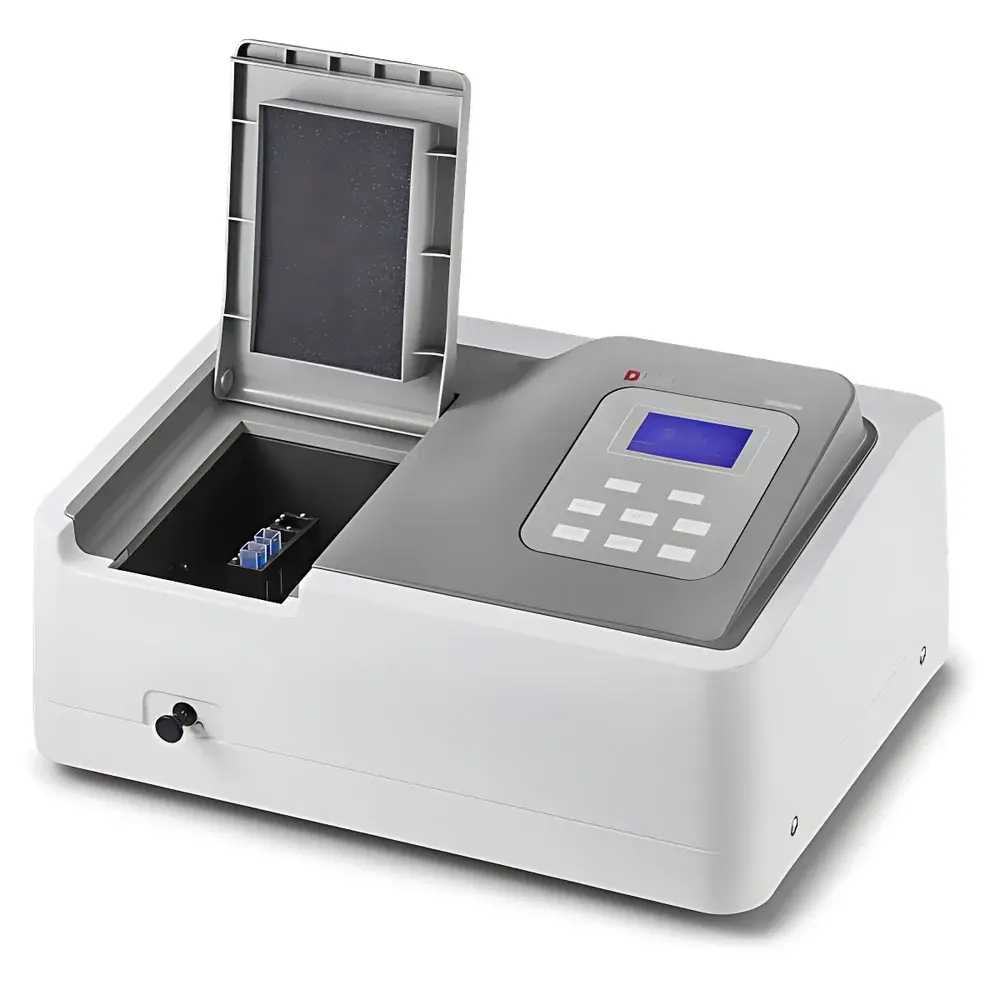
DLAB SP-UV1000 Ultraviolet-Visible Spectrophotometer
| Brand | DLAB |
|---|---|
| Origin | Beijing, China |
| Manufacturer Type | Original Equipment Manufacturer (OEM) |
| Instrument Architecture | Single-Beam |
| Wavelength Range | 200–1000 nm |
| Spectral Bandwidth | 4.0 nm |
| Wavelength Accuracy | ±2 nm |
| Wavelength Repeatability | ≤1 nm |
| Stray Light | ≤0.2% T at 360 nm |
| Light Source Configuration | Tungsten Lamp + Deuterium Lamp (Auto-Switching) |
| Data Storage Capacity | Up to 5,000 measurements with auto-backup |
| Measurement Modes | Photometric, Quantitative Analysis, Multi-Wavelength Scanning |
| Application Scope | Nucleic Acid (DNA/RNA) Quantification, Protein Concentration Determination, Clinical Biochemistry, Educational Laboratories |
Overview
The DLAB SP-UV1000 is a single-beam ultraviolet-visible (UV-Vis) spectrophotometer engineered for precision absorbance and transmittance measurements across the 200–1000 nm spectral range. It operates on the fundamental principle of Beer–Lambert law-based absorption spectroscopy, where sample-specific attenuation of incident light is quantified to determine analyte concentration or characterize molecular electronic transitions. Its dual-lamp architecture—integrating a deuterium lamp for UV output (190–360 nm) and a tungsten-halogen lamp for visible/NIR output (360–1100 nm)—enables seamless spectral coverage without manual intervention. Automatic lamp switching occurs at user-defined or factory-optimized transition points (typically ~360 nm), ensuring optimal signal-to-noise ratio and photometric stability throughout the full operational range. Designed for reproducibility in regulated and academic environments, the instrument complies with core optical performance criteria outlined in ISO 8579-1:2021 (spectrophotometer verification) and aligns with routine validation protocols required under GLP and educational QA frameworks.
Key Features
- Single-beam optical design with optimized collimation and fixed grating monochromator, delivering consistent photometric response across extended measurement sessions.
- Automated dual-source selection ensures wavelength-appropriate illumination intensity and spectral purity—critical for low-absorbance nucleic acid measurements at 260 nm and high-transmittance solvent blanking in visible assays.
- 4.0 nm spectral bandwidth meets standard method requirements for pharmaceutical assay validation (e.g., USP ) and clinical biochemistry protocols where resolution balances sensitivity and throughput.
- Wavelength accuracy of ±2 nm and repeatability ≤1 nm support reliable method transfer between instruments and long-term calibration stability under routine laboratory conditions.
- Stray light performance ≤0.2% T at 360 nm minimizes non-linear absorbance deviation at high optical densities—essential for accurate quantification of concentrated protein samples (e.g., BSA at 280 nm) or turbid biological matrices.
- Onboard data management system stores up to 5,000 measurement records with timestamped metadata and automatic backup upon power interruption—supporting audit readiness and data integrity per ALCOA+ principles.
Sample Compatibility & Compliance
The SP-UV1000 accommodates standard 10 mm pathlength quartz or UV-grade fused silica cuvettes (including matched pairs for reference/blank compensation), as well as micro-volume adapters compatible with 50–200 µL sample volumes. It supports both transmission-mode liquid-phase analysis and solid-sample reflectance via optional accessories. The instrument’s optical performance conforms to internationally recognized verification benchmarks: wavelength scale traceability to NIST-traceable holmium oxide and didymium filters; photometric linearity verified over 0–3.0 A using neutral density filters; and stray light assessment per ASTM E275-22 Annex A1. While not pre-certified for FDA 21 CFR Part 11, its data logging architecture—including immutable timestamps, operator ID fields, and exportable CSV/Excel-compatible files—facilitates implementation of electronic signature workflows and audit trail configurations required in GxP-compliant laboratories.
Software & Data Management
The SP-UV1000 operates via embedded firmware with intuitive touchscreen navigation and optional PC connectivity through USB 2.0 or RS-232 interfaces. Its native software suite enables real-time spectral scanning, kinetic time-course acquisition (up to 60 points/sec), and multi-point quantitative calibration (linear, quadratic, or 3-point standard curve fitting). All measurement datasets include embedded metadata: date/time stamp, lamp status, wavelength setpoint, integration time, and user-defined sample ID. Raw absorbance spectra and processed results are exportable in ASCII, CSV, and XML formats—ensuring compatibility with LIMS platforms, statistical analysis tools (e.g., R, Python pandas), and regulatory documentation systems. Internal flash memory retains configuration profiles and calibration logs independent of external power supply, mitigating risk of parameter corruption during brownouts or scheduled maintenance cycles.
Applications
This spectrophotometer serves as a foundational analytical tool in diverse life science and quality control settings. In molecular biology labs, it performs standardized DNA/RNA quantification (A260/A280 ratios), protein concentration estimation via Bradford/Lowry/BCA assays, and enzyme kinetic monitoring (e.g., NADH oxidation at 340 nm). In clinical chemistry, it supports serum bilirubin, creatinine, and uric acid assays per CLSI EP15-A3 guidelines. Academic teaching laboratories utilize its robustness and intuitive interface for undergraduate instruction in spectroscopic theory, calibration methodology, and error propagation analysis. Industrial QC environments deploy it for raw material identity verification, cleaning validation residue testing, and stability-indicating assay development—particularly where cost-effective, method-validated instrumentation is prioritized over high-throughput automation.
FAQ
What is the recommended calibration frequency for the SP-UV1000?
Routine wavelength calibration is advised before each daily use session using holmium oxide reference solution; photometric calibration with neutral density filters should be performed weekly or after lamp replacement.
Can the SP-UV1000 be integrated into a LIMS environment?
Yes—via standardized CSV/XML data export and optional RS-232/USB communication protocols, enabling direct ingestion into most modern LIMS architectures with minimal middleware configuration.
Is the instrument suitable for measuring turbid or particulate-containing samples?
While optimized for clear solutions, it can accommodate mildly turbid samples using longer pathlength cells or by applying baseline correction algorithms; however, dedicated double-beam or integrating sphere configurations are recommended for highly scattering matrices.
Does the SP-UV1000 support GLP-compliant audit trails?
The embedded system logs operator ID, timestamp, and method parameters per measurement; full 21 CFR Part 11 compliance requires supplemental software-layer controls deployed at the institutional IT level.
What maintenance procedures are required for the deuterium and tungsten lamps?
Lamp lifetime is typically 1,000–2,000 hours; automatic usage tracking is provided in firmware. Replacement is tool-free and guided by on-screen prompts; no optical realignment is necessary post-installation.






